AI Automation for New York City Ad & Marketing Agencies: The 2026 Playbook
How New York City ad and marketing agencies are using AI automation in 2026 to scale output, cut operational overhead, and win more business, with ROI data, real NYC industry use cases, and a practical implementation roadmap.
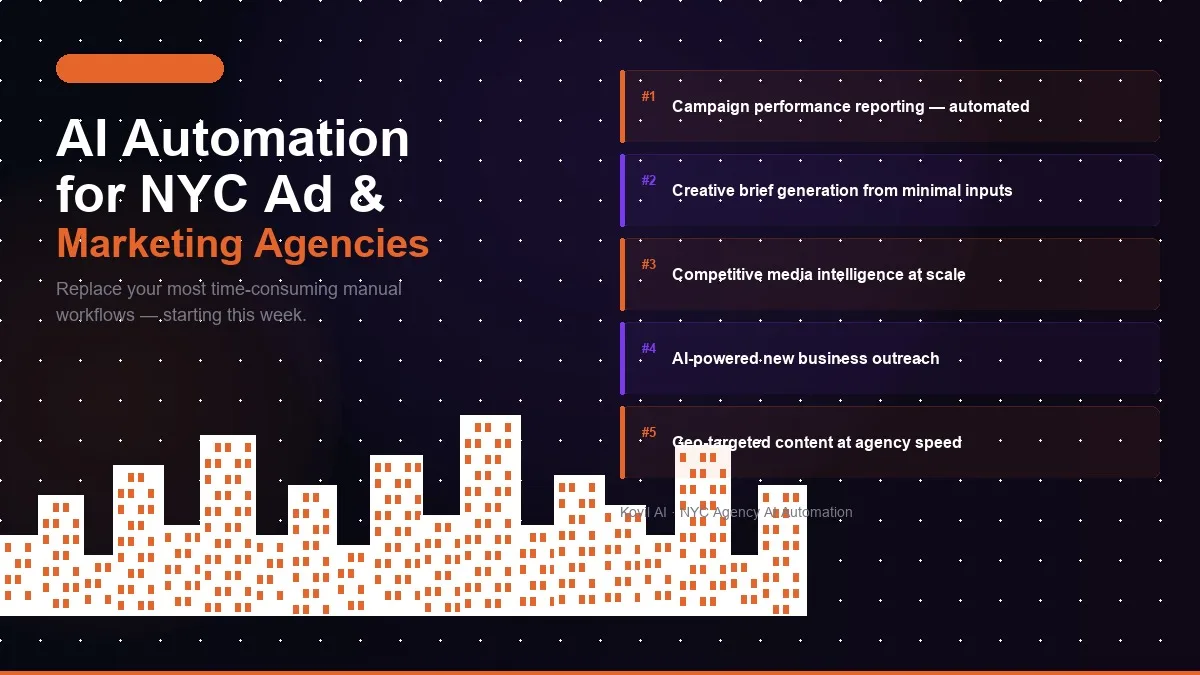
If you're running an ad agency or marketing agency in New York City right now, you're operating in one of the most competitive, talent-expensive, and client-demanding markets in the world. Overhead is brutal. Turnover is high. Clients expect faster turnarounds, lower fees, and measurable ROI on every dollar spent. And yet, most of the operational work that keeps your agency alive, campaign reporting, creative briefing, media planning, client updates, new business outreach, is still largely manual.
That is changing fast. The most forward-looking agency leaders in NYC, from boutique creative shops in DUMBO to performance marketing firms in Midtown to full-service agencies on Madison Avenue, are building AI automation into their core workflows. Not as a novelty, but as a structural advantage.
Kovil AI · NYC Agency Automation
We specialize in AI automation for New York ad and marketing agencies.
This is the 2026 playbook for how to do it.
Why New York City Agencies Are Feeling the Pressure Most
The economics of running an agency in New York City have always been challenging. But several converging forces are making the status quo untenable for agencies that haven't started automating.
Talent costs are at an all-time high. The average mid-level account manager in NYC now commands a base salary north of $85,000. Senior media planners, paid social specialists, and data analysts earn significantly more, and they're being poached constantly by in-house teams at brands who can offer stability and equity. Hiring, onboarding, and backfilling roles is burning time and budget that agencies can't afford to waste.
Clients are demanding more transparency and speed. The era of monthly PDF reports is over. Brands want live dashboards, real-time performance alerts, and strategic recommendations, not retrospective summaries. Meeting that bar manually, at scale, across multiple client accounts, is impossible without either hiring more people or automating.
Margins are under structural pressure. Procurement teams at enterprise brands are squeezing agency fees. Smaller DTC brands in NYC, especially in fashion, beauty, fintech, and media, are moving work in-house or to freelancers rather than paying agency retainers. The agencies that survive this shift are the ones that can deliver more output at lower cost per deliverable.
The competition is using AI and you might not know it. Your competitors are quietly implementing AI workflows that let them pitch faster, report more granularly, and produce creative variants at a fraction of what they used to cost. If you haven't started, you are already behind.
What AI Automation Actually Means for an Ad or Marketing Agency
Before diving into specific use cases, it's worth being precise about what AI automation means in an agency context, because the term gets thrown around loosely and it leads to misaligned expectations.
AI automation for agencies is not about replacing your strategists, creatives, or account leads with robots. It's about removing the manual, repetitive, low-judgment work from their plates so they can focus on the high-value thinking that clients actually pay for.
Think about where your best account managers spend their time. A significant portion of their week is likely consumed by:
- Pulling data from multiple ad platforms and assembling reports
- Writing status update emails and meeting recaps
- Coordinating internally to get information they need to answer a client question
- Manually building media plans in spreadsheets
- Chasing approvals, versions, and feedback
None of that requires the expertise you hired them for. It's administrative overhead masquerading as account management. AI automation strips it away and gives your people back the hours they should be spending on strategy, creative thinking, and client relationships.
That is what AI automation means for a New York City agency in 2026, not science fiction, but surgical removal of operational drag.
6 High-Impact Ways NYC Agencies Are Automating with AI Right Now
1. Automated Campaign Performance Reporting
Campaign reporting is one of the single highest-leverage areas for AI automation in any agency. It's time-consuming, repetitive, and error-prone when done manually, and it happens on a weekly or monthly cycle for every client, indefinitely.
NYC agencies leading in this area have built automated pipelines that pull data from Google Ads, Meta, LinkedIn, TikTok, and programmatic platforms into a centralized data warehouse (typically BigQuery or Snowflake), run automated transformations and KPI calculations, and push formatted reports to client-facing dashboards in real time.
The more advanced implementations use LLMs to generate natural language summaries of performance data, written in the agency's voice, contextualized against targets and prior periods, and flagging anomalies or opportunities. What used to take a junior analyst two to three hours per client per week is now generated in minutes, reviewed by the account lead in 15 minutes, and sent to the client.
For a mid-sized NYC agency managing 20 to 30 clients, this automation alone can recover 40 to 60 hours of team time per week. That is the equivalent of one to one-and-a-half full-time employees, without the salary, benefits, office space, or management overhead.
2. AI-Powered Creative Brief Generation
The creative brief is the most important document in the agency process and often the most poorly executed. Briefs are frequently rushed, incomplete, or templated in ways that don't actually give creative teams what they need to do their best work.
AI brief generation tools, built on LLMs with custom prompting layers trained on your agency's brief format, client voice, brand guidelines, and past campaign learnings, can produce a first draft brief from a minimal input set: client goal, target audience, budget, and channel mix. The brief is then reviewed and refined by a strategist rather than built from scratch.
This doesn't replace the strategist, it elevates them. Instead of spending 90 minutes filling in a brief template, they spend 20 minutes sharpening a draft that already contains the right structure, relevant audience insights, and historical context from previous campaigns.
Several Madison Avenue agencies have implemented this and report brief quality actually improving, because the AI-generated draft forces a more structured review conversation rather than a blank-page exercise.
3. AI for Media Planning and Competitive Intelligence
Media planning in New York City is particularly complex. The local media landscape, which spans national digital platforms, NYC-specific OOH inventory, local streaming and podcast channels, regional print, and event sponsorships, requires deep market knowledge and significant manual research to plan effectively.
AI tools are now being used to automate competitive spend analysis, pulling data from platforms like SimilarWeb, Semrush, SpyFu, and programmatic intelligence tools to give media planners a real-time view of what competitors are spending, where, and with what apparent targeting strategy. This competitive layer, which used to require hours of manual research, can now be surfaced automatically at the start of every planning cycle.
For keyword strategy specifically, critical for any agency managing SEO or paid search for NYC clients, AI keyword clustering and opportunity analysis tools can identify gaps between what your client ranks for and what their highest-value audience is searching for. For a local New York City business, this means identifying high-intent, geo-modified keywords like "best [service] New York City," "top [category] agency NYC," or "[problem] help Manhattan" that have strong commercial intent and achievable ranking difficulty.
Agencies that have embedded AI into their media planning workflow report being able to deliver more sophisticated and better-justified media plans in roughly half the time, a significant advantage when pitching new business competitively.
4. Client-Facing AI Reporting Dashboards with Narrative Intelligence
The shift from static reports to live dashboards is well underway in NYC's agency community. But the frontier in 2026 is not just showing the numbers in real time, it's explaining what the numbers mean, in plain language, automatically.
Agencies building this capability are using a combination of data visualization tools (Looker Studio, Tableau, or custom-built React dashboards), a data warehouse layer, and an LLM integration that reads the current data state and generates an executive summary, what's working, what's underperforming, what changed this week, and what action is recommended.
This is particularly valuable for senior client stakeholders, CMOs, VPs of Marketing, CEOs at founder-led DTC brands, who don't have time to interpret raw dashboards and want the insight delivered directly. Agencies that provide this level of automated intelligence are positioning themselves as strategic partners rather than execution vendors. That distinction matters enormously for retention and fee negotiations.
5. AI for Content Production and Campaign Asset Generation at Scale
For agencies managing content marketing, social media, email, or SEO programs for multiple NYC clients simultaneously, content production volume is an enormous operational burden. AI-assisted content workflows are fundamentally changing the economics of content delivery.
The most effective implementations use a tiered approach: AI generates first drafts of blog posts, social copy, email sequences, and ad copy based on a strategic brief. A human editor reviews, refines, and adds brand-specific voice and factual grounding. The final product is indistinguishable from fully human-written content, and often more consistent, because it's produced against a clear structure every time.
For New York City clients specifically, this includes geo-targeted content, blog posts, landing pages, and local service pages optimized for NYC search intent. Pages targeting terms like "AI marketing agency New York City," "paid media agency Manhattan," or "digital marketing for NYC startups" can be researched, drafted, structured, and internally reviewed significantly faster using AI-assisted workflows, letting agencies offer local SEO and content programs at prices that would have been margin-negative before automation.
6. Automated New Business Development and Outreach Pipelines
New business development is the lifeblood of any NYC agency, and it's chronically under-resourced. Most agency new business efforts are reactive: responding to RFPs, relying on referrals, or doing ad hoc outreach when a senior person has a spare hour. That is not a pipeline. That is hope.
AI automation is letting forward-thinking NYC agencies build actual new business systems. These typically include:
- Automated prospect research: AI tools that identify target companies in NYC (by industry, size, recent funding, current ad spend signals) and enrich them with contact data, technology stack information, and recent news, giving business development leads a qualified, context-rich list rather than a raw database.
- Personalized outreach generation: LLM-powered email drafting that creates genuinely personalized outreach messages based on the prospect's industry, recent company news, competitive landscape, and the agency's relevant case studies, at a volume no human outreach team could match.
- Automated follow-up sequencing: Multi-touch nurture sequences that trigger based on prospect engagement behavior, opens, clicks, website visits, keeping warm leads in motion without requiring manual intervention from the new business team.
Agencies that have implemented these systems report 3x to 5x increases in outreach volume with the same or smaller new business team, and meaningfully higher response rates because the personalization quality is genuinely higher than what rushed manual outreach produces.
Use Cases for NYC Ad Agencies: AI Automation by Industry
New York City's agency ecosystem is not monolithic. The automation priorities for a fashion agency in SoHo are different from those of a fintech performance shop in the Flatiron District or a full-service media agency serving entertainment brands in Midtown. Here is how AI automation plays out across the dominant NYC agency client verticals:
- Fashion and Luxury Brands: NYC fashion agencies, working with clients across Garment District brands, LVMH-adjacent labels, and DTC fashion startups in lower Manhattan, use AI automation primarily for seasonal campaign reporting, creative variant generation for social, and influencer performance analysis. Agencies report a 60–70% reduction in time spent on post-campaign reporting, freeing creative strategists to focus on the brand positioning work that actually drives client retention.
- Fintech and Financial Services: Fintech brands, concentrated in the Flatiron District, Hudson Yards, and the growing Brooklyn Tech Triangle, require fast, compliant content production and rigorous campaign performance analytics. AI automation helps agencies serving this vertical produce compliant ad copy variants at scale, automate regulatory review flagging, and deliver real-time performance dashboards that satisfy both marketing and compliance teams.
- Media and Entertainment: NYC's media agencies serving broadcast, streaming, and publishing clients are using AI to automate audience segmentation analysis, generate content promotion copy across multiple formats simultaneously, and analyse competitive media spend across streaming platforms. Agencies in this vertical report AI tools enable them to run 3x more A/B tests per campaign cycle without increasing headcount.
- Real Estate and PropTech: New York City real estate brands, from luxury residential developers to commercial PropTech platforms, require hyper-local content targeting specific neighbourhoods, building types, and buyer profiles. AI-assisted content workflows allow agencies to produce neighbourhood-specific landing pages, listing descriptions, and local SEO content at a volume that was previously cost-prohibitive.
- Health, Wellness and Beauty: DTC health and beauty brands based in NYC, a category that has exploded since 2022, have tight margins and high creative volume needs. AI brief-to-copy workflows allow agencies serving this vertical to produce product launch content, email sequences, and paid social creative in a fraction of previous timelines, enabling smaller teams to service more accounts profitably.
- Food, Beverage and Hospitality: Agencies working with NYC's restaurant groups, hospitality brands, and food and beverage companies use AI automation to manage high-frequency social content calendars, automate review monitoring and response drafting, and generate weekly promotional email copy, workflows that previously required dedicated junior staff for each account.
Across all of these verticals, the common thread is the same: agencies using AI see an average 40–60% reduction in time spent on repeatable deliverable production, with some reporting creative production time cut by as much as 70% for templated asset types. That is not a marginal efficiency gain, it is a structural transformation of what an agency team can produce at a given headcount.
The ROI Case for AI Automation in a New York City Agency Context
The business case for AI automation in a NYC agency is exceptionally strong because the cost of manual labor in New York City is among the highest in the world, and the operational overhead of agency work is extremely high relative to the strategic value it creates.
Consider a concrete model. An agency with $5M in annual revenue, 25 staff, and typical NYC overhead is probably running at 15 to 20 percent EBITDA margins, call it $750,000 to $1,000,000 in operating profit. A meaningful portion of the team's time is being consumed by automatable work: reporting, data entry, brief writing, internal coordination, research.
Conservative estimates suggest that 20 to 30 percent of a typical agency employee's time is spent on tasks that are highly automatable with current AI technology. At an average fully-loaded cost of $120,000 per NYC employee (salary, benefits, taxes, real estate allocation), that represents $600,000 to $900,000 in annualized automatable labor cost for a 25-person agency.
Even capturing 50 percent of that through AI automation, a conservative target, represents $300,000 to $450,000 in recovered capacity annually. That capacity can be redeployed to higher-margin work, reduced to improve profitability, or used to take on more client revenue without adding headcount.
The investment required to build these automations, through a managed AI builder engagement rather than a DIY approach, is typically $50,000 to $150,000 for a comprehensive agency automation implementation. The payback period is measured in months, not years.
What Separates NYC Agencies That Win with AI from Those That Don't
Not every agency that explores AI automation actually captures the value. Having worked with agencies across New York City's media and marketing ecosystem, several patterns distinguish the ones that succeed.
They start with processes, not tools. The agencies that struggle with AI implementation typically start by purchasing AI software subscriptions and hoping the value materializes. The ones that succeed start by mapping their highest-friction, highest-volume workflows and identifying where human time is being consumed without proportionate value creation. The tool selection follows the process analysis, not the other way around.
They build for their specific client mix. A performance marketing agency managing DTC e-commerce brands in NYC has fundamentally different automation needs than a full-service agency serving B2B enterprise clients or a PR-led integrated shop working with NYC's arts and culture sector. Generic AI tools deliver generic results. Custom automation built around your specific workflows, your client categories, and your reporting standards delivers durable competitive advantage.
They treat AI implementation as a product build, not an IT project. The agencies that succeed appoint an owner, often a senior strategist or operations lead, who is accountable for the automation program the way a product manager is accountable for a software product. They define success metrics, iterate based on usage data, and continuously expand the automation surface over time.
They use managed implementation rather than trying to DIY. The temptation to have an internal team member "figure out" AI automation using off-the-shelf tools is understandable but expensive. The hidden cost of DIY AI implementation is the senior talent time consumed in the attempt, the months of delay, and the suboptimal outputs of someone learning while building. Agencies that move fastest and capture the most value use specialized AI builders, people who have already solved these problems for other agencies, to implement, then hand over.
The NYC Agency Opportunity: What's Still Available to Claim
Despite the rapid adoption curve, the honest reality in early 2026 is that AI automation is still early enough in the NYC agency market that there is significant first-mover advantage available.
Most independent agencies in New York, the boutique shops, the specialist performance houses, the integrated mid-size agencies, have explored AI tools at the surface level but have not built the kind of deep workflow automation that compounds over time. The agencies that do this in the next 12 months will have lower cost structures, better client retention (because their reporting and service delivery is more consistent), and faster new business velocity than their competitors.
The window to claim that advantage is not infinite. As AI automation becomes standard practice in the industry, the differentiation it provides will narrow. The agencies that build now are building moats. The ones that wait will be catching up.
For NYC specifically, where the density of high-value brand clients, in fashion, media, fintech, health and wellness, food and beverage, real estate, and professional services, is unmatched anywhere in the world, the prize for operating a highly efficient, AI-automated agency is substantial.
How to Start: The Practical Path for NYC Agency Leaders
If you're a founder, CEO, or COO of a New York City ad or marketing agency reading this, here is a practical starting framework.
Week 1-2: Audit your operational overhead. Have each team lead document where their time goes across a typical week. Specifically identify tasks that are: repetitive (done on a schedule or triggered by the same event), data-driven (pulling numbers from platforms or spreadsheets), or output-generating (producing documents, reports, or summaries that follow a consistent structure). These are your automation targets.
Week 3-4: Size the opportunity. Estimate the hours per week consumed by each automation target across your team. Multiply by average fully-loaded hourly cost. Prioritize the highest-value automations, typically reporting, brief generation, and new business outreach tend to rank highest in agency environments.
Month 2: Engage an AI builder, not a consultant. The difference matters. A consultant will give you a roadmap. An AI builder will give you working automation. Look for builders with experience in marketing and agency technology stacks specifically, they will be able to move significantly faster because they've already solved the integration challenges with tools like Google Ads API, Meta Marketing API, HubSpot, Salesforce, and the programmatic platforms your team uses.
Month 3 onwards: Measure, expand, and compound. Start with one or two high-value automations, measure the actual time recovered, and use that data to build the internal business case for expanding the program. The compounding effect of automation builds over time, each new workflow you automate builds on the infrastructure of the previous ones.
Why Kovil AI Works with New York City Agency Leaders
At Kovil AI, we work exclusively with businesses that want to implement AI seriously, not dabble in it. For New York City ad and marketing agencies, that typically means a phased program that begins with the highest-leverage workflow automations (usually reporting and brief generation), demonstrates measurable ROI within the first 60 days, and then expands to cover the full operational surface of the agency over time.
Our AI builders are not generalists. They are specialists who have built agency-specific automation systems, connected to the platforms, APIs, and workflows that matter to ad and marketing agencies in NYC and beyond. Depending on your situation, there are a few ways we work with agency leaders:
- Outcome-Based AI Project, fixed scope, fixed price, milestone-gated delivery. The right fit when you have a clearly defined automation target and want predictable results without an open-ended retainer.
- Managed AI Builder, a dedicated AI engineer embedded with your team, building and iterating on your automation infrastructure over time. Best for agencies ready to build a sustained automation programme.
- AI App Rescue, if you've already invested in an AI or automation build that is underperforming, our engineers audit, diagnose, and fix it. Common for agencies that tried DIY implementations and hit a wall.
See also how we've solved similar problems for other businesses: our case studies show the kind of before/after operational impact that is achievable within a focused engagement.
If you're running an agency in New York City and you're ready to have a serious conversation about where AI automation fits in your operational model, we'd like to talk. No pitch deck. No sales pressure. Just a direct conversation about what's possible and what it would take to get there.
The agencies winning in New York City in 2026 are the ones that are building now. The question is whether yours will be one of them.
Related Services
Frequently Asked Questions
What is AI automation for marketing agencies?
AI automation for marketing agencies means using artificial intelligence to eliminate repetitive, manual tasks, such as campaign reporting, creative brief writing, media planning research, and new business outreach, so that agency teams can focus on high-value strategic and creative work. It is not about replacing people; it is about removing operational drag from the workflows that consume the most time.
How much can AI automation save a NYC marketing agency?
For a 25-person NYC agency with $5M in revenue, conservative estimates suggest 20-30% of team time is spent on automatable tasks. At an average fully-loaded cost of $120,000 per employee, that represents $600,000–$900,000 in automatable labor annually. Capturing just 50% of that through AI automation recovers $300,000–$450,000 in capacity, with a typical implementation investment of $50,000–$150,000 and a payback period measured in months.
Which agency workflows benefit most from AI automation?
The highest-leverage automations for NYC ad and marketing agencies are: (1) campaign performance reporting, replacing manual data pulls with automated dashboards and AI-generated narrative summaries; (2) creative brief generation, producing structured first drafts from minimal inputs; (3) competitive media intelligence, automating research across platforms like SimilarWeb and Semrush; and (4) new business outreach, building AI-powered prospect research and personalized email pipelines.
How long does it take to implement AI automation in a marketing agency?
A focused AI automation implementation for a marketing agency typically runs 6–12 weeks for the first high-value workflow, with measurable ROI visible within 60 days. Weeks 1–2 are used for operational auditing and prioritization. Month 2 involves building and deploying the first automation. Month 3 onwards is measurement and expansion. Using a specialist AI builder rather than DIY significantly compresses this timeline.
Should a NYC agency build AI automation in-house or hire a specialist?
Hiring a specialist is almost always faster and cheaper than building in-house. The hidden cost of DIY AI implementation is the senior talent time consumed in the attempt, the months of delay, and the suboptimal results of someone learning while building. Agencies that move fastest use specialized AI builders who have already solved the integration challenges with tools like Google Ads API, Meta Marketing API, HubSpot, and Salesforce, then hand over ownership of the system.
What AI tools do NYC ad and marketing agencies use?
NYC agencies most commonly use a combination of: LLM APIs (OpenAI GPT-4o, Anthropic Claude) for content generation and brief automation; n8n or Make for workflow orchestration; BigQuery or Snowflake for campaign data warehousing; Looker Studio or custom React dashboards for client reporting; and SimilarWeb, Semrush, or SpyFu for AI-assisted competitive intelligence. The key is not which individual tools you use but how they are integrated into a unified automation layer across your workflows.
Which NYC industries are adopting agency AI automation fastest?
Fashion and beauty brands, fintech and DTC startups, media and entertainment companies, and real estate firms are leading AI automation adoption among NYC agency clients. These sectors share high creative volume, fast reporting cycles, and strong performance marketing budgets, all of which create immediate ROI for automation. Agencies specialising in these verticals are finding that AI automation is a decisive competitive differentiator in 2026 pitches.
Keep reading
Kovil AI · NYC Agency Automation
Running an ad or marketing agency in New York?
We specialize in AI automation for NYC agencies — campaign reporting, brief generation, client dashboards. Let's replace your most time-consuming manual workflows.