9 AI Automation Use Cases for E-Commerce in 2026
E-commerce businesses are cutting support costs by 60%, recovering abandoned carts automatically, and generating thousands of product descriptions in hours. Here are 9 proven AI use cases with realistic ROI benchmarks for 2026.
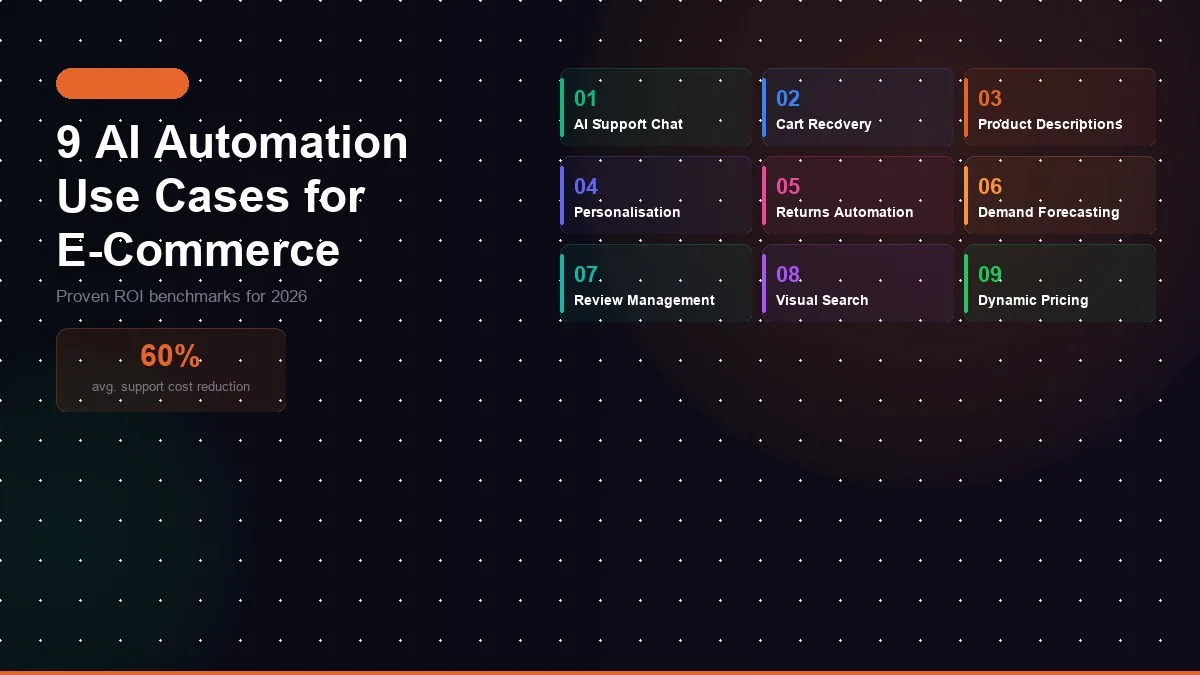
E-commerce was one of the first industries to adopt AI at scale — recommendation engines, fraud detection, and dynamic pricing have been running in production at major retailers for years. What has changed in 2024–2026 is that these capabilities, previously requiring data science teams and significant infrastructure investment, are now accessible to mid-market and independent e-commerce businesses through LLM APIs and pre-built integrations.
Here are the nine AI use cases that deliver the clearest ROI for e-commerce businesses in 2026, with realistic build costs, timelines, and payback benchmarks.
Kovil AI · AI for E-Commerce
We have built AI automation systems for e-commerce businesses — from chatbots to product generation.
1. Customer Support Chatbot
What it does: Handles inbound support queries automatically — order status, shipping updates, return requests, product questions — without human agent involvement for the majority of tickets.
How it works: A RAG-based chatbot grounded in your return policy, shipping information, FAQ documentation, and integrated with your order management system for real-time order lookup. The AI retrieves relevant context and generates a response, escalating to a human agent when confidence is low or the issue requires judgement.
ROI benchmark: E-commerce support teams report 55–75% ticket automation rates. At 700 tickets/week with a $35/hour support cost, automated resolution of 60% of tickets saves approximately $340,000/year. Build cost: $25,000–$45,000. Payback: 4–7 months.
2. AI Product Description Generator
What it does: Generates SEO-optimised product descriptions at scale — from product specifications, images, and category context — in your brand voice.
How it works: A prompt pipeline that takes structured product data (name, category, specifications, materials, dimensions) and brand voice guidelines as input and generates descriptions in the required format. Human review is typically applied to a sample before bulk publication.
ROI benchmark: Businesses with 1,000+ SKUs report 90% reduction in time to publish new products. A copywriter at $50/hour producing 10 descriptions per hour costs $5 per description. AI generation costs $0.02–0.10 per description. Build cost: $8,000–$20,000. Payback: 2–4 months for high-SKU catalogues.
3. Abandoned Cart Recovery
What it does: Sends personalised, AI-generated follow-up messages to shoppers who abandoned a cart, tailored to their specific cart contents, browsing history, and the likely reason for abandonment.
How it works: Triggered by cart abandonment event in your e-commerce platform, an AI system generates a personalised email or SMS that references the specific products left in the cart, highlights relevant social proof or urgency signals, and optionally includes a personalised incentive based on customer lifetime value.
ROI benchmark: Personalised abandonment messages recover 5–12% of abandoned carts, compared to 3–5% for generic template emails. At $120 average order value and 500 cart abandonments per week, even a 2% improvement in recovery rate generates $6,240/week in additional revenue.
4. AI-Powered Product Recommendations
What it does: Recommends products based on a customer's browsing behaviour, purchase history, and semantic similarity to products they have engaged with — not just "customers who bought this also bought" collaborative filtering.
How it works: Products are embedded as vectors capturing their semantic content (category, description, attributes). Customer behaviour is used to build a preference profile. Recommendations are generated by finding products whose vector representations are close to the customer's inferred interest vector.
ROI benchmark: Product recommendation engines account for 35% of Amazon's revenue. For mid-market e-commerce, well-implemented recommendation systems increase average order value by 10–25% and repeat purchase rate by 15–30%. Build cost: $30,000–$60,000 including data pipeline.
5. Intelligent Search
What it does: Returns semantically relevant search results rather than keyword matches. A search for "something waterproof for camping" returns appropriate rain gear and waterproof packs — not just products with the word "waterproof" in the title.
How it works: Product catalogue is embedded and stored in a vector database. Search queries are embedded at query time. Nearest-neighbour search retrieves the most semantically relevant products, optionally combined with traditional keyword search in a hybrid retrieval setup.
ROI benchmark: Sites with improved search convert browsers to buyers at 2–3x the rate of sites with poor search. Search users typically have a higher purchase intent — lifting search quality directly lifts conversion rate for the highest-intent segment of your traffic.
6. Returns Processing Automation
What it does: Automates the intake, classification, and initial processing of return requests — determining eligibility, generating return labels, updating inventory systems, and communicating status to customers — without manual agent involvement.
How it works: An AI agent processes return requests against your policy, verifies eligibility criteria, interfaces with your order management and inventory systems, generates the appropriate label or refund instruction, and sends confirmation to the customer. Exceptions and policy edge cases escalate to a human.
ROI benchmark: Returns processing typically costs $15–35 per return in agent time. Automating 65% of return processing at an average $25/return saves $16.25 per automated return. For a business processing 200 returns/week, this is $169,000/year in labour savings.
7. Review Summarisation and Sentiment Analysis
What it does: Synthesises hundreds of customer reviews into structured summaries — top pros, top cons, common themes, sentiment by product attribute — surfacing actionable insights from the review corpus without manual analysis.
How it works: A batch LLM pipeline processes review text in chunks, extracts sentiment by product attribute (quality, sizing, shipping, value), identifies recurring themes, and generates a structured summary. Can be run on demand or on a scheduled basis as new reviews accumulate.
ROI benchmark: Build cost is low ($5,000–$15,000 as a standalone tool). Value is primarily in product development and merchandising intelligence — understanding which product attributes drive returns or negative reviews before they compound.
8. Dynamic Pricing Intelligence
What it does: Monitors competitor pricing and your own inventory levels to recommend price adjustments that maximise margin while staying competitive — without a data science team.
How it works: An AI agent monitors competitor prices via structured data sources, compares against your current prices and inventory position, and generates pricing recommendations within rules you define (minimum margin, maximum discount, priority categories). Recommendations can be reviewed by a human or applied automatically with guardrails.
ROI benchmark: Even a 1% improvement in net margin from better pricing decisions is significant at scale. For a business doing $5M in annual revenue at 30% margin, 1% margin improvement is $50,000/year. Build cost: $20,000–$40,000.
9. AI-Assisted Buying and Inventory Forecasting
What it does: Analyses sales velocity, seasonal patterns, and external signals (trend data, search volume changes) to generate reorder recommendations and demand forecasts — reducing overstock and stockout events.
How it works: Historical sales data combined with external trend signals (Google Trends, social search volume, seasonal indices) feeds an AI forecasting pipeline that generates category-level and SKU-level demand projections. Reorder recommendations are surfaced to buyers with confidence intervals and the signal data behind each recommendation.
ROI benchmark: Inventory optimisation typically reduces overstock by 15–25% and stockout events by 20–35%. For a business carrying $1M in average inventory, a 20% overstock reduction frees $200,000 in working capital.
Where to Start
The highest-ROI starting point for most e-commerce businesses is the combination of customer support automation and product description generation — both have fast payback periods, clear success metrics, and do not require complex data infrastructure to build.
We have built AI systems across all nine of these use cases for e-commerce businesses. If you want to understand which would deliver the clearest return for your specific operation, our Outcome-Based AI Project process includes a scoping session that maps your current operations to the right AI investment. Reach out and we will scope it in 48 hours.
Related Services
Frequently Asked Questions
What is the best AI use case for e-commerce in 2026?
Customer support automation consistently delivers the highest and fastest ROI for e-commerce businesses — typically 5–8 month payback periods. E-commerce support is highly repetitive (order status, returns, shipping queries account for 60–70% of volume), the data needed to train the system already exists in your help desk, and the cost of a full-time support agent is easy to compare against the build and running cost of an AI chatbot. For businesses with high SKU counts, AI product description generation is a close second — it delivers immediate productivity gains with very low build cost.
How much does AI automation cost for an e-commerce business?
A customer support chatbot for e-commerce integrated with your help desk and order management system typically costs $20,000–$45,000 to build. An AI product description generator costs $8,000–$20,000. An abandoned cart recovery system with personalised AI-generated messages costs $15,000–$35,000. These are one-time build costs — running costs (LLM API + hosting) are typically $500–$3,000 per month depending on volume. Most e-commerce AI projects pay back within 6–12 months.
Can AI replace my e-commerce customer support team?
AI can automate 55–75% of e-commerce support tickets — the tier of common, predictable queries about orders, shipping, returns, and product questions. It should not replace the support team entirely: the remaining 25–45% of tickets require human judgement, empathy, or authority to make exceptions. The right model is AI handling tier-1 queries automatically, routing tier-2 queries to agents with context pre-populated, and reserving human time for complex or high-value interactions.
What data does an e-commerce AI system need?
For a support chatbot: historical support tickets with resolutions, your FAQ documentation, return policy, shipping carrier details, and API access to your order management system for real-time order lookup. For product description generation: existing product data (name, category, specifications, images), your brand voice guidelines, and examples of descriptions you consider high-quality. For recommendations: order history, browsing behaviour, product catalogue, and category relationships. Most e-commerce platforms (Shopify, Magento, WooCommerce) have APIs that make this data accessible.
How long does it take to deploy AI for an e-commerce business?
A customer support chatbot integrated with Shopify or Zendesk typically takes 4–6 weeks from kickoff to production deployment. A product description generator takes 2–4 weeks. A personalised recommendation engine is more complex — typically 8–12 weeks including data pipeline setup, model configuration, and A/B test infrastructure. The main variable is integration complexity: the more systems the AI needs to connect to, the longer the build.
Keep reading
Kovil AI · AI for E-Commerce
Ready to automate your e-commerce operations with AI?
We have built AI-powered support chatbots, product description generators, returns automation systems, and personalisation engines for e-commerce businesses. Fixed price, clear deliverables, 4–8 week delivery.