How to Write an AI Project Brief (Before You Hire)
The brief you hand an AI development team determines the price, timeline, and outcome of your project. Here's exactly what to include — the 8 sections that let any team scope your AI project accurately in 48 hours.
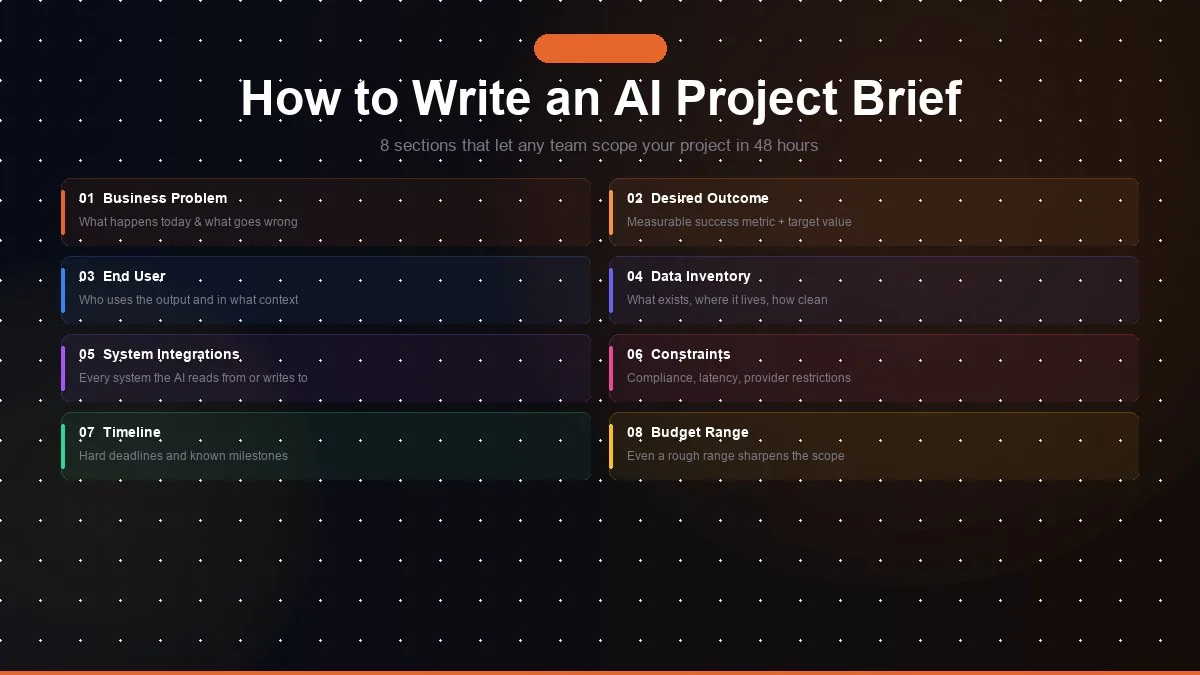
Most AI projects fail not because of bad engineering, but because of a bad brief. The engineering team builds what they were told to build. The business expected something different. Neither side is wrong — they were just working from an incomplete shared understanding of the problem.
A project brief solves this before it becomes expensive. Here is exactly what to include, section by section, so that any competent AI development team can scope your project accurately in 48 hours.
Kovil AI · Fixed-Cost AI Builds
We scope AI projects in 48 hours and give you a fixed price before any work begins.
Why AI Briefs Are Different from Software Briefs
A regular software brief describes features and user flows. An AI brief needs to answer two additional questions that software briefs never ask: what data exists, and what does success look like in measurable terms?
AI systems are data-dependent. An AI that answers customer questions needs your actual support documentation, not a vague reference to "our knowledge base." An AI that classifies inbound leads needs labelled examples of what a good lead looks like. Without data documentation, engineers spend the first weeks of a project discovering constraints that should have been known before the contract was signed.
AI systems also produce probabilistic outputs — they are right most of the time, not all of the time. Without a defined accuracy threshold, there is no objective way to agree on when the project is complete. "The AI makes mistakes" is not an actionable bug report; "the AI misclassifies more than 5% of support tickets" is.
The 8 Sections Every AI Project Brief Needs
1. The Business Problem
One paragraph. Describe what is happening today — what your team does manually, how often, how long it takes, and what goes wrong when it fails. Avoid describing the AI solution. Describe the problem.
Example: Our support team handles 800 inbound tickets per week. 60% of them are variations of the same 20 questions. Each ticket takes an average of 8 minutes to resolve. We want to automate resolution of the common-question tier so agents can focus on complex issues.
2. The Desired Outcome
What does success look like in measurable terms? Specify the metric, the target value, and the timeframe. This becomes the acceptance criterion for the project.
Example: Automatically resolve 55% of inbound support tickets with a customer satisfaction rating of 4.0/5.0 or above, within 6 months of deployment.
3. The End User
Who interacts with the AI output? Customers, internal staff, or another system? What is their technical literacy? What device or interface will they use it through? End user characteristics affect model choice, output format, latency requirements, and UX design.
4. Data Inventory
This is the section most briefs skip and most projects suffer for. List every data source the AI will use:
- What data exists? (support transcripts, product documentation, CRM records, structured database tables)
- How much of it is there? (number of documents, rows, word count)
- How current and clean is it? (last updated, known gaps or errors)
- Is it labelled? (for classification tasks: do you have ground-truth examples?)
- Where does it live? (internal database, Google Drive, Zendesk, Confluence)
You do not need to provide the data itself at briefing stage — you need to describe what exists so the engineering team can assess whether it is sufficient.
5. System Integrations
List every external system the AI needs to read from or write to. For each, note whether an API exists, whether credentials are available, and any known restrictions (rate limits, compliance requirements, read-only access).
Common integrations: Zendesk, Salesforce, HubSpot, Slack, Google Workspace, Shopify, custom internal databases, internal REST APIs.
Integration complexity is one of the biggest drivers of project cost and timeline. Documenting this upfront prevents mid-project surprises.
6. Constraints
Non-negotiable requirements that bound the solution. List anything the AI must or must not do:
- Compliance: HIPAA, GDPR, SOC 2, industry-specific regulations
- Data residency: must data stay within a specific geography?
- Latency: does the AI need to respond in under 2 seconds for a real-time user experience?
- Model restrictions: are there company policies about which AI providers can be used?
- Budget ceiling: maximum ongoing API cost per month
7. Timeline and Milestones
When do you need this live? Are there external dependencies (a product launch, a board presentation, a compliance deadline) that create hard stops? List any known milestones, not just the final delivery date.
8. Budget Range
Providing a budget range — even a broad one — dramatically improves scoping accuracy. Without it, an engineering team will produce a proposal calibrated to their assumptions about your budget, which may be completely wrong. A $30k budget and a $200k budget produce very different solutions to the same problem, and both can be valid depending on business context.
What Not to Include in Your Brief
Do not specify the technical solution. Saying "we want to use GPT-4 with LangChain hosted on AWS" when you have not evaluated the alternatives — or when your use case might be better served by a fine-tuned smaller model — constrains the engineering team unnecessarily and often results in a more expensive, less accurate system.
The brief should describe what the AI needs to achieve, not how it should be built. The how is the engineering team's expertise.
A One-Page Brief Template
| Section | What to Write |
|---|---|
| Business problem | What happens today, how often, and what goes wrong |
| Desired outcome | Measurable success metric + target value |
| End user | Who uses the output, in what context |
| Data inventory | What exists, where it lives, how much, how clean |
| System integrations | Every system the AI reads from or writes to |
| Constraints | Compliance, latency, provider, budget ceiling |
| Timeline | Hard deadlines and known milestones |
| Budget range | Even a rough range improves scoping accuracy |
If you have a brief — or a business problem you are ready to scope — our Outcome-Based AI Project process uses exactly this structure to produce a fixed price and clear deliverables within 48 hours. You can also reach out directly and we will help you build the brief together as part of the scoping conversation.
Related Services
Frequently Asked Questions
What should an AI project brief include?
An AI project brief should include: the business problem you are solving, the specific outcome you want to measure, the data you have available, the systems it needs to integrate with, your non-negotiable constraints (compliance, latency, budget), your timeline, and who the end user is. Eight sections covers most AI projects comprehensively. The brief does not need to specify the technical solution — that is the engineering team's job.
How do you scope an AI project without a technical background?
Focus on the problem, not the solution. Describe what your team currently does manually, how often, how long it takes, and what a good outcome looks like. List every system that would need to connect to the AI. Document the data you have. A good engineering team can translate a clear business problem into a technical scope — what slows them down is vague or missing requirements, not your lack of ML knowledge.
What is the difference between an AI brief and a regular software brief?
An AI project brief requires two extra sections that software briefs usually skip: data documentation and success metric definition. AI systems are only as good as the data they learn from or retrieve, so you must describe what data exists and its quality. And because AI outputs are probabilistic, you need to define upfront what 'good enough' accuracy means for your use case — otherwise there is no objective way to know when the project is complete.
How long does it take to scope an AI project?
With a well-written brief, a structured scoping process takes 24–48 hours. Without a brief, scoping turns into a series of clarifying calls that stretch over weeks and often still produce inaccurate estimates. The brief is the most time-efficient investment you can make before hiring an AI development team.
What happens if you start an AI project without a clear brief?
Without a clear brief, AI projects routinely run 2–4x over initial cost estimates and miss their original timeline by months. The most common failure modes are: the model is accurate on test data but fails on real data that was never documented, the integration with an existing system takes three times longer than expected because the system's constraints were unknown, and the success metric was never defined so there is no agreement on when the project is done.
Keep reading
Kovil AI · Fixed-Cost AI Builds
Ready to scope your AI project?
Hand us your brief — or let us help you write one. We'll scope your AI project in 48 hours with a fixed price, clear deliverables, and a team that has shipped AI products across fintech, retail, and SaaS.