AI for Healthcare
HIPAA-Compliant Clinical AI for Health Systems and Digital Health Companies
Patient intake automation, clinical documentation, medical coding, and EHR integration built for production clinical workflows. Kovil AI eliminated 95% of manual data entry in a production healthcare AI integration — with full HIPAA compliance and physician oversight built in.
Healthcare AI use cases Kovil AI builds
From patient intake through revenue cycle, each system is designed around your clinical workflows, EHR infrastructure, and HIPAA requirements.
Patient Intake Automation
Conversational AI collects demographics, insurance, medical history, and chief complaint before the encounter. Reduces front desk burden by 40 to 60% and improves data completeness entering the clinical workflow.
Clinical Documentation AI
AI-assisted note generation from structured input or ambient encounter transcription. Physicians review and sign — drafting time reduced by 30 to 50%. Kovil AI eliminated 95% of manual data entry in a production healthcare integration.
Medical Coding Automation
ICD-10 and CPT code suggestion from clinical notes, with confidence scoring and a human review queue. Improves coding throughput and reduces denial rates from missed or incorrect codes.
EHR Integration AI
HL7 FHIR-based data pipelines connecting AI systems to Epic, Cerner, Athenahealth, and custom EHRs. Real-time data exchange for clinical workflows without manual re-entry or PDF uploads.
Prior Authorization AI
Automates criteria matching, documentation assembly, and payer submission for prior authorization requests. Reduces per-request time from 30+ minutes to under 10 minutes and improves first-pass approval rates.
Clinical Decision Support
Evidence-based alerts, drug interaction warnings, and care gap identification surfaced within clinical workflows. Designed to complement physician judgment without alert fatigue from low-specificity notifications.
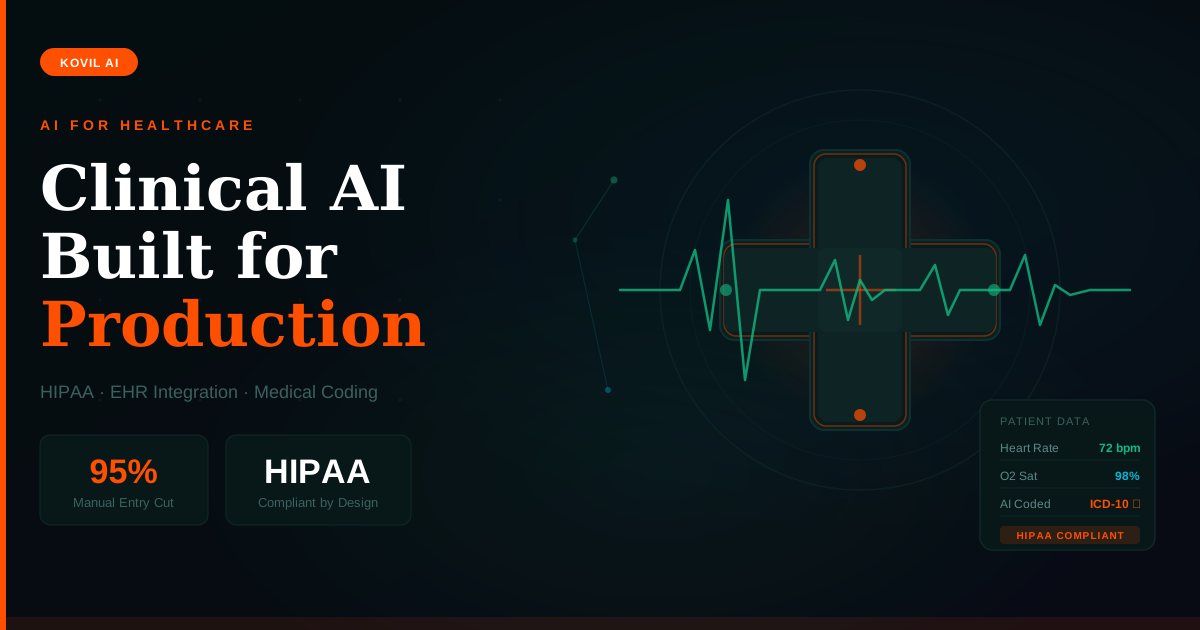
Kovil AI builds healthcare AI with HIPAA compliance and clinical validation as first-class requirements — not afterthoughts.
Where healthcare AI projects fail — and how Kovil AI avoids it
Healthcare AI failures are almost always compliance, validation, or adoption failures — not model failures. The risks are predictable and preventable.
PHI compliance cannot be retrofitted
Healthcare AI projects that start with the model and add HIPAA compliance later consistently end up rebuilding the data layer. PHI isolation, audit logging, and BAA-compliant data handling must be designed in from the start — they affect infrastructure choices, model training protocols, and deployment architecture. Kovil AI establishes compliance requirements before writing the first line of code.
Clinical validation takes longer than teams expect
A coding AI with 85% accuracy sounds impressive until it hits a batch of complex multi-diagnosis encounters and produces 60% accuracy. Clinical AI must be validated against a representative sample of your actual patient population and documentation patterns — not a general benchmark dataset. This validation phase takes 4 to 6 weeks for most systems and requires clinical staff time. Teams that skip it discover the gaps in production, where fixing errors is expensive.
EHR integration is the hardest part
Epic, Cerner, and other major EHRs have extensive APIs — but accessing them requires IT involvement, SMART on FHIR registration, and often lengthy vendor approval processes. Building AI that sits outside the EHR and requires manual data entry creates a parallel workflow clinicians will not sustain. Integration planning must start on day one of the project, not after the AI is built.
Physician adoption is an implementation problem, not a technology problem
Healthcare AI built without clinical input into the workflow design fails at adoption regardless of technical quality. If the AI-generated note requires more editing than writing from scratch, physicians stop using it. If the coding suggestion queue interrupts the workflow, coders bypass it. Kovil AI embeds workflow design into the build phase — clinical staff review prototypes and provide feedback before any system goes to production.
How Kovil AI builds healthcare AI — four phases
Every healthcare AI engagement starts with a HIPAA and clinical workflow assessment. Compliance is established before architecture decisions are made — not added at the end.
HIPAA and clinical workflow assessment
We map your PHI data flows, existing EHR infrastructure, and clinical workflows before designing anything. HIPAA compliance requirements — BAA execution, PHI handling protocols, audit logging standards — are established as hard constraints. We identify which clinical workflows have the highest AI ROI: intake typically reduces staff burden by 40 to 60%, prior auth automation reduces denial rates by 20 to 35%, and documentation AI reduces physician charting time by 30 to 50%.
AI architecture with HIPAA controls
We design the AI architecture with PHI isolation, role-based access controls, encrypted data storage and transmission, and complete audit logging of all AI interactions with patient data. For clinical documentation systems, we design the physician review workflow alongside the AI — every AI-generated note requires physician sign-off before it enters the medical record. For coding systems, we build the human review queue for AI-suggested codes.
Build and clinical validation
We build the system and validate against a representative sample of your actual clinical data — de-identified for training, validated against live workflows with clinical staff. For documentation systems, we measure documentation completeness and accuracy against a baseline. For coding systems, we measure coding accuracy and denial rate impact. No system goes to production without passing clinical validation with your staff.
EHR integration and production deployment
We integrate with your EHR via HL7 FHIR or direct API where available, and deploy with full audit logging, PHI access monitoring, and model performance tracking. Post-launch, we monitor for model drift (clinical language and coding guidelines change over time), physician override rates, and downstream quality metrics like denial rates and documentation completeness scores.
Who Kovil AI builds healthcare AI for
Healthcare AI priorities differ by organization type. The compliance requirements are identical — the use cases and ROI drivers are not.
Health systems and large medical groups
Multi-specialty health systems and large physician groups with high documentation and coding volume. The ROI on clinical documentation AI and coding automation compounds at scale — a 30-physician group saving 90 minutes per day across physicians represents significant reclaimed clinical capacity.
Revenue cycle and billing companies
Medical billing companies and revenue cycle management firms processing high volumes of claims across multiple practices. Coding AI improves throughput per coder and reduces first-pass denial rates — both directly impacting margin on processing-fee-based revenue models.
Digital health and health IT companies
Digital health startups and health IT vendors building AI into their products. Kovil AI builds the AI layer — intake chatbots, documentation generation, clinical data pipelines — so product teams can ship AI features without a dedicated ML team or the compliance overhead of building it from scratch.
Healthcare AI delivered by Kovil AI — real results
Case study — Healthcare integration
95% of manual data entry eliminated in production
A healthcare organization was manually re-entering patient data across disconnected clinical systems, consuming significant staff hours per day and creating data integrity risks. Kovil AI built an AI integration layer that automated 95% of that data movement — connecting the systems, validating data quality, and surfacing exceptions for human review. Staff hours spent on data entry dropped from hours to minutes per shift.
Read the case studyTypical outcomes
Reduction in physician documentation time with AI-assisted note generation
Reduction in front desk burden with patient intake automation
Improvement in prior auth first-pass approval rates
Reduction in coding denial rates with AI-assisted code suggestion
Frequently asked questions
What types of healthcare AI systems does Kovil AI build?
Kovil AI builds patient intake automation systems (conversational AI that collects demographics, insurance, chief complaint, and medical history before the encounter), clinical documentation AI (ambient or structured note generation from clinical encounters), medical coding automation (ICD-10, CPT code suggestion from clinical notes), EHR integration pipelines (HL7 FHIR-based data exchange between AI systems and EHRs like Epic, Cerner, Athenahealth), prior authorization AI (automated criteria matching and documentation assembly), and clinical decision support tools (evidence-based alerts and recommendations within clinical workflows). All systems are HIPAA-compliant by design.
How does Kovil AI ensure HIPAA compliance in healthcare AI projects?
HIPAA compliance is a design constraint, not a feature added at the end. Before writing any code, Kovil AI executes a Business Associate Agreement (BAA), maps all PHI data flows, defines data residency requirements, and establishes audit logging standards. Systems are built with PHI isolation by patient, role-based access controls, encrypted storage and transmission (AES-256 at rest, TLS 1.3 in transit), and complete audit logs of every AI interaction with patient data. No PHI is used to train or fine-tune models without explicit written authorization. Deployment environments are HIPAA-eligible cloud configurations (AWS HealthLake, Azure Health Data Services, or Google Cloud Healthcare API).
Can AI replace physician documentation?
No — and Kovil AI does not build systems designed to remove the physician from the loop. Clinical documentation AI generates a draft note from the clinical encounter (either from structured input or ambient conversation transcription), but the physician reviews, edits, and signs every note before it enters the medical record. This is both a clinical safety requirement and a legal requirement under state medical record laws. The value is time savings: physicians typically spend 1.5 to 2.5 hours per day on documentation. AI-assisted documentation reduces that to 30 to 60 minutes by handling the drafting layer.
What EHR systems can Kovil AI integrate with?
Kovil AI has built integrations with Epic (via SMART on FHIR and Epic APIs), Cerner/Oracle Health, Athenahealth, and eClinicalWorks. For health systems with HL7 FHIR R4 APIs exposed, integration is straightforward. For older HL7 v2 interfaces, we build the transformation layer. Custom EHRs used by specialty practices or digital health companies are assessed during the workflow audit phase. If your EHR has no API, we assess HL7 feed and export options as integration paths.
How accurate is AI medical coding?
In production healthcare AI coding systems, ICD-10 primary diagnosis accuracy typically runs 88 to 94% for common conditions in well-documented notes. CPT procedure code suggestion accuracy is higher — 91 to 96% — because procedure descriptions are more standardized. Accuracy drops for complex, multi-diagnosis encounters and for rare conditions with limited training examples. Kovil AI builds coding systems with a mandatory human review step: AI suggests codes with confidence scores, coders review and confirm. This is not optional — AI-only coding without human review creates compliance and billing risk.
What is prior authorization AI and how much time does it save?
Prior authorization AI automates the matching of clinical documentation against payer criteria to determine whether a prior auth request is likely to be approved, assembles the required documentation package, and in some cases submits directly via payer APIs. Manual prior auth typically takes 20 to 40 minutes per request and has a first-pass denial rate of 15 to 25%. AI-assisted prior auth reduces assembly time to 5 to 10 minutes per request and improves first-pass approval rates by pre-checking criteria alignment before submission. The savings compound at scale — practices processing 50+ prior auths weekly see significant staff hour reduction.
How long does a healthcare AI project take?
A focused patient intake automation system can be built and deployed in 8 to 10 weeks. Clinical documentation AI with EHR integration typically takes 12 to 16 weeks — the integration and clinical validation phases take the most time. Medical coding systems with human review queues and denial analytics run 14 to 20 weeks. Prior authorization automation timelines depend heavily on payer API availability: practices relying on payer portals without APIs require additional integration work. All timelines are milestone-gated and agreed before work begins.
Does Kovil AI work with digital health startups or only large health systems?
Both. Large health systems engage Kovil AI for EHR integration projects, documentation AI pilots across service lines, and coding automation for revenue cycle improvement. Digital health startups engage Kovil AI to build the AI layer of their product — intake chatbots, clinical note generation, or symptom triage — without hiring a dedicated ML team. The compliance requirements are identical regardless of organization size: HIPAA applies to both a 50-physician practice and a 5,000-bed health system.
Who owns the AI models and code built by Kovil AI?
The client owns 100% of all code, models, pipelines, and IP produced during the engagement. Kovil AI retains no rights to any system built for you. No patient data or clinical content is used to train or improve Kovil AI systems or any third-party models. You receive full source code, model artifacts, and deployment infrastructure as a deliverable, suitable for hosting in your HIPAA-eligible cloud environment.
Explore related work
Ready to build healthcare AI that works?
Book a 30-minute call. We will assess your clinical workflows and HIPAA environment, identify the highest-ROI AI opportunity, and outline a milestone delivery plan.
Book a Call