VTiger vs SuiteCRM: Which Open-Source CRM Should You Choose in 2026?
VTiger and SuiteCRM are the two most deployed open-source CRMs in 2026. This comparison covers pricing, AI capabilities, integrations, customisation, and exactly when to pick each — plus how to add AI agents to either platform.
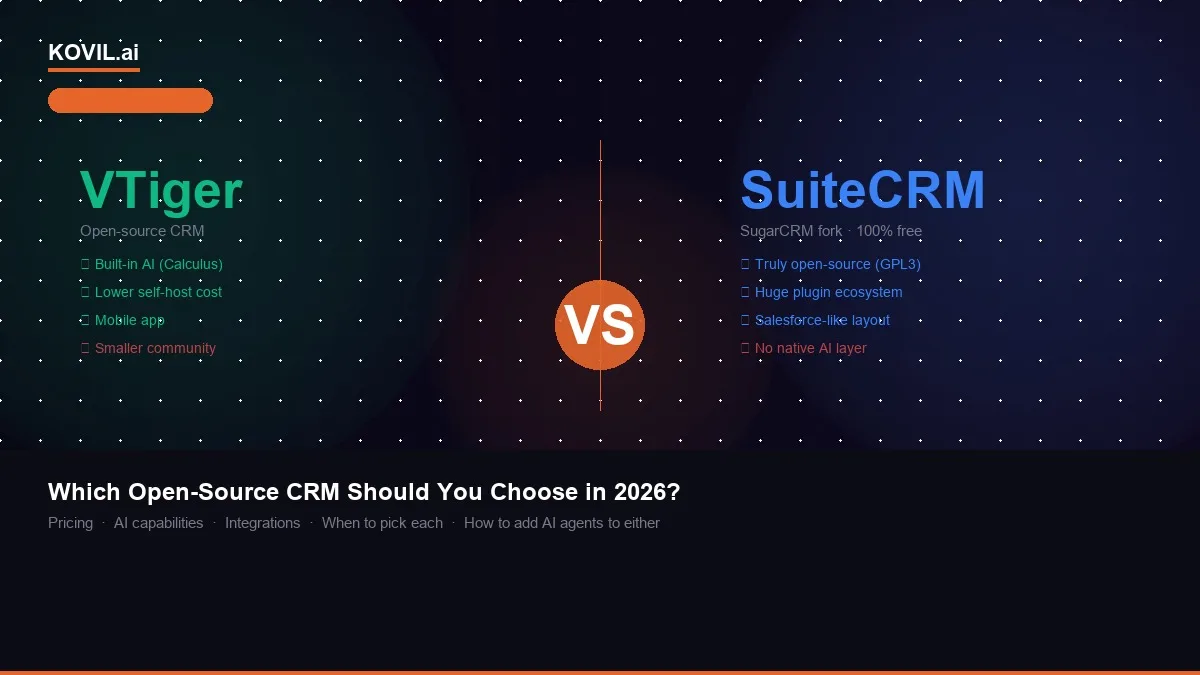
If you are evaluating open-source CRMs in 2026, the shortlist almost always comes down to two platforms: VTiger and SuiteCRM. Both are mature, actively maintained, and deployed by thousands of businesses worldwide. Both can replace Salesforce or HubSpot for a fraction of the cost.
But they are built on different philosophies, serve different types of organisations, and have very different AI stories — which matters a lot in 2026, when AI agents are moving from experimental to expected in CRM workflows.
Kovil AI
We build AI-powered software for businesses — from automations to full product builds.
This is a complete, no-fluff comparison. We will cover pricing, UI, customisation, integrations, automation, AI capabilities, and give you a clear decision framework for which to choose. We will also cover something most comparison posts miss entirely: how to add AI agents to either platform — because neither does it well out of the box.
Kovil AI · CRM AI Integration
Already using VTiger or SuiteCRM?
We build AI agents that plug into your existing CRM — lead scoring, pipeline health monitoring, AI email drafting, and support deflection. Fixed-price. 2-week pilot.
Book a Free Discovery Call →Quick Verdict: VTiger vs SuiteCRM at a Glance
| Category | VTiger | SuiteCRM | Edge |
|---|---|---|---|
| Licence cost | Free (self-host) / $12–42/user cloud | Free (GPL v3) | SuiteCRM |
| UI / ease of use | Modern, clean (especially cloud) | Functional, steeper learning curve | VTiger |
| Mobile app | Yes, native iOS & Android | Limited / third-party | VTiger |
| Customisation | Good (Studio, modules) | Excellent (deep module builder) | SuiteCRM |
| Plugin ecosystem | Moderate | Large (SuiteCRM Store + community) | SuiteCRM |
| Built-in AI | Calculus AI (cloud tier only) | None native | VTiger (cloud) |
| REST API | Yes (v2 API) | Yes (v8 API) | Draw |
| Community size | Moderate | Large (SalesAgility-backed) | SuiteCRM |
| Hosting options | Self-host or VTiger Cloud | Self-host or SuiteCRM Hosting | Draw |
| Best for | SMBs wanting clean UX + mobile | Tech-capable teams wanting full control | — |
What Is VTiger CRM?
VTiger was founded in 2004 as an open-source fork of SugarCRM, and has since evolved into one of the most widely deployed CRM platforms globally. The company behind it, Vtiger Systems, is headquartered in Bangalore and maintains two distinct products: VTiger Open Source (the self-hosted, free version) and VTiger CRM Cloud, a commercial SaaS product built on the open-source core but with proprietary additions including Calculus AI.
VTiger is particularly strong in the SMB segment — companies with 10–200 users who need a full-featured CRM with Sales, Support, and Marketing modules under one roof, and who value a clean modern UI over maximum extensibility.
VTiger strengths
- Modern UI: The cloud version especially has a clean, responsive interface that requires less training than legacy open-source CRMs
- All-in-one: Sales, helpdesk, inventory, and marketing campaign modules are all included — reducing the need for third-party tools
- Mobile: Native iOS and Android apps with full offline capability, which SuiteCRM lacks at parity
- Calculus AI: On paid cloud tiers, VTiger includes AI-powered lead scoring, deal health scores, and next-best-action suggestions built directly into the workflow
- Lower infrastructure complexity: The cloud option removes the DevOps burden entirely
VTiger weaknesses
- The most valuable AI features (Calculus) are cloud-only — self-hosted users get none of them
- The open-source community is smaller and less active than SuiteCRM's
- Module customisation depth is shallower than SuiteCRM for complex enterprise requirements
- Pricing for the cloud tiers adds up quickly at scale — the per-user model becomes expensive above 50 seats
What Is SuiteCRM?
SuiteCRM was created in 2013 by SalesAgility, a UK-based CRM consultancy, as a response to SugarCRM's pivot away from open-source. SalesAgility forked SugarCRM Community Edition under the GPL v3 licence and committed to keeping it permanently free and open. The result is the most widely deployed open-source CRM in the world, with over 4.5 million downloads and deployments across 200+ countries.
SuiteCRM is the default recommendation for organisations that want Salesforce-like CRM capabilities with zero licence cost, maximum data sovereignty, and the ability to modify every line of the codebase if needed.
SuiteCRM strengths
- Truly free: No hidden tiers, no feature walls, no per-user fees. The entire product is open-source under GPL v3
- Deep customisation: Studio, Module Builder, and Logic Hooks allow developers to modify almost any behaviour — including custom workflows, module relationships, and UI components
- Large ecosystem: The SuiteCRM Store and community plugins cover hundreds of integrations including telephony, e-commerce, accounting, and document management
- Salesforce-familiar layout: Organisations migrating from Salesforce find the module structure and navigation immediately recognisable
- SalesAgility backing: Unlike pure community projects, SuiteCRM has a commercial company investing in roadmap and security updates
SuiteCRM weaknesses
- No native AI layer — zero built-in machine learning, lead scoring, or prediction features
- Steeper onboarding for non-technical users compared to VTiger's cloud version
- Mobile experience is significantly weaker — no official native app as of 2026
- Requires PHP/MySQL expertise for administration and customisation
- SuiteCRM 8 (based on Symfony + Angular) introduced technical debt concerns during migration from SuiteCRM 7
Head-to-Head: 6 Key Categories
1. Pricing and Total Cost of Ownership
On pure licence cost, SuiteCRM wins unconditionally — it is free. VTiger Open Source is also free, but the features most organisations want (AI, mobile, cloud sync) require the paid cloud tiers.
However, licence cost is not total cost of ownership. Both platforms require:
- Server infrastructure (VPS or cloud VM): $20–200/month depending on user count and data volume
- Database and backup management
- Plugin licences for specific integrations
- Developer time for customisation
At 25 users, a realistic TCO comparison looks approximately like this:
| Cost component | VTiger (self-host) | VTiger Cloud | SuiteCRM (self-host) |
|---|---|---|---|
| Licence (annual) | $0 | $3,600–12,600 | $0 |
| Hosting (annual) | $600–1,800 | Included | $600–1,800 |
| Admin/dev time | Medium | Low | Medium-high |
| Rough total | $600–1,800/yr | $3,600–12,600/yr | $600–1,800/yr |
For comparison: HubSpot Sales Hub Professional at 25 seats costs approximately $18,000–30,000/year. Salesforce Professional Edition at 25 seats is approximately $22,500/year. Both VTiger and SuiteCRM represent 60–90% cost reduction at equivalent functional depth.
2. UI and Ease of Use
VTiger Cloud has a meaningfully better out-of-box user experience. The interface is clean, module navigation is intuitive, and onboarding time for non-technical sales reps is low. The 2024–2026 UI redesign brought VTiger Cloud visually closer to HubSpot's aesthetic.
SuiteCRM's UI is functional but shows its SugarCRM heritage. The layout is dense, module navigation requires more clicks, and new users typically need a brief orientation. SuiteCRM 8's Angular frontend is significantly cleaner than SuiteCRM 7, but the migration has been bumpy — many organisations are still on 7.x because 8.x introduced compatibility issues with existing customisations.
Winner: VTiger, especially on cloud. If your sales team skews non-technical, VTiger's UI reduces training overhead.
3. Customisation and Module Architecture
SuiteCRM wins here, and it is not close for complex deployments. The Module Builder allows you to create entirely custom modules with relationship types, fields, dashlets, and logic hooks without writing PHP. The Workflow module (AOS_PDF_Templates, AOP_Cases) is more mature than VTiger's equivalent. And because every line of SuiteCRM is open-source under GPL, developers can modify core behaviour in ways VTiger's cloud SaaS does not allow.
VTiger Studio is adequate for standard customisation — adding fields, modifying views, creating basic workflows. But for organisations with complex, non-standard sales processes or custom module relationships, SuiteCRM's Module Builder is the better tool.
Winner: SuiteCRM for complex or non-standard requirements. VTiger for standard SMB configurations.
4. Integrations and REST API
Both platforms expose REST APIs that allow external systems to read and write CRM data — which is the foundation for adding AI agents, webhook triggers, and third-party tool integrations.
VTiger v2 API is clean, well-documented, and supports standard CRUD operations across all modules. VTiger also has native integrations with Google Workspace, Microsoft 365, Zoom, and major email providers.
SuiteCRM v8 API (based on JSON:API) is more RESTful and better structured for modern developer workflows. The community has built adapters for almost every major business tool. SuiteCRM's integration surface is broader, partly because of its larger developer community.
Winner: Draw for standard integrations. SuiteCRM for breadth. VTiger for native out-of-box connectors.
5. Workflow Automation
Both platforms include visual workflow builders for automating common CRM tasks: field updates on status change, automated email triggers, assignment rules, and escalation paths.
VTiger's Process Designer (in cloud tiers) is more accessible for non-developers and handles common scenarios well. SuiteCRM's Workflow module is more flexible but requires more configuration effort.
Neither platform's native workflow engine approaches the sophistication of modern AI-driven automation — they handle deterministic rule-based flows well but have no conditional reasoning, natural language input processing, or autonomous agent behaviour. This gap is where AI integration becomes relevant. See the section below on bridging the AI gap.
Winner: VTiger for ease. SuiteCRM for flexibility. Neither for AI-native automation.
6. AI Capabilities in 2026
This is the category that matters most for organisations thinking beyond basic CRM functionality.
VTiger Calculus AI (cloud paid tiers only) includes:
- Lead and deal scoring based on historical conversion patterns
- Next-best-action recommendations for sales reps
- Basic email sentiment analysis
- Conversation intelligence for calls (limited)
Calculus AI is a meaningful starting point, but it is shallow by 2026 standards. It scores and recommends — it does not autonomously act, draft, or reason across complex multi-step processes.
SuiteCRM has no native AI layer at all. AI capabilities require third-party integration or custom development.
The honest assessment: neither platform is competitive with Salesforce Agentforce or HubSpot's Breeze AI agents on native AI depth. If AI-driven automation is a primary requirement, you are looking at building on top of these platforms, not using them as-is.
Winner: VTiger on native AI features. But for organisations with specific AI requirements, both platforms need external AI development regardless.
When to Choose VTiger
- Your team is non-technical and needs a low-friction onboarding experience
- You want a mobile-first field sales workflow — VTiger's native app is genuinely good
- You want some built-in AI features (Calculus) without custom development, and the cloud pricing fits your budget
- You need an all-in-one CRM + helpdesk + inventory tool and want them pre-integrated
- Your customisation requirements are standard — the Studio covers what you need without deep development
When to Choose SuiteCRM
- Zero licence cost is a hard requirement — you are not willing to pay per-user fees now or at scale
- You have internal PHP/MySQL development capacity and want full control over every module
- You are migrating from Salesforce and want a structurally familiar layout at open-source pricing
- Your processes are non-standard and you need Module Builder-level customisation
- Data sovereignty is critical — you need on-premise deployment with no third-party data processing
- You plan to build AI capabilities yourself via the REST API and do not need a vendor-provided AI layer
The AI Gap: What Both Platforms Miss in 2026
Here is the uncomfortable truth that neither VTiger nor SuiteCRM marketing will tell you: CRM automation in 2026 is not about workflow rules. It is about autonomous agents.
The difference is significant. A workflow rule says: "When deal stage changes to Proposal Sent, send this email template." An AI agent says: "Review the deal history, the prospect's recent activity, and the competitive landscape. Draft a personalised follow-up email addressing the specific objections raised in the last call. Send it at the optimal time based on the prospect's engagement patterns."
Neither VTiger nor SuiteCRM does the second thing natively. VTiger Calculus gets you halfway there with scoring and recommendations — but the agent still needs to act. SuiteCRM has no starting point at all.
The high-value AI use cases for CRM in 2026 that require custom AI agent development include:
| AI use case | What it does | Native in VTiger? | Native in SuiteCRM? |
|---|---|---|---|
| AI Lead Scoring Agent | Scores every inbound lead in real-time based on 20+ signals including firmographic, behavioural, and engagement data | Partial (Calculus, cloud only) | No |
| Pipeline Health Monitor | Analyses deal velocity, days in stage, and engagement patterns to flag at-risk deals before they go cold | Partial (deal scoring only) | No |
| AI Email Drafter | Generates personalised, context-aware email drafts for each prospect based on their history, industry, and deal stage — for rep review before sending | No | No |
| Support Deflection Agent | Resolves Tier 1 support cases autonomously against your knowledge base — only escalating to a human when confidence is below threshold | No | No |
| CRM Data Quality Agent | Monitors for duplicate records, enriches contact data from public sources, and flags stale/incomplete records for remediation | No | No |
All five of these are buildable on top of VTiger or SuiteCRM using their REST APIs as the data layer, with an external AI agent handling the reasoning and action steps. The CRM becomes a structured data store and action target; the AI layer sits above it.
This is actually an advantage of open-source CRMs over locked-down SaaS platforms: the REST API is fully accessible, the data model is transparent, and there are no artificial restrictions on third-party integrations. You can build AI capabilities that would cost 10x more as a Salesforce add-on.
Kovil AI · CRM AI Engineering
Add AI agents to VTiger or SuiteCRM — fixed-price, 2-week pilot
We build production AI agents that connect to your CRM's REST API — lead scoring, pipeline monitoring, email drafting, and support automation. 2-week risk-free pilot. No commitment until you see results.
How to Add AI Agents to VTiger or SuiteCRM
The architecture for adding AI agents to either platform follows the same pattern, regardless of which CRM you have chosen:
Step 1: Map the CRM data model
Identify which modules and fields contain the signals your AI agent needs. For a lead scoring agent: Leads module, custom fields (source, intent signals, company size), linked Activities, and historical conversion outcomes from Opportunities. Both platforms expose full module schemas via their APIs.
Step 2: Build a read/write integration layer
Create authenticated API connections from your AI agent's infrastructure to the CRM. VTiger's v2 API uses session-based auth; SuiteCRM's v8 API uses OAuth 2.0. Both support full CRUD on all standard modules and custom fields.
Step 3: Design the agent's reasoning loop
Define the trigger (new lead created → score it), the input data (CRM fields + enrichment sources), the model and prompt (GPT-4o or Claude 3.5 Sonnet for scoring rationale; a fine-tuned classifier for the score itself), and the output action (write score back to a custom CRM field + create a Task for the assigned rep if score exceeds threshold).
Step 4: Handle state and audit
Production CRM AI agents need to log every decision — what data was used, what the model returned, and what action was taken. This is both operationally necessary (debugging) and compliance-relevant in regulated industries. Build an audit log as a standard component, not an afterthought.
Step 5: Monitor for drift
A lead scoring model trained on Q1 data may degrade by Q4 as market conditions change. Build a regular evaluation run that compares model-scored leads against actual conversion outcomes. If accuracy drops below your threshold, retrain or recalibrate. This is the AI Operations layer that most build teams skip and then regret six months later.
The total engineering investment for a production-grade lead scoring AI agent on either CRM platform is typically 3–6 weeks for an experienced AI engineering team — which is roughly what a single month of Salesforce Einstein licences costs at 50 seats. The ROI case is clear.
Migration Considerations: Can You Switch Between Them?
If you start with one and want to switch later, migration between VTiger and SuiteCRM is possible but non-trivial. Both platforms store data in MySQL, but their schema structures differ significantly. Standard records (Contacts, Accounts, Opportunities) can be migrated via CSV export/import with field mapping. Custom modules, relationships, and workflow logic require significant remapping effort.
The practical answer: choose carefully based on the framework above, because switching after significant customisation investment is a 2–4 week engineering project. If you are genuinely unsure, SuiteCRM's zero licence cost makes it a lower-risk starting point — you can always move to a commercial platform later without having paid SaaS fees during your evaluation period.
Our Recommendation
There is no universally correct answer, but here is the decision tree we give clients:
- Choose VTiger Cloud if: you are an SMB (under 50 users), your team is non-technical, you want a managed hosting option, and you want some AI features without custom development work. The monthly cost is justified by reduced IT overhead.
- Choose SuiteCRM if: you have technical development capacity, zero licence cost is critical, you are migrating from Salesforce, or you need deep customisation. SuiteCRM's REST API is excellent for AI integration — the lack of native AI is a feature if you want to build your own.
- Choose neither if: AI-native CRM is a top-three business requirement and you have the budget for Salesforce Agentforce or are willing to invest in a full custom AI agent layer. Neither platform is designed first for AI — they are designed first for CRM data management.
For most organisations considering VTiger vs SuiteCRM, the real differentiator in 2026 is not which CRM you pick — it is whether you build AI agents on top of it. The CRM that best supports your AI integration goals (good REST API, clean data model, predictable schema) matters more than the native feature set.
Both VTiger and SuiteCRM meet that bar. The agent layer is what separates a 2026-ready CRM system from a 2019-era one.
Kovil AI · Get Started
Ready to add AI agents to your CRM?
We have built AI agent layers on top of VTiger, SuiteCRM, HubSpot, and Salesforce. Fixed-price sprints. 2-week risk-free pilot. Book a call to scope your first agent.
Related Services
Frequently Asked Questions
Is VTiger CRM really free?
VTiger has two versions: VTiger Open Source, which is free to self-host with no licence fee, and VTiger CRM Cloud (formerly VTiger One), which is a paid SaaS product starting around $12–42 per user/month. The open-source version is fully functional but requires your own hosting infrastructure and lacks the cloud-native AI features (Calculus AI) available in the paid tier.
Is SuiteCRM completely free?
Yes. SuiteCRM is released under GPL v3 and is 100% free with no per-user fees, no feature tiers, and no mandatory cloud subscription. You pay only for your hosting infrastructure. SalesAgility, the maintainer, offers commercial support contracts and hosted SuiteCRM as paid options, but the software itself costs nothing.
Which is better for a small business: VTiger or SuiteCRM?
For small businesses with limited IT resource, VTiger Cloud's paid tier often wins because it reduces infrastructure overhead. For small businesses with basic technical capability who want zero licence cost, SuiteCRM on a VPS is hard to beat on total cost. The deciding factor is usually whether you need a mobile app (VTiger has one; SuiteCRM's is limited) and whether you need built-in email marketing (VTiger includes this in higher tiers).
Can you add AI to SuiteCRM or VTiger?
Yes — both platforms expose REST APIs that allow external AI systems to read and write CRM data. Common AI additions include lead scoring agents that classify incoming leads by conversion probability, email reply agents that draft personalised outreach, pipeline health monitors that flag at-risk deals, and support deflection agents that resolve queries before they hit a human. These are built as external AI services that integrate via the CRM's API layer.
How does VTiger compare to HubSpot and Salesforce?
VTiger and SuiteCRM are self-hosted open-source platforms with no per-user SaaS fees. HubSpot is a cloud-native SaaS CRM with a generous free tier but expensive paid tiers ($800–$3,200+/month for the full Marketing Hub). Salesforce is the enterprise standard at $25–$300+/user/month. If your primary driver is cost control and you have technical resource to manage infrastructure, VTiger or SuiteCRM will be 60–90% cheaper than HubSpot or Salesforce at equivalent feature sets — but without the same ecosystem depth or built-in AI maturity.
Kovil AI
Looking to bring AI into your business?
Whether you need a custom AI build, workflow automation, or a fast MVP — our engineers have done it across industries. Let's talk about what you're trying to solve.