What Is AI Integration? A Complete Business Guide (2026)
AI integration is the fastest path to operational efficiency in 2026. Learn what it means, the four core types, real industry examples, and how to get started.
Every few years, a technology shift arrives that separates companies that adapt from those that fall behind. In 2026, that shift is AI integration, and the gap between businesses that have embedded AI into their operations and those that haven't is widening faster than most executives realize.
But "AI integration" is one of those phrases that gets used constantly without anyone stopping to define it clearly. Is it building a chatbot? Replacing employees with robots? Buying an AI-powered CRM? The answer is both simpler and more powerful than most of those interpretations.
Kovil AI · AI Integration
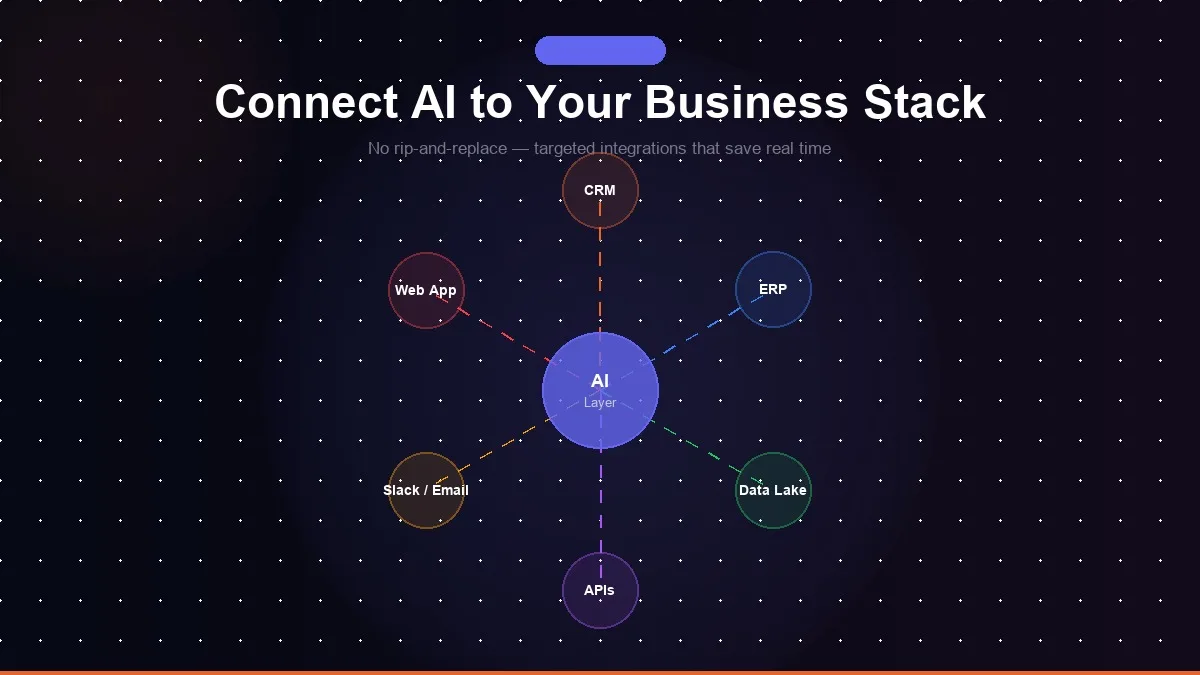
We connect AI to your existing business stack — no rip-and-replace, just targeted integrations.
What AI Integration Actually Means
Definition
AI integration is the process of embedding AI capabilities, including machine learning models, large language models (LLMs), computer vision, predictive analytics, and workflow automation, directly into your existing business processes and technology stack, so that AI operates within your specific business context rather than as a standalone tool.
The key word is existing. You don't have to rebuild your business from scratch to benefit from AI. The most valuable AI integrations typically sit on top of what you already have, connecting to your current tools, data, and workflows, and making them dramatically smarter.
Here's the distinction that matters most: AI integration is not the same as buying AI-powered products. Subscribing to ChatGPT or Notion AI is using AI tools. AI integration means custom-building the connection between AI capabilities and your specific business logic, data, and systems.
The Four Core Types of AI Integration
1. Workflow Automation
Workflow automation uses AI to eliminate repetitive, rule-based tasks from your team's day. n8n, Zapier, Power Automate, and Make let you build automated pipelines that respond to triggers, a new form submission, an incoming email, a status change in your CRM, and carry out multi-step actions automatically. Not sure which platform is right for your stack? See our Power Automate vs n8n vs Zapier vs Make comparison for an honest breakdown.
A typical example: every time a lead fills out your contact form, an AI workflow enriches the record with company data, scores the lead based on fit criteria, assigns it to the right sales rep, drafts a personalised outreach email, and logs everything in your CRM, all without human involvement.
The operational leverage here is enormous. Teams that used to spend hours on manual data entry and task coordination can redirect that time to work that actually requires human judgment.
2. LLM Integration
Large language models like GPT-4, Claude, and Llama 3 can understand and generate human language at a level that was unimaginable five years ago. Integrating an LLM into your business means connecting these capabilities to your data and workflows.
Practical applications include: AI-powered customer support agents that understand nuanced queries and respond from your knowledge base; intelligent document processing that extracts, classifies, and summarises contracts, invoices, and reports; internal knowledge assistants that answer employee questions by searching across your company's documentation; and sales enablement tools that draft personalised proposals, follow-ups, and responses.
The critical difference between just using ChatGPT and a proper LLM integration is context. A generic model doesn't know your business. A properly integrated LLM is connected to your data, grounded in your company's voice and policies, and trained on your specific use cases.
3. Predictive Analytics
Predictive analytics integrations use machine learning models trained on your historical data to forecast future outcomes. Demand forecasting, churn prediction, inventory optimisation, risk scoring, these systems turn your existing data into competitive advantage.
Unlike reporting dashboards that tell you what happened, predictive systems tell you what's likely to happen next, giving you time to act before problems escalate or opportunities close.
4. Document AI and Computer Vision
Document AI extracts structured information from unstructured documents, contracts, invoices, medical records, product images, application forms. Computer vision can analyse images and video, enabling use cases like quality control in manufacturing, automated product cataloguing in e-commerce, and identity verification in financial services.
These integrations can reduce manual data entry by 80-95%, eliminate human error in document processing, and dramatically reduce the cost of operations that currently require large teams of people doing repetitive review tasks.
How AI Integration Fits Into the Broader AI Development Lifecycle
AI integration is one phase of a longer journey. Once you have identified a business process to automate or augment, you're entering what practitioners call the AI development lifecycle, the structured sequence of phases from problem definition through to production deployment and ongoing monitoring.
Understanding the full lifecycle matters because the most common integration failures aren't technical, they happen when teams skip critical phases: rushing past data validation, skipping evaluation, or treating deployment as the finish line rather than the start of a monitoring discipline. If you're planning your first AI integration, reading about what the AI development lifecycle looks like end-to-end will help you set realistic timelines and avoid the pitfalls that derail most projects.
Why Now? The 2026 AI Integration Imperative
The conversation about AI integration has been building for years, but 2026 marks a genuine inflection point for several reasons.
The technology matured. LLMs have moved from impressive demos to production-reliable systems. Hallucination rates have dropped significantly. Context windows have expanded to handle entire contracts or codebases. The capability gap between the best AI systems and human performance on routine cognitive tasks has effectively closed in most domains.
The cost dropped to near-zero. Running a sophisticated AI integration that processes thousands of queries per day now costs fractions of a cent per interaction. What would have required a team of analysts now runs automatically for a few hundred dollars a month.
Your competitors are already doing it. Early AI adopters have been quietly compounding efficiency gains for 18+ months. In most industries, there are now companies operating with 30-50% lower operational costs than their peers, not because they have more staff, but because they've automated more intelligently.
The switching cost is growing. Every month you delay implementing AI integrations, your competitors deepen their lead. Proprietary data compounds. Processes that took months to automate become entrenched advantages. The gap you're trying to close next year will be wider than the one you could close today.
The Business Impact: What the Numbers Say
The ROI numbers for well-executed AI integrations are striking. Across projects we've delivered at Kovil, the patterns are consistent:
- Workflow automation projects typically reduce time spent on the targeted process by 60-80%. A team spending 20 hours a week on manual data handling can often get that down to 3-4 hours of exception management.
- LLM-powered support agents typically handle 60-70% of inbound queries without human intervention, reducing support costs while improving response times from hours to seconds.
- Document AI integrations in industries like logistics, insurance, and financial services regularly show 10x reductions in processing time and near-zero error rates compared to manual review.
- Predictive systems in e-commerce have reduced overstock and understock events by 40-60%, with corresponding margin improvements.
These aren't edge cases or cherry-picked results. They're what happens when AI is applied correctly to the right business problems.
Common Mistakes Companies Make with AI Integration
Starting too broad
The most common failure mode is trying to "do AI" at a company level before identifying specific, high-value use cases. AI integration is most effective when it targets a clearly defined process with measurable outcomes. Start narrow. Prove value. Then expand.
Treating it as an IT project
AI integration projects that get handed entirely to IT teams often stall or produce tools that nobody uses. The most successful integrations are co-owned by the operational teams who will use them daily. The people who understand the workflow pain should be in the room when the integration is being designed. For a deeper look at what causes AI projects to fail, including this pattern, see our post on why AI projects fail.
Underinvesting in data quality
AI systems are only as good as the data they're trained on or connected to. Before investing in an LLM integration or predictive model, assess your data quality. Clean, well-structured data dramatically improves outcomes and reduces the cost of getting there.
Skipping change management
Even perfectly designed AI integrations fail if the people using them don't trust or understand them. Investing time in team training, clear documentation, and gradual rollouts dramatically improves adoption rates and real-world outcomes.
Building instead of integrating
Most businesses don't need to build their own AI models. They need to integrate existing, best-in-class models (OpenAI, Claude, open-source alternatives) into their specific workflows. Building from scratch is expensive, slow, and rarely justified unless you have genuinely proprietary data at scale.
AI Integration in Practice: Industry Examples
AI integration looks different across industries, but the underlying pattern is consistent: identify a high-friction, data-rich process, connect the right AI capability to it, and measure the outcome. Here are three examples from sectors where integration ROI is particularly clear.
Healthcare: Clinical Documentation Automation
One of the highest-friction processes in healthcare is clinical documentation. Physicians spend an average of 2 hours on administrative tasks for every 1 hour of direct patient care, a ratio that burns out clinicians and inflates costs. AI integration in this context means connecting an LLM to the clinical workflow, capturing consultation audio, extracting structured notes, pre-filling EHR fields, and flagging documentation gaps before submission. A well-implemented document AI integration in a mid-sized practice can reclaim 90+ minutes per physician per day while improving documentation accuracy and billing compliance.
Fintech: Automated Risk Scoring and Fraud Detection
In financial services, manual underwriting and fraud review are bottlenecks that slow approvals and create inconsistent decisions. AI integration here typically involves training a predictive model on historical transaction and applicant data, then connecting it to the loan origination or payment processing pipeline so that every new application or transaction is scored in real time. Firms that have completed this integration report 40-60% reductions in manual review volume, with false positive rates lower than human reviewers, because models don't have bad days. The integration usually connects to existing CRM, core banking, and case management systems without requiring a full platform rebuild.
Logistics: Demand Forecasting and Route Optimisation
Logistics operations are data-rich environments where small prediction improvements compound into significant cost savings. A regional distribution company integrating predictive analytics into its inventory and routing systems can reduce overstock and understock events by 40-60%, cutting both warehousing costs and last-minute rush shipments. The AI connects to existing WMS (warehouse management) and TMS (transport management) platforms through their APIs, ingesting historical order data, seasonal patterns, and external signals like weather and events, and outputting daily reorder recommendations and optimised route plans automatically.
The Numbers: What AI Integration Delivers
The ROI on well-executed AI integrations is well-documented across research and practitioner data:
- Workflow automation reduces time spent on targeted processes by 60-80% on average, according to McKinsey's 2024 State of AI report. Teams redirecting that time to higher-judgment work see productivity gains that compound quarterly.
- LLM-powered support agents handle 60-70% of inbound queries without human intervention, reducing support costs while cutting response times from hours to seconds (Salesforce, 2024 AI Trends Report).
- Document AI in industries like insurance and logistics shows 10x reductions in processing time with near-zero error rates compared to manual review, with straight-through processing rates reaching 85-90% for standard document types.
- Predictive analytics integrations in e-commerce reduce inventory inefficiency events by 40-60%, with direct margin improvement of 3-8 percentage points across companies that have deployed forecasting models for 12+ months.
These figures align with our own delivery data at Kovil. The pattern is consistent: well-scoped, production-grade AI integrations pay back their implementation cost within 6-12 months, and the efficiency gains compound as more processes are automated.
How to Choose the Right AI Integration Platforms
The platform you choose depends heavily on your technical stack, team capabilities, and use case. Here's a practical guide:
For workflow automation: Zapier is the most accessible option for non-technical teams with straightforward processes. n8n offers more power and flexibility for complex workflows, and can be self-hosted for data-sensitive use cases. Power Automate and Workato are strong choices for enterprises already invested in Microsoft or Salesforce ecosystems.
For LLM integration: OpenAI's API (GPT-4o) and Anthropic's Claude API both offer excellent production-ready capabilities. Claude tends to perform better for long-document analysis and tasks requiring nuanced reasoning; GPT-4o excels at code generation and structured data extraction. LangChain and LlamaIndex are valuable frameworks for building more complex, retrieval-augmented applications.
For vector search and RAG: Pinecone, Weaviate, and Qdrant are leading vector databases for building AI systems that search and retrieve information from your internal knowledge base.
Getting Started: The Right Approach
The companies that get the most from AI integration don't start with technology, they start with problems. Here's the framework we recommend. You can also see how this plays out in practice in our AI integration case studies.
Step 1: Audit your highest-friction processes. Where does your team spend disproportionate time on low-judgment, repetitive work? Where do errors occur most frequently? Where do bottlenecks slow down revenue-generating activity? These are your integration targets.
Step 2: Quantify the opportunity. For each candidate process, estimate: how many hours per week does it consume? What's the cost of errors? What would it mean for the business if this happened 10x faster with zero errors? This framing helps prioritise where to start.
Step 3: Choose your first integration based on impact and feasibility. The best first AI integration has a clear, measurable outcome and doesn't require rebuilding your entire data infrastructure. Quick wins build organisational confidence and fund further investment.
Step 4: Build with production in mind from day one. AI integrations that work in demos but fail in production are common and costly. Invest in proper testing, error handling, monitoring, and fallback logic from the start.
Step 5: Measure, iterate, and expand. Track the impact rigorously. What got faster? What got cheaper? What errors disappeared? Use those numbers to build the case for the next integration.
For a deeper look at how to structure each phase of your AI project from scoping through production monitoring, see our guide to the AI development lifecycle, it covers every stage and the most common failure modes at each one.
When to Bring In an Integration Partner
Most companies benefit from working with an experienced AI integration partner for at least their first major project. Building reliable, production-grade AI integrations requires a combination of skills, prompt engineering, API development, workflow design, security review, and change management, that most internal teams haven't developed yet.
The right partner brings a library of proven integration patterns, accelerates the build significantly, and helps you avoid the expensive mistakes that slow down first-time projects. Critically, they should also transfer knowledge to your team so that you can maintain and extend the system without ongoing dependency.
When evaluating integration partners, look for: experience with your specific tools and platforms, evidence of production deployments (not just proofs of concept), a clear methodology for scoping and delivery, and a willingness to document their work thoroughly.
The Bottom Line
AI integration in 2026 is not an experiment or a hedge, it's table stakes for companies that want to remain competitive. The organisations that move decisively now will compound significant operational advantages that become harder to close the longer they run.
The good news: the technology is proven, the platforms are accessible, and the ROI is clear. What most organisations need is not more information, it's a clear plan and the right team to execute it.
If you're ready to move from curiosity to action, the first step is a clear-eyed audit of your highest-value automation opportunities, and a team with the expertise to turn those opportunities into production systems.
Related Services
Frequently Asked Questions
What is AI integration?
AI integration is the process of embedding AI capabilities, such as large language models, workflow automation, predictive analytics, or computer vision, into your existing business processes and technology stack. Unlike simply subscribing to an AI-powered tool, integration means custom-building the connection between AI and your specific data, workflows, and systems so the AI operates within your business context.
What are the four main types of AI integration?
The four core types are: (1) Workflow automation, using tools like n8n, Zapier, or Power Automate to eliminate repetitive, rule-based tasks; (2) LLM integration, connecting large language models like GPT-4o or Claude to your data for support agents, document processing, or knowledge assistants; (3) Predictive analytics, using machine learning trained on your historical data for forecasting, churn prediction, or risk scoring; and (4) Document AI and computer vision, extracting structured information from unstructured documents or images.
How long does AI integration typically take?
A focused first AI integration, targeting one clearly defined business process, typically takes 4–8 weeks from scoping to production deployment. Simpler workflow automations can go live in days. Complex LLM integrations with custom RAG pipelines and thorough testing take 6–12 weeks. The biggest variable is how well-defined the target process is at the start of the project.
What does AI integration cost?
Costs range widely based on complexity. Simple workflow automations using tools like Zapier or n8n cost $5,000–$25,000 to implement professionally. LLM integrations with custom RAG pipelines typically run $25,000–$75,000. Complex, multi-system integrations with predictive models can exceed $100,000. Ongoing infrastructure costs for running production AI integrations are typically $200–$1,000/month depending on query volume.
When should I hire an AI integration partner instead of building in-house?
For most organisations, hiring an experienced AI integration partner is faster and cheaper than building in-house for the first major project. Integration requires a combination of skills, prompt engineering, API development, workflow design, security review, and change management, that most internal teams haven't developed yet. A good partner brings proven integration patterns, accelerates delivery, and transfers knowledge so your team can maintain the system long-term.
Keep reading
Kovil AI · AI Integration
Ready to integrate AI into your existing business stack?
We connect AI models, APIs, and your existing tools into workflows that actually work. No rip-and-replace — just targeted integrations that save real time.