AI Agents vs AI Chatbots: What's the Difference and Which Does Your Business Need?
Both involve AI and conversation, but AI agents and chatbots are fundamentally different tools built for different jobs. Here's how to tell them apart, and how to decide which one your business actually needs.
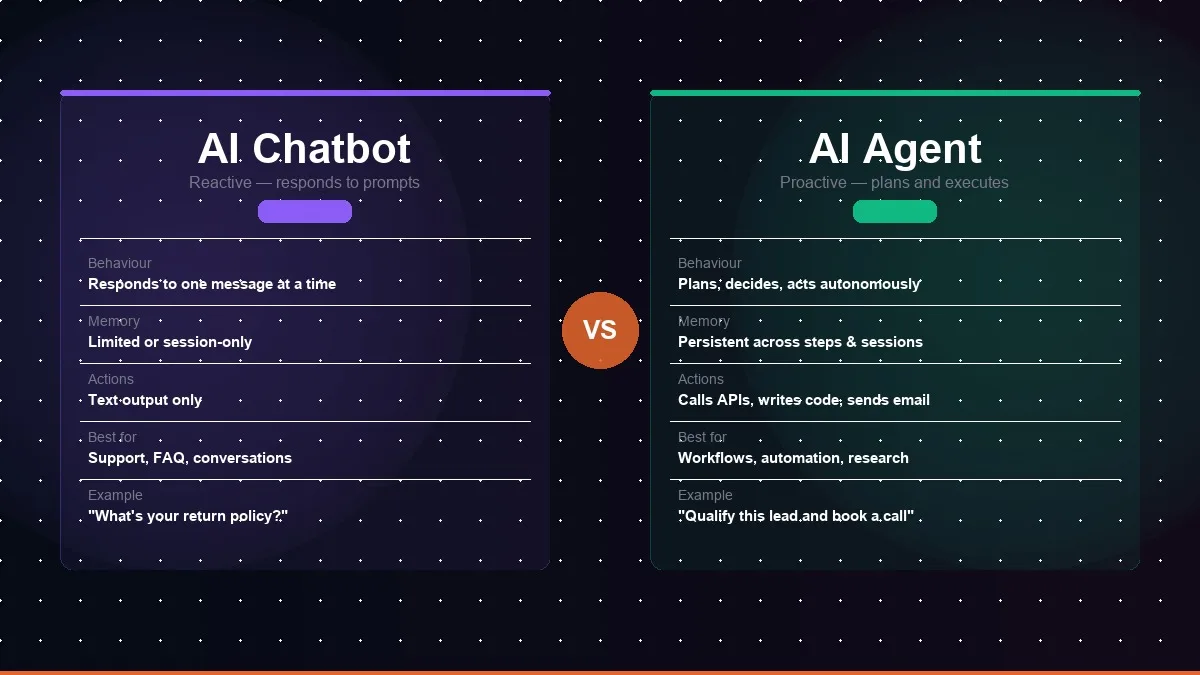
The terms "AI agent" and "AI chatbot" are used interchangeably in most business conversations, product pitches, and vendor decks. They are not the same thing. Confusing them leads to buying the wrong solution, scoping the wrong project, and setting the wrong expectations, all of which are expensive mistakes.
Here is a plain-English breakdown of what each one is, how they differ, and which your business is more likely to need.
Kovil AI · AI Engineering
We build production-grade AI agents and chatbots — not demos. From scoping to deployment.
What Is an AI Chatbot?
An AI chatbot is a conversational interface that uses a language model to respond to user input. The user says something; the chatbot replies. That is the core loop.
Modern AI chatbots, built on OpenAI GPT-4o, Anthropic Claude 3.5 Sonnet, Google Gemini 1.5 Pro, or similar frontier models, are significantly more capable than the rule-based bots of five years ago. They understand natural language, handle follow-up questions, maintain context within a conversation, and can be grounded in your specific knowledge base through retrieval-augmented generation (RAG).
What chatbots do not do is take independent action in the world. They respond. They inform. They answer. The user is always the one who decides what to do with that information.
Common chatbot use cases include customer support automation, internal FAQ tools, sales qualification, product recommendation, and employee onboarding assistants.
What Is an AI Agent?
An AI agent is a system that uses a language model not just to respond, but to plan and execute multi-step tasks autonomously. An agent is given a goal and a set of tools, the ability to search the web, query a database, send an email, call an API, write and run code, and it figures out the sequence of actions needed to achieve that goal.
The defining characteristic of an agent is action. It doesn't just tell you what to do; it does things. It can research a topic, draft a response, check your calendar, book a meeting, and send a confirmation email, all as part of a single prompted instruction from the user.
Agent frameworks like LangChain, LlamaIndex, and AutoGen, combined with OpenAI GPT-4o's function calling and Anthropic Claude 3.5's tool use API, have made agentic systems significantly easier to build reliably in the past 18 months.
What Is the Key Difference Between AI Agents and Chatbots?
The clearest way to understand the distinction is this:
- Chatbots respond. Agents act.
- Chatbots are reactive. Agents are goal-driven.
- Chatbots use the LLM to generate text. Agents use the LLM to make decisions about what to do next.
A chatbot answers the question "What are our return policy terms?" An agent, given the instruction "Process this return request," would look up the order, verify eligibility, initiate the refund, update the CRM, and email the customer a confirmation, without a human in the loop.
This is not a small difference. It is a fundamental architectural difference that changes what the system can do, how complex it is to build, what it costs to run, and what the failure modes look like.
| Feature | AI Chatbot | AI Agent |
|---|---|---|
| Primary function | Respond to user input | Complete multi-step tasks autonomously |
| Decision-making | None, responds to prompts | Plans and sequences actions toward a goal |
| Tool access | None (text output only) | APIs, databases, web, email, code execution |
| Build complexity | 2–4 weeks | 4–12 weeks |
| Inference cost | Low (1 LLM call per turn) | Higher (multiple LLM calls per task) |
| Best for | Q&A, support, qualification | Workflow automation, process execution |
Which Does Your Business Actually Need?
The answer depends on what job you are trying to get done.
Choose a chatbot if:
- You need to answer questions, from customers, employees, or prospects, at scale and without human intervention.
- The interaction is mostly one-directional: user asks, system answers.
- You want to reduce inbound support volume or improve response time on common queries.
- Speed of deployment and simplicity of maintenance matter more than autonomous capability.
Choose an AI agent if:
- You need to automate a multi-step workflow, not just answer a question.
- The task requires accessing multiple systems, APIs, or data sources in sequence.
- You want to reduce the human time spent on a repeatable process, not just the communication around it.
- You are comfortable with the higher complexity, cost, and testing requirements that agentic systems carry.
Many businesses end up needing both, a chatbot as the front-end conversational interface, and agents handling the back-end workflows that the chatbot triggers. A customer service chatbot that can answer questions is useful. A customer service chatbot that can also trigger a return, escalate a ticket, check inventory, and schedule a callback, because it is backed by agents, is transformative.
How Much Do AI Agents Cost to Build Compared to Chatbots?
Chatbots are significantly faster and cheaper to build and maintain. A well-scoped customer support chatbot grounded in your documentation can be built in two to four weeks by an experienced AI engineer. The ongoing costs are primarily vector database hosting, LLM API calls, and occasional knowledge base updates.
AI agents are more complex. They require careful tool design (every tool the agent can use must be explicitly defined and tested), robust error handling (agents fail in more interesting ways than chatbots), thorough evaluation (agentic failures are harder to detect automatically), and more expensive inference (more LLM calls per task). A production-grade AI agent for a business workflow typically takes four to twelve weeks to build properly, depending on the number of tools and integrations required.
The cost is justified when the workflow being automated is high-volume, high-value, or both. Automating a workflow that currently takes a human 30 minutes per instance, at 200 instances per month, has a clear ROI calculation. Automating a workflow that happens twice a month does not.
How Do You Get Started?
Start by mapping the specific job you want AI to do. Is the job primarily communicating information to people? That is a chatbot problem. Is the job completing a multi-step process that currently requires human judgment and action at each step? That is an agent problem.
If you are not sure which applies to your use case, or if you have a workflow that combines both, talk to us. We scope AI projects in 48 hours and tell you exactly what to build, how long it will take, and what it will cost, before you commit to anything. Our Outcome-Based AI Project engagement is designed for exactly this kind of scoped build, whether it ends up being a chatbot, an agent, or a combination of both.
Key Takeaway
Chatbots and AI agents are not competing technologies, they solve different problems. Chatbots handle communication at scale. Agents handle execution at scale. Most mature AI implementations use both: a chatbot as the front-end interface, backed by agents that carry out the actions the conversation triggers. The right starting point is always the specific job you need AI to do, not the technology label.
Related Services
Frequently Asked Questions
What is the difference between an AI agent and an AI chatbot?
An AI chatbot responds to user input by generating text, it answers questions, provides information, and holds conversations. An AI agent takes autonomous action to complete multi-step tasks using tools like web search, database queries, and API calls. Chatbots respond; agents act.
Which is better for my business, an AI agent or a chatbot?
It depends on the job. If you need to answer questions at scale, customer support, FAQ automation, sales qualification, a chatbot is the right tool. If you need to automate a multi-step workflow that currently requires human action at each step, an AI agent is the right tool. Many businesses end up needing both.
How much does it cost to build an AI agent?
A production-grade AI agent for a business workflow typically takes four to twelve weeks to build properly, depending on the number of tools and integrations required. An AI chatbot grounded in your documentation can usually be built in two to four weeks. Agents have higher ongoing inference costs because each task requires multiple LLM calls.
What can AI agents do that chatbots cannot?
AI agents can take independent action in the world, they can search the web, query databases, call APIs, send emails, book calendar appointments, and execute code. A chatbot can tell you how to do something; an agent can do it for you.
Can AI agents replace human workers?
AI agents can automate specific repeatable workflows that previously required human action at each step, but they are not general replacements for human workers. They excel at high-volume, rules-based, multi-step processes with clear success criteria. Tasks requiring judgment, relationship management, creative problem-solving, or accountability in novel situations still require humans. The practical outcome for most businesses is that AI agents handle repetitive process work, freeing human staff to focus on higher-value tasks.
Kovil AI · AI Engineering
Ready to deploy an AI agent or chatbot for your business?
We build production-grade AI agents and chatbots — not demos. From scoping to deployment, our engineers handle the full build and make sure it works in the real world.