AI Model Drift: What It Is, How to Detect It Early, and How to Fix It
Production AI systems degrade silently. Model drift — the gradual decline in accuracy, relevance, or reliability — is the most underappreciated production AI problem. Here's how to detect it early, diagnose the type, and remediate it before it breaks your business.
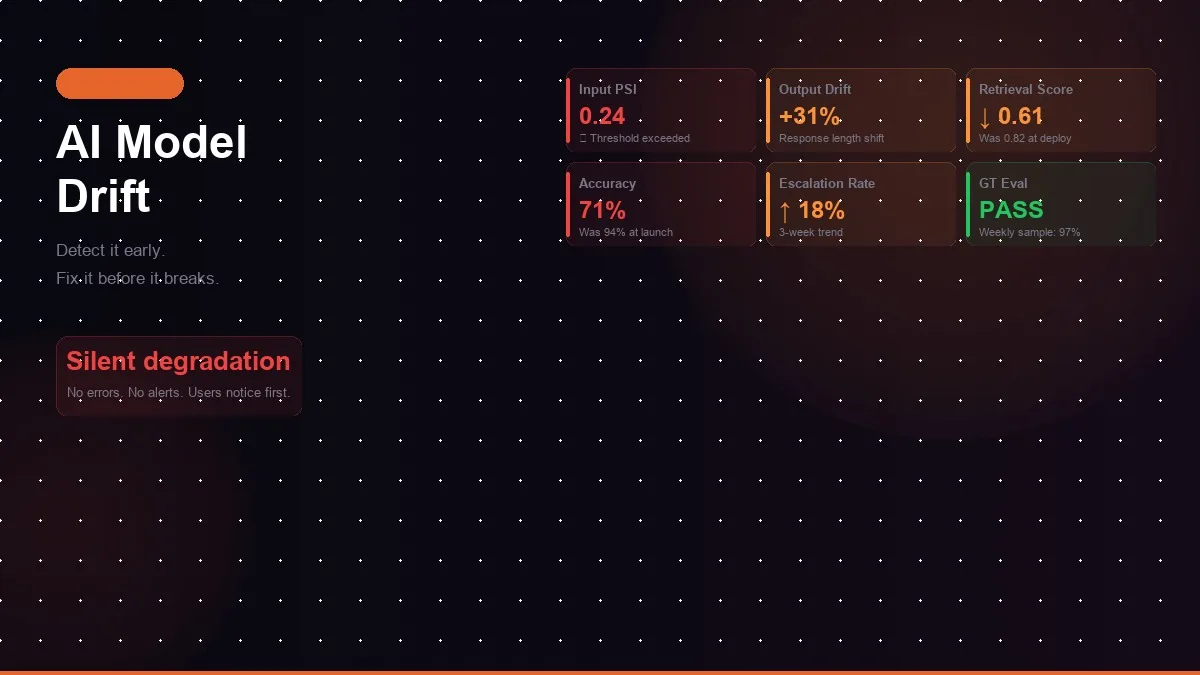
You deploy an AI system and it performs well. Six weeks later, users are complaining. The model is still running, still returning responses, but the quality is measurably worse. No error logs. No deployment failure. No obvious cause. This is AI model drift — and it is the most underappreciated production AI problem teams encounter after a successful launch.
Most engineering teams do not think about drift until they are in the middle of it. By then, weeks or months of degraded user experience have already accumulated, the gap between current and required performance is large, and the remediation is expensive. This guide gives you the framework to prevent that: what drift is, why LLM drift is fundamentally different from classical ML drift, the five warning signs to watch for, how to measure it, and a concrete remediation playbook. For broader operational context, see the complete guide to AI Operations and the production AI agent build guide.
Kovil AI · AI Operations
We detect and remediate AI model drift as part of our managed Operate tier — starting $8k/mo.
What Model Drift Actually Is
AI model drift is the degradation of a deployed model's performance over time due to changes in the statistical relationship between real-world inputs and the correct outputs. The model was optimised for one data distribution; when that distribution shifts, its predictions become less accurate, less relevant, or less reliable — without any change to the model itself.
Drift is not a bug. The model is functioning exactly as designed. The problem is that "exactly as designed" is no longer right for the environment it is now operating in. In traditional software, a function that worked six months ago still works today — the code has not changed. In AI, a model that was accurate six months ago may not be accurate today, because the inputs have changed, the correct answers have changed, or the language users employ has evolved.
There are three primary drift types you need to understand:
Data Drift (Covariate Drift)
The statistical distribution of input features changes. The model is predicting the same thing, but the inputs it receives now look different from its training data. Example: a churn prediction model trained when your typical customer was a mid-size SaaS company is now being applied to enterprise accounts — the feature distributions are entirely different. Detection uses statistical tests: Population Stability Index (PSI), Kolmogorov-Smirnov test, Jensen-Shannon divergence.
Concept Drift
The relationship between inputs and correct outputs changes. The same inputs now have different correct answers than at training time. Example: a fraud detection model trained on 2023 transaction patterns — fraudsters have adapted, and the same input patterns now map to different fraud labels. Concept drift requires ground truth to detect: human-verified labels on a sample of production outputs compared against model predictions.
Output Drift (Prediction Drift)
The model's output distribution shifts regardless of whether the underlying data or concept has changed. This is the most common drift type in LLM-based systems. A prompt template that produced consistent, structured outputs at launch starts producing longer, less structured outputs after a provider model update. Detection: monitor output statistics — response length, structure conformance, refusal rate, confidence score distribution.
Why LLM Drift Is Different From Classical ML Drift
Traditional ML drift monitoring was designed for structured models — classification and regression on tabular data. The field of MLOps built its tooling around this paradigm: track feature distributions, monitor prediction distributions, trigger retraining when PSI exceeds a threshold. This works well for a churn model or a demand forecasting model. It does not work well for LLM-based systems, and applying classical ML monitoring to LLM systems is one of the most common operational mistakes we see.
LLM systems have drift failure modes that simply do not exist in classical ML:
Provider-induced drift
OpenAI, Anthropic, and Google update their hosted models continuously. The same API endpoint — same model version string — can produce measurably different outputs month-over-month as providers push silent updates. A prompt that reliably produced structured JSON in January may occasionally produce malformed output in June, not because your code changed but because the underlying model did. Classical ML monitoring has no concept of an external vendor changing your model without notice. LLM monitoring must account for it.
Mitigation: pin to specific model versions in production and treat provider model upgrades as deployments — staged, tested, with rollback capability.
Prompt template erosion
LLM behaviour is partially determined by prompt templates. As teams accumulate edge cases and apply incremental prompt engineering fixes, templates become bloated, contradictory, and progressively less effective. The model's behaviour degrades not because the model changed but because the instructions it receives have gradually degraded in quality. This is a form of drift that has no classical ML equivalent.
Mitigation: version-control prompt templates like code. Run structured regression tests on every template change. Never allow ad-hoc prompt edits in production.
Retrieval degradation in RAG systems
In production RAG pipelines, the quality of the model's outputs depends on retrieval quality — if the vector index is returning less relevant context, the model's answers degrade even though the model itself is unchanged. This degradation can come from a stale index (new content added without re-indexing), embedding model updates (the new embedding model produces vectors that do not align well with the existing index), or index fragmentation over time.
Mitigation: monitor retrieval quality scores separately from generation quality. Schedule regular index refreshes. Treat embedding model upgrades as requiring full re-indexing.
Semantic input shift
Classical ML detects input drift using statistical tests on structured features. LLM systems receive free-text inputs. The vocabulary, intent distribution, and complexity of user queries shift over time — a customer support LLM trained when your product was a simple MVP receives very different queries after two years of feature expansion. Statistical tests on token counts or n-gram distributions are proxies for this shift, but they are imprecise. Semantic similarity monitoring — comparing recent query embeddings against a training-time baseline — is more reliable but requires additional infrastructure.
The 5 Warning Signs Your AI Model Is Drifting
Most teams detect drift through user complaints — which means detection is already weeks or months late. These five signals allow earlier detection without waiting for a business-critical failure:
1. Rising escalation rate
For customer-facing AI systems (chatbots, support agents, document classifiers), track how often the AI's output is escalated to a human or manually overridden. A steady rise in escalation rate is one of the earliest indicators that the model is producing outputs users or downstream systems no longer trust. It often precedes a visible accuracy decline by weeks.
2. Output distribution shift
Track the statistical distribution of model outputs over time. For classifiers: is the model predicting class A significantly more or less than at launch? For generative systems: is average response length trending up or down? Is the refusal rate increasing? A 20–30% shift in any output distribution metric without a corresponding change in the deployment is a signal worth investigating.
3. Input embedding drift
Compute embeddings for a sample of recent production inputs and compare their distribution against a sample from the training period using centroid distance or distribution divergence. A growing semantic distance between current inputs and training-time inputs indicates the model is being asked questions it was not designed to answer — a leading indicator of accuracy degradation.
4. Retrieval quality decline (RAG systems)
In RAG pipelines, monitor retrieval quality separately: track the average similarity score of the top-k retrieved chunks against the user query. A declining average similarity score means the retrieval layer is returning less relevant context — which degrades generation quality downstream, even when the generation model itself is unchanged. This is often the first measurable signal of RAG system drift.
5. Ground truth accuracy drop
The definitive signal: sample 1–2% of production outputs weekly and evaluate them against verified correct answers (human labels or LLM-as-judge). A measurable accuracy drop versus the deployment-time baseline is confirmation of concept drift. By the time this signal appears, drift has usually been accumulating for weeks — but it is the cleanest signal for triggering a remediation response.
How to Measure Drift: Metrics, Baselines, and Evaluation Frameworks
Drift measurement requires establishing baselines at deployment time and comparing production metrics against them on a defined cadence. The specific metrics depend on the system type:
| System Type | Input Metrics | Output Metrics | Ground Truth Metric |
|---|---|---|---|
| Classifier (structured) | PSI per feature | Class distribution, confidence scores | Accuracy, F1 |
| LLM chatbot | Query embedding drift, token length | Response length, refusal rate, escalation rate | LLM-as-judge correctness score |
| RAG pipeline | Query embedding drift | Retrieval similarity score, citation rate | Faithfulness score, answer relevance |
| Document classifier | Document length, vocabulary shift | Class distribution, confidence | Precision, recall per class |
For LLM evaluation, the LLM-as-judge pattern — using a capable model (GPT-4o or Claude Sonnet) to score production outputs against defined criteria — is now the standard approach for scalable ground truth evaluation. It is not perfect but is measurably better than no ground truth evaluation and far cheaper than human labelling at scale.
Root Cause Analysis: What Causes Drift in Production RAG Systems
RAG systems warrant specific attention because they have more drift failure modes than simpler model architectures. A RAG pipeline has three independently driftable components — the retrieval layer, the embedding layer, and the generation layer — and drift in any one of them degrades the end-to-end output quality.
Stale knowledge index
The most common RAG drift cause. The vector index was built on a knowledge base snapshot at a point in time. As the underlying knowledge base grows and changes — new product documentation, updated policies, new regulatory guidance — the index no longer reflects current knowledge. Queries that should surface recent content return stale results or return nothing. The generation model produces confidently wrong answers based on outdated retrieved context.
Root cause signal: retrieval similarity scores declining; users reporting outdated information; specific query categories suddenly performing worse.
Fix: implement automated re-indexing on a defined schedule (daily or weekly, depending on knowledge base update frequency). For high-velocity knowledge bases, implement incremental indexing — new and updated documents are re-embedded and re-indexed within hours of upload.
Embedding model version mismatch
When an embedding model is updated by the provider — or when you intentionally upgrade to a better embedding model — the new model produces vectors that occupy a different geometric space than the old model's vectors. If the index was built with the old model but queries are now embedded with the new model, the similarity search is comparing vectors from different spaces. Retrieval quality collapses, often dramatically.
Root cause signal: sudden, large drop in retrieval similarity scores coinciding with an embedding model version change.
Fix: full re-indexing with the new embedding model before any production traffic switches to the new embedding model. Always treat embedding model upgrades as requiring a full re-index — there is no partial fix.
Query distribution shift
Users start asking questions that fall outside the topical coverage of the knowledge base. The index may be fresh and accurate, but it does not contain relevant content for the new query types. This appears as high retrieval similarity scores (the retriever is doing its best) combined with low generation quality (there is no good answer in the retrieved context).
Root cause signal: high retrieval scores but low LLM-as-judge correctness scores on a specific query category; users flagging a specific class of questions as unhelpful.
Fix: expand knowledge base coverage to include the missing topic area. This is a knowledge gap, not a technical drift — but it manifests as performance degradation from the user's perspective.
Remediation Playbook
Once drift is confirmed, the correct remediation depends on the root cause.
Retrieval index refresh
Applicable when: stale index, embedding model mismatch, or significant knowledge base expansion.
- Audit current index coverage against the current knowledge base — identify which documents are missing or outdated.
- Re-embed all documents using the current embedding model version.
- Build the new index in a staging environment and run retrieval quality benchmarks against a test set of known queries.
- Run the new index in shadow mode alongside the production index for 24–48 hours, comparing retrieval quality metrics.
- Promote the new index when shadow quality exceeds production quality on benchmark queries.
Timeline: hours to days depending on knowledge base size. For large enterprise knowledge bases (100k+ documents), incremental indexing infrastructure is worth building to avoid full re-index latency.
Prompt tuning
Applicable when: output format has shifted, refusal rate has increased, or provider model update has changed behaviour.
- Collect a representative sample of recent low-quality outputs.
- Identify the pattern — are outputs too long? Missing required structure? Refusing valid queries?
- Edit the prompt template in a staging environment. Treat the edit as a code change — version it, review it, test it.
- Run the updated template against your regression test set (a fixed set of queries with known good responses).
- If the updated template passes regression, deploy with monitoring. Watch the affected output metrics for 24–48 hours post-deploy.
Timeline: hours to days. Prompt tuning is the fastest remediation available for LLM systems — but it only works for output drift caused by prompt-addressable issues. It cannot fix knowledge gaps or retrieval failures.
Fine-tuning triggers
Fine-tuning is the most expensive remediation and should only be triggered when prompt tuning and retrieval improvements have been exhausted. Triggers that justify fine-tuning:
- Consistent output format failures that cannot be reliably fixed by prompt engineering (the model ignores the format instruction at a rate that remains above ~5% after prompt tuning).
- Domain vocabulary failure — the base model consistently misunderstands or mislabels domain-specific terminology that has emerged since the original training.
- Latency constraints that require a smaller, faster model to replace a larger model on a high-volume endpoint.
Before committing to fine-tuning, validate that the performance gap is actually large enough to justify the cost. Run an A/B comparison: prompt-tuned current model vs. a fine-tuned candidate on a production traffic sample. If the fine-tuned candidate does not meaningfully outperform the prompt-tuned model on your primary metric, the fine-tuning investment is not justified.
Building a Drift Detection System
A production-grade drift monitoring system requires five components:
- Data logging pipeline. Every input-output pair is logged with a timestamp. This is the non-negotiable foundation — you cannot monitor what you have not logged. Ensure PII is handled appropriately in the logging pipeline.
- Baseline statistics. At deployment, capture the statistical profile of your training data and first-30-days production inputs. This is the benchmark everything future is compared against. Baselines should be versioned alongside your model versions.
- Continuous statistical monitoring. Automated jobs on a defined cadence (hourly or daily) running statistical tests on recent input and output distributions against the baseline. PSI is the standard metric for structured inputs; embedding distance for unstructured inputs.
- Alerting thresholds. PSI > 0.1 triggers a warning; PSI > 0.2 triggers an action-required alert. These thresholds should be calibrated during the first 30 days in production — some systems have naturally higher input variance and need higher thresholds to avoid alert fatigue.
- Ground truth evaluation pipeline. A process — automated LLM-as-judge or human review — that produces accuracy scores on a sample of production data on a regular cadence. Weekly is the minimum viable frequency; daily is appropriate for high-stakes or high-velocity systems.
Infrastructure options: Evidently AI, WhyLabs, Arize, and Fiddler provide managed drift monitoring platforms. Cloud-native options include Vertex AI Model Monitoring, AWS SageMaker Model Monitor, and Azure ML data drift detection. The right choice depends on where your model is deployed and whether you want to own the monitoring infrastructure or buy it as a service.
Kovil AI · Operate Tier
We detect and remediate AI drift as part of our Operate tier — starting $8k/mo
Full drift monitoring setup, alerting, ground truth evaluation, and remediation runbooks — managed by Kovil AI engineers. If you have a production AI system and no monitoring, our free audit identifies where your performance gaps are and what is causing them.
Where to Start
If you have an AI system in production with no drift monitoring: start with output monitoring. It requires no labels, can be set up in days, and provides the first line of early warning for all four drift types. Add input statistical monitoring next — PSI on structured features or embedding distance for LLM systems. Then build the ground truth evaluation pipeline targeting a 1–2% sample of production volume reviewed weekly.
If you are building a new system: design monitoring into the architecture from day one. Capture your baseline metrics at deployment, set alert thresholds, and treat the first 30 days in production as calibration for those thresholds. Drift will come. The question is whether you detect it in days or months.
For the complete picture of how drift monitoring fits within a full AI Operations practice, see What Is AI Operations? — and for the specific challenges of keeping a production RAG system accurate over time, see the guide to building a production RAG pipeline.
Related Services
Frequently Asked Questions
What is AI model drift?
AI model drift is the gradual decline in a deployed model's performance over time. It happens because the real-world data the model encounters in production diverges from the data it was trained on. The model was optimised for one distribution of inputs; when that distribution shifts, its accuracy, relevance, or reliability degrades — often silently, without any error logs or alerts.
What are the main types of AI model drift?
The four main types are: data drift (the statistical distribution of input features changes), concept drift (the relationship between inputs and correct outputs changes), label drift (the distribution of output classes changes), and prediction drift (the model's output distribution shifts regardless of whether inputs changed). Each requires a different detection and remediation strategy.
How do you detect AI model drift in production?
Detection requires a combination of output monitoring (tracking the distribution of model predictions over time), input monitoring (statistical tests like PSI or KS-test on input features), and ground truth comparison (comparing model outputs against human-verified labels on a sample of production data). Shadow deployments — running a retrained model alongside the current model — are also used to detect when retraining has improved performance sufficiently to justify a swap.
How do you fix AI model drift?
Remediation depends on the drift type. Data drift is addressed by retraining on a dataset that includes recent production examples. Concept drift requires new labelled examples that reflect the new input-output relationship. Prompt drift in LLM systems is fixed by updating prompt templates and retrieval configurations. Embedding drift requires re-indexing the vector store with an updated embedding model. Most production systems implement automated retraining pipelines triggered when drift metrics cross defined thresholds.
How often should you monitor AI models for drift?
Monitoring frequency depends on how quickly your data environment changes. High-velocity environments (e-commerce, financial markets, customer support) warrant daily monitoring. Stable enterprise environments may need only weekly checks. At minimum, any model in production should be evaluated against a sample of ground truth labels on a regular cadence — monthly at the absolute minimum — and have statistical input monitoring running continuously.
Kovil AI · AI Operations
Is your production AI system drifting?
Most teams don't know their model is drifting until users complain. Kovil AI's Operate tier includes full drift monitoring, alerting, ground truth evaluation, and remediation — managed by our engineers. Start with a free AI audit.