Fixed-Price vs Time-and-Materials for AI Projects: How to Choose
Fixed-price and time-and-materials are the two dominant contract models for AI development. Neither is always right. Here's how to think through the choice for your specific project.
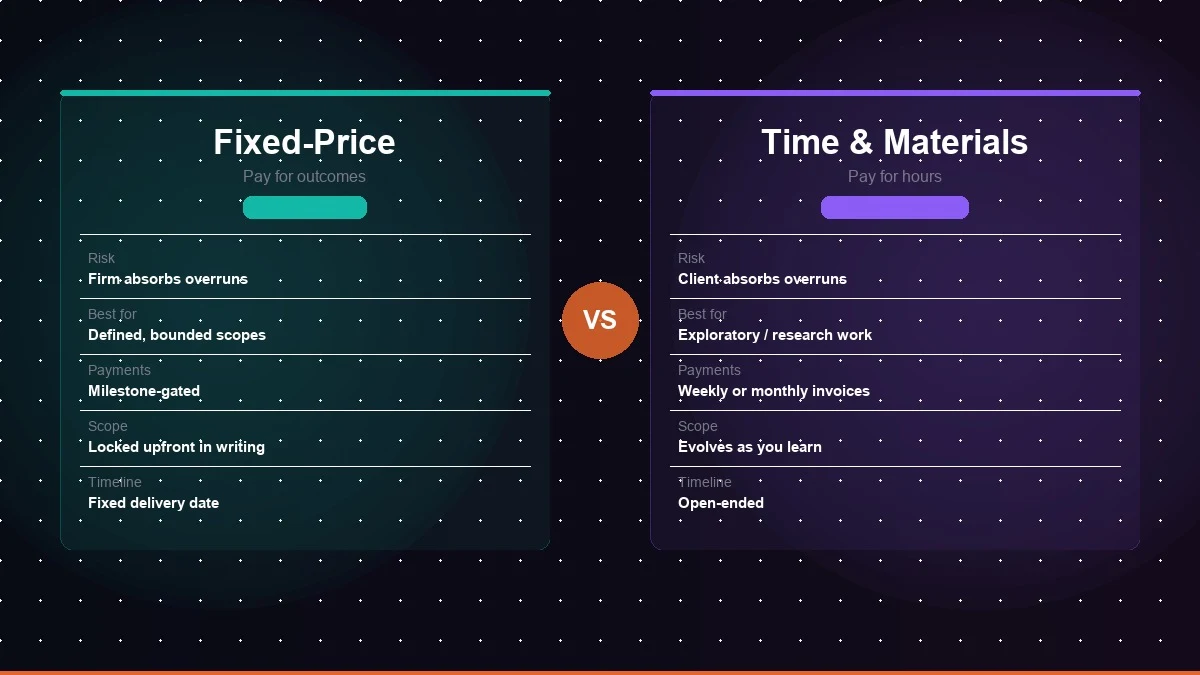
The choice between fixed-price and time-and-materials (T&M) is one of the most consequential decisions you make at the start of an AI project. Each model allocates risk differently. Each creates different incentives for the engineering team. And for AI projects specifically, where scope can be genuinely hard to define upfront, getting this decision wrong creates expensive problems that compound over months.
This guide explains both models clearly, describes when each is appropriate for AI projects, covers the hybrid approaches that sophisticated engineering firms use, and gives you a decision framework you can apply to your specific situation.
Kovil AI
We build AI-powered software for businesses — from automations to full product builds.
Fixed-Price: The Core Mechanics
In a fixed-price engagement, the scope is defined upfront and the price is set before work begins. Payment is tied to milestone deliverables, not to hours worked. If the project takes longer than estimated, the firm absorbs the extra cost. If it takes less time, they keep the margin.
Fixed-price creates a specific incentive structure: the engineering firm is motivated to deliver the agreed scope efficiently, since overruns come out of their margin. This aligns incentives well when the scope is genuinely fixed, since both parties benefit from efficient delivery.
Fixed-price works when: You can specify the input data, the expected output, the evaluation criteria, and the system integrations in writing before any code is written. If you cannot write those specifications, the scope is not ready for fixed-price.
What Makes an AI Project Scope Fixable
Not all AI projects can be fixed-price, and attempting to fix-price an undefined scope creates adversarial dynamics that serve neither party. An AI project scope is fixable when:
- Input data is defined: The document corpus, database, API feeds, or other data sources the AI system will use are known, accessible, and representative of production data.
- Output is specified: What the system produces, and in what format, is agreed before build begins. A RAG system that produces answers with source attribution is a defined output. "A smarter AI" is not.
- Success criteria are measurable: Both parties agree on how the system will be evaluated. "85% relevance accuracy on the benchmark query set we define in week one" is measurable. "Works well" is not.
- Integrations are scoped: All upstream and downstream system integrations are identified and their APIs are accessible for development.
- Non-functional requirements are stated: Latency targets, throughput, availability, and data privacy constraints are documented upfront.
Fixed-Price Examples That Work Well for AI
These project types are well-suited to fixed-price AI engagements:
- A RAG pipeline over a defined document corpus (support articles, internal documentation, product manuals)
- A document extraction and classification system for a known document type (invoices, contracts, medical records)
- An AI agent with defined tools, a defined task scope, and clear evaluation criteria
- A customer-facing chatbot with a defined knowledge base and measurable deflection target
- An LLM integration into an existing product workflow with agreed input/output specifications
Time-and-Materials: The Core Mechanics
In a time-and-materials engagement, you pay for engineering time at an agreed rate. Hours are logged and invoiced periodically, typically weekly or monthly. Scope evolves as the project progresses. The engineering firm delivers what they can in the agreed time. The risk of scope expansion sits with you as the client.
T&M creates a different incentive structure: the firm is motivated to provide good engineers and bill accurately, but has less direct financial incentive to complete work on time. This makes T&M more appropriate when you have strong internal project management and technical oversight.
T&M works when: The problem is exploratory, the solution approach is uncertain, the scope genuinely cannot be defined upfront, or you need maximum flexibility to redirect the engineering team based on what you learn.
When T&M Is the Right Choice for AI Projects
During exploratory and research phases
When you are investigating which AI approach is right for your use case, whether RAG or fine-tuning, which model performs best on your data, or what the right evaluation methodology is, the scope is inherently uncertain. Time-boxing this work (a fixed number of weeks with a defined output, such as an architecture recommendation) on T&M is more appropriate than attempting to fix-price research that by definition produces unexpected results.
For ongoing AI operations
Once an AI system is in production, the work of maintaining, evaluating, and improving it does not have natural fixed-price units. Monitoring output quality, updating the knowledge base, fine-tuning prompts, adding new capabilities in response to user feedback: this is ongoing operational work that suits a retainer or T&M model.
When requirements will change
If your product is early-stage and you expect requirements to shift significantly as you learn from users, T&M gives you the flexibility to redirect the engineering team without triggering change orders. The trade-off is cost unpredictability.
The Hybrid: Milestone-Gated Fixed-Price
The most sophisticated AI engineering firms use a milestone-gated approach that combines the predictability of fixed-price with the flexibility of T&M. The structure looks like this:
- Phase 1 (Discovery): Fixed-price, typically 1 to 2 weeks, produces a detailed technical specification, evaluation framework, and architecture recommendation. At the end of this phase, you review and decide whether to proceed.
- Phase 2 (Build): Fixed-price per milestone, with each milestone producing a specific agreed deliverable. You hold approval rights at each gate. If you want to change scope, a change order is issued for the next phase.
- Phase 3 (Launch and iterate): Moves to T&M or a retainer for ongoing operations, where the work is continuous and a fixed-price model is no longer appropriate.
This structure gives you the most important benefits of fixed-price (cost predictability, clear deliverables, aligned incentives) while preserving flexibility at the transition points between phases.
Side-by-Side: Fixed-Price vs T&M vs Milestone-Gated
| Dimension | Fixed-Price | Time & Materials | Milestone-Gated |
|---|---|---|---|
| Cost risk holder | Firm | Client | Firm (per phase) |
| Cost predictability | High | Low | High per phase |
| Scope flexibility | Low | High | Medium (at gates) |
| Best for | Defined scope, measurable output | Exploratory, ongoing work | Most AI product builds |
| Incentive alignment | Strong (firm absorbs overruns) | Weak (firm benefits from overruns) | Strong per milestone |
How to Protect Yourself in Either Model
In fixed-price contracts
- Require a detailed technical specification before work begins, not after
- Define evaluation criteria and acceptance tests before the build phase
- Agree on change order thresholds and processes in the contract
- Include an IP assignment clause that transfers all rights to you from day one
In time-and-materials contracts
- Require weekly or biweekly progress reports with hours logged by task
- Define a budget ceiling that triggers a conversation before you exceed it
- Maintain the right to review and approve scope additions before they are billed
- Set clear review checkpoints where you can pause, redirect, or stop the engagement
Making the Decision
The clearest decision rule for AI projects: if you can write down what done looks like before the project starts, and both parties agree on how it will be evaluated, fixed-price is appropriate. If you cannot, use T&M or a time-boxed discovery phase first.
For the majority of well-scoped AI product builds (RAG systems, document automation, AI agents with defined tools and tasks), milestone-gated fixed-price is the strongest model. It protects you on cost, creates aligned incentives, and gives you real flexibility at the transition points that matter.
For more on AI project contract structures, see Staff Augmentation vs Outsourcing. For teams evaluating staff augmentation as an alternative to project delivery, see What Is AI Staff Augmentation?.
Frequently Asked Questions
What is a fixed-price AI project?
A fixed-price project has a defined scope, a defined price, and milestone-gated payment. You pay for outcomes, not hours. The risk of cost overruns sits with the engineering firm, not the client. For fixed-price to work, both parties must agree in writing on what done looks like before any code is written.
What is time-and-materials for AI development?
Time-and-materials (T&M) means you pay for engineering hours at an agreed rate, typically hourly or daily. Scope can evolve as the project progresses and you learn more. The risk of cost overruns sits with the client, since the firm bills for actual time spent regardless of scope changes.
Which contract model is better for AI projects?
Fixed-price works well for bounded, well-defined scopes where the output is measurable, for example a RAG pipeline over a specific document corpus with agreed accuracy benchmarks. T&M works better for research-heavy AI work, exploratory phases, or ongoing operations where scope is genuinely unclear upfront.
Can you do a hybrid of fixed-price and time-and-materials?
Yes. Milestone-gated pricing is a common hybrid: each phase is fixed-price with an agreed deliverable, but scope can be redefined at each milestone gate. This gives you the cost predictability of fixed-price within a phase and the flexibility to change direction between phases.
What happens if an AI project goes over scope on a fixed-price contract?
In a fixed-price contract, the firm absorbs cost overruns that result from their own estimation errors or execution issues. If you change the scope, that triggers a change order with a revised price. Well-structured fixed-price contracts have clear change order processes defined upfront to avoid disputes.
Is fixed-price right for exploratory AI research?
No. Exploratory AI research and proof-of-concept work is inherently uncertain in scope and effort. Attempting to fix-price research work forces both parties to either over-pad estimates or cut corners when reality exceeds estimates. Use T&M or a time-boxed exploration phase with a clear output (a technical specification or architecture recommendation) rather than a fully built system.
How do I write a scope that is detailed enough for a fixed-price AI contract?
A fixable scope for an AI project specifies: the input data (what, how much, in what format), the output (what the system produces), the evaluation criteria (how success is measured), the integrations required (what existing systems it connects to), and the non-functional requirements (latency, availability, throughput). If you cannot specify these, the scope is not ready to be fixed-price.
What is outcome-based pricing for AI development?
Outcome-based pricing ties payment to a measurable business result rather than to a technical deliverable. For example, you might pay based on the percentage of support tickets successfully deflected by an AI system rather than for the system itself. This is appropriate when the business outcome is clear and measurable, and both parties are confident in the causal link between the system and the outcome.
Kovil AI
Looking to bring AI into your business?
Whether you need a custom AI build, workflow automation, or a fast MVP — our engineers have done it across industries. Let's talk about what you're trying to solve.