Staff Augmentation vs Outsourcing: Which Is Right for Your AI Project?
Staff augmentation and outsourcing both give you external engineering capability, but they work very differently. Here's a clear breakdown of when to use each model for AI projects.
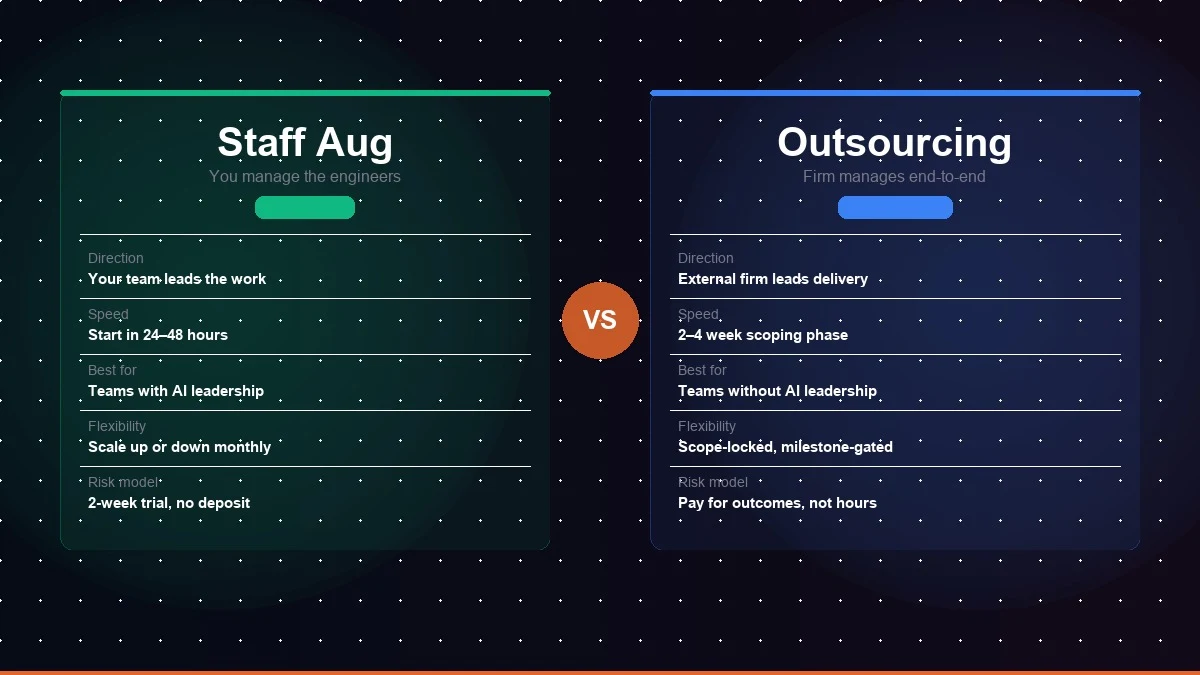
Staff augmentation and outsourcing are two fundamentally different ways to bring external engineering capability into your organisation. Both are legitimate. Neither is universally better. The right choice depends on what you need, specifically how much internal AI expertise you have and how much you want to own the direction of the work.
For AI projects specifically, this decision is more consequential than for general software development. AI systems require constant architectural decisions about model selection, retrieval design, evaluation methodology, and production monitoring. Who makes those decisions, and when, determines a large part of your project outcome.
Kovil AI
We build AI-powered software for businesses — from automations to full product builds.
Staff Augmentation: What It Means in Practice
In staff augmentation, an external engineer or team of engineers joins your organisation and works under your direction. They attend your standups. They use your Jira, Slack, and GitHub. They take direction from your engineering lead or product manager. You are responsible for defining and prioritising the work. The external firm is responsible for the quality of the person they place.
The fundamental characteristic of staff augmentation is that management stays with you. The augmentation firm is a talent supplier, not a project manager. This model works extremely well when you have the internal AI expertise to direct the work and simply need more hands to execute it faster.
Staff aug in practice: Your lead AI engineer knows you need a RAG pipeline for a new product feature. They brief the augmentation firm, a senior AI engineer joins your team within 48 hours, and your lead directs their work through the sprint cycle. The augmentation firm handles the employment logistics. You handle the technical direction.
Outsourcing: What It Means in Practice
In project-based outsourcing, you hand a scope to a third party and they own the execution. They manage their own team, their own process, and their own timeline, with agreed milestone checkpoints where you review progress. You define what you want. They figure out how to build it.
A well-run outsourcing engagement for AI projects is milestone-gated: you pay for defined outcomes, not for hours worked. The external firm is accountable for delivery quality, not just for placing qualified people.
Outsourcing in practice: You need a document intelligence system for your legal team. You brief the engineering firm on the requirements. They own the architecture, build the system, and deliver it against defined milestones. You review at each milestone and accept or iterate. The AI architecture decisions are owned by their team.
Side-by-Side Comparison
| Dimension | Staff Augmentation | Outsourcing |
|---|---|---|
| Who manages the work | Your team | External firm |
| Architecture decisions | Your team owns them | External firm owns them |
| Payment model | Hourly or monthly rate | Fixed-price milestones or T&M |
| Cost predictability | Variable (depends on scope changes) | High (if fixed-price) |
| Speed to start | 24 to 48 hours | 2 to 4 week scoping phase |
| Scope flexibility | High, adjust daily | Lower, scope changes are formal |
| Knowledge retention | Your team learns as you go | Knowledge held by external team |
| Best for | Teams with internal AI direction | Teams without internal AI leadership |
The Key Question for AI Projects
For AI projects specifically, there is one question that determines which model is right: do you have an internal AI lead who can define and review architecture decisions on a daily or near-daily basis?
If yes, staff augmentation extends their capacity. The augmented engineer takes direction from your lead, executes against well-defined technical requirements, and produces work that your lead can review and validate.
If no, staff augmentation is risky. An AI engineer without direction will make architecture decisions by default. Those decisions may be reasonable from a general standpoint but wrong for your specific product context, data, and evaluation criteria. In this case, a managed project engagement where the external firm owns the AI architecture is far more likely to produce a good outcome.
When to Choose Staff Augmentation
Staff augmentation is the right model when:
- Your team includes at least one AI-experienced engineer who can direct the augmented person
- The work is well-defined at the technical level (the architecture is decided, execution capacity is what you need)
- You need to move faster than a hiring process allows
- The scope is likely to evolve and you want the flexibility to redirect week by week
- You want to retain knowledge and build internal AI capability over time
When to Choose Outsourcing (Managed Project Delivery)
Project-based outsourcing is the right model when:
- You do not have internal AI engineering leadership to direct daily work
- The scope is sufficiently defined that you can specify what done looks like upfront
- You want cost predictability more than you want flexibility
- You need to prove the concept before building internal AI capability
- The deliverable is bounded and can be handed over at completion
The Hybrid Pattern That Many Teams Use
Many AI projects begin with a managed phase and transition to augmentation. The pattern looks like this:
- Discovery and architecture (weeks 1 to 4): A fixed-price engagement where the external firm owns the architecture design and produces a technical specification and proof of concept. Your team reviews and approves.
- Build phase (months 2 to 5): The core system is built through a combination of the external firm's engineers and augmented engineers embedded in your team.
- Iteration and scale (months 6+): With the architecture established and your team now familiar with the system, you transition to staff augmentation for ongoing development, now directing augmented engineers against a well-defined architecture.
This hybrid pattern gives you the architecture ownership of a managed engagement early on, and the flexibility and speed of staff augmentation as the project matures.
Common Mistakes When Choosing Between the Two Models
Choosing staff aug without internal AI direction
The most common expensive mistake. A capable AI engineer placed into a team with no AI leadership will default to their own preferences. This is not the engineer's fault. Direction is your responsibility in a staff aug model. Without it, you get a technically competent engineer building in a direction that may not align with your product needs.
Outsourcing a scope that is not defined
Outsourcing works when the scope is clear. "Build AI for our business" cannot be outsourced effectively. "Build a RAG system over our 50,000 support ticket corpus that answers employee questions with source attribution and achieves 85% relevance accuracy on a defined benchmark" can be. The more ambiguous the scope, the higher the risk of an outsourced engagement going sideways.
Not requiring documentation in an outsourced engagement
One of the highest-risk outcomes from outsourcing AI systems is knowledge lock-in. If the external firm builds a system that your team cannot maintain or extend, you become permanently dependent on that firm. Require architecture documentation, decision logs, and handover materials as deliverables from the start.
Making the Decision
Use this decision framework:
- Do you have an internal AI lead? If yes, consider staff aug. If no, consider a managed project.
- Is the scope defined enough to specify done? If yes, fixed-price outsourcing is viable. If no, staff aug with clear sprint objectives is more appropriate.
- Is knowledge retention a priority? If yes, lean toward staff aug. If the goal is a one-time build, outsourcing is fine.
For more detail on the staff augmentation model, see What Is AI Staff Augmentation?. For teams considering a dedicated long-term team rather than project-based work, see What Is a Dedicated AI Team?. For information on the contract structures available for managed AI projects, see our guide on Fixed-Price vs Time-and-Materials for AI Projects.
Frequently Asked Questions
What is the difference between staff augmentation and outsourcing?
In staff augmentation, external engineers join your team and work under your direction. You manage the priorities, the architecture decisions, and the daily work. In outsourcing, you hand a project scope to a third party who manages it end-to-end and delivers an agreed result. Staff aug gives you control. Outsourcing gives you delegation.
Which is better for AI projects in 2026?
It depends on whether you have internal AI expertise to direct the work. If you have a CTO or lead AI engineer who can define and review AI architecture decisions, staff aug extends their capacity effectively. If you need the external firm to own all AI design and architecture decisions, a managed fixed-price project engagement is a better fit.
Can you switch between models mid-project?
Yes, and many teams do. A common pattern: start with a fixed-price discovery phase where the external firm owns the architecture and specification, then transition to staff aug once the architecture is defined and your internal team can direct ongoing development.
Is staff augmentation cheaper than outsourcing?
Not necessarily on a per-project basis. Staff aug rates are transparent (hourly or monthly) but total project cost depends on how efficiently your team directs the work. Outsourcing with fixed milestones can be more cost-predictable for defined scopes. For exploratory or R&D-heavy AI work, the flexibility of staff aug often ends up more cost-efficient.
What are the risks of outsourcing AI projects?
The main risks are: losing control of architectural decisions that affect your product long-term, knowledge loss when the engagement ends (the external team holds all context), and quality degradation if milestones are accepted without rigorous evaluation criteria. Mitigate these with detailed specifications, evaluation frameworks agreed upfront, and handover documentation requirements in the contract.
What are the risks of AI staff augmentation?
The main risks are: direction without sufficient AI expertise (augmented engineers need someone to direct them), knowledge concentration if documentation is not enforced, and coordination overhead if the augmented team is not well-integrated. Mitigate these by assigning a dedicated internal point of contact and requiring documentation from day one.
How do I know which model is right for my specific AI project?
Ask yourself: do I have an internal AI lead who can define and review architecture decisions daily? If yes, staff aug is likely the right model. If no, consider a managed project where the external firm owns AI architecture. The decision hinges on where internal AI expertise sits in your organisation.
Can I use both staff augmentation and outsourcing on the same project?
Yes. Many complex AI projects use a hybrid: a fixed-price engagement to build the core AI system, combined with staff augmented engineers to handle ongoing development, integration, and iteration. The two models address different phases of an AI project's lifecycle.
Kovil AI
Looking to bring AI into your business?
Whether you need a custom AI build, workflow automation, or a fast MVP — our engineers have done it across industries. Let's talk about what you're trying to solve.