What Is AI Staff Augmentation? (And When Should You Use It?)
AI staff augmentation places vetted AI engineers directly into your team on demand. Here's how it works, how it compares to hiring and outsourcing, and when it's the right model for your project.
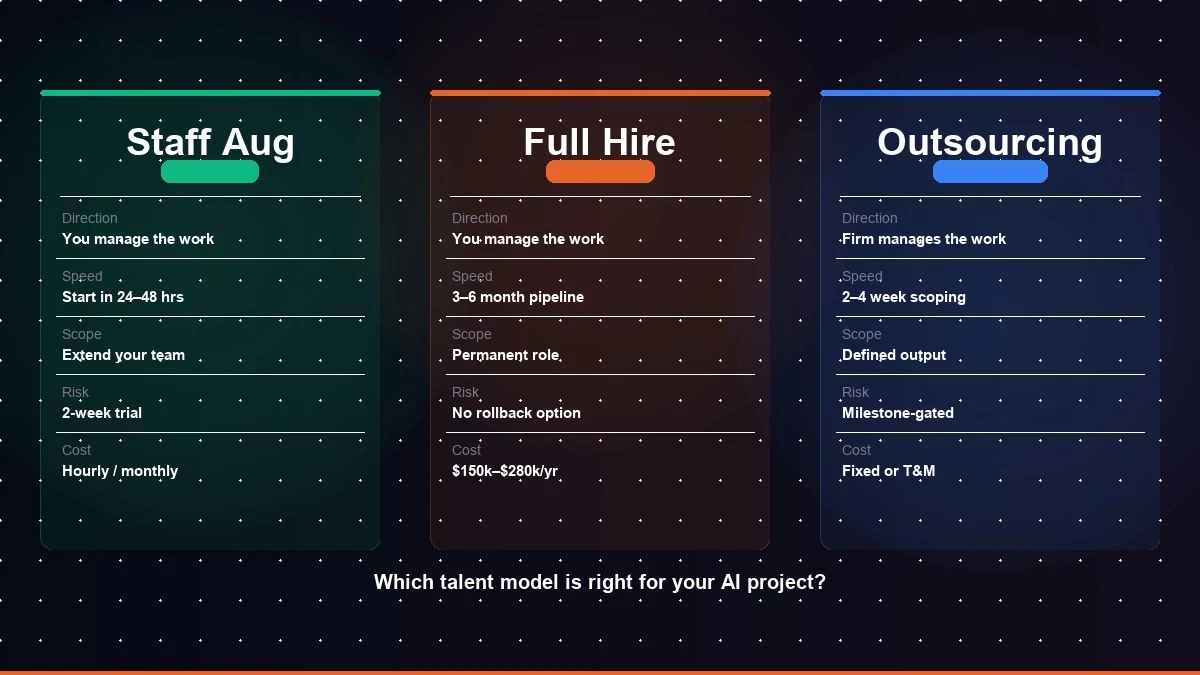
AI staff augmentation is a talent model where you extend your engineering team with external AI specialists without going through a full hiring process. The engineers work directly within your team, on your codebase, attending your standups, following your processes. They are managed by your team, not by the augmentation firm.
In 2026, AI staff augmentation has become a standard operating model for companies that need to build AI capabilities faster than the talent market allows. Full-time AI engineer hiring pipelines take 3 to 6 months on average. AI staff augmentation can place a vetted engineer in 24 to 48 hours. For competitive products, that speed difference is significant.
Kovil AI
We build AI-powered software for businesses — from automations to full product builds.
How AI Staff Augmentation Works
The process is straightforward once you understand it. Here is the typical sequence for an AI staff augmentation engagement:
- Brief: You describe your requirements to the augmentation firm: the AI domain (RAG, fine-tuning, agents, data pipelines), required tech stack, seniority level, and engagement duration.
- Match: The firm identifies candidates from their vetted pool. Strong providers match within 24 to 48 hours.
- Trial: You run a short trial period, typically 2 weeks. This is low-risk: you evaluate fit without committing to a long engagement.
- Embed: The engineer joins your Slack, GitHub, Jira, and any other tools your team uses. They attend your standups and code reviews. They take direction from your engineering lead.
- Extend or convert: At the end of the trial, you extend the engagement for as long as you need, or make a full-time offer if the fit is strong.
Key point: In staff augmentation, the augmentation firm is responsible for the quality of the engineer they place. You are responsible for the direction of the work. This is the defining feature of the model.
AI Staff Augmentation vs Full-Time Hiring
The question most teams face is not whether to augment or outsource but whether to augment or hire. Here is how the two models compare across the dimensions that matter most.
| Dimension | AI Staff Augmentation | Full-Time Hire |
|---|---|---|
| Time to start | 24 to 48 hours | 3 to 6 months |
| Commitment | Flexible, monthly or project-based | Permanent (difficult to unwind) |
| Recruiting overhead | None (firm handles it) | High (sourcing, interviews, offers) |
| Benefits overhead | None | 20 to 30% of salary |
| Hourly rate | Higher per hour | Lower per hour |
| Risk of bad hire | Low (trial period exits) | High (months to reverse) |
| Best for | Project-specific AI needs, 6 to 18 months | Long-term, permanent AI capability |
For most AI-specific projects in 2026, the math favors staff augmentation for engagements under 18 months. The speed advantage alone often justifies the higher hourly rate when a competitor is shipping AI features every sprint.
AI Staff Augmentation vs Outsourcing
Staff augmentation and outsourcing are frequently confused. They are fundamentally different models with different risk profiles and different control structures.
In staff augmentation, you manage the engineer. You define their priorities, review their work, and own the architecture decisions. The augmentation firm is responsible for placing a qualified person and handling employment logistics.
In project-based outsourcing, the external firm manages the delivery. You define an outcome and milestone checkpoints. The firm owns how to get there. This works well when you do not have internal AI leadership to direct the work daily.
For more detail on how to choose between the two, see our comparison: Staff Augmentation vs Outsourcing for AI Projects.
When to Choose AI Staff Augmentation
Staff augmentation is the right model when several conditions are true:
You have internal AI leadership
If your CTO, VP Engineering, or lead AI engineer can define and review architecture decisions, staff aug extends their capacity without handing control to an external firm. This is the most important condition. Staff aug without internal AI direction often produces inconsistent results.
You need speed
When a feature needs to ship in weeks, not months, staff augmentation is the only practical talent model. Full-time hiring cannot move fast enough. Fixed-price project delivery can work but requires a fully scoped brief, which takes time to develop.
Your need is time-bounded
If you need two AI engineers for 9 months to build a specific system, staff augmentation avoids the permanent headcount commitment of hiring. You scale the team for the project, then scale it back.
You want to evaluate before committing
Many companies use staff augmentation as a risk-free trial for potential full-time hires. A 2-week trial period is far more informative than a 4-round interview process when evaluating someone's ability to ship production AI systems.
Roles Available Through AI Staff Augmentation
The most commonly augmented AI engineering roles in 2026 include:
- AI Engineer: Builds LLM-based systems including RAG pipelines, AI agents, and LLM APIs integrations
- ML Engineer: Trains, evaluates, and fine-tunes models, handles data pipelines and feature engineering
- LLM Engineer: Specialises in prompt engineering, context window optimisation, and LLM orchestration
- Data Engineer: Builds and maintains the data infrastructure that AI systems depend on
- AI Architect: Designs the overall system architecture, selects models and infrastructure, makes build vs buy decisions
- DevOps/MLOps Engineer: Handles deployment, monitoring, model serving infrastructure, and CI/CD for AI systems
What to Look For in an AI Staff Augmentation Provider
Not all augmentation firms have genuine AI engineering depth. Here is how to evaluate providers before committing:
Domain-specific vetting, not just coding tests
Any firm can run a LeetCode-style coding test. Genuine AI engineering vetting means evaluating RAG design decisions, LLM evaluation methodology, agent orchestration approaches, and production deployment practices. Ask the firm to walk you through how they vet AI engineers specifically.
A track record of real AI deployments
Ask for case studies that show production AI systems their engineers have shipped, with measurable outcomes. Vague claims about "AI experience" are not a substitute for shipped product examples.
An Engagement Manager, not just a recruiter
Reputable AI augmentation firms assign an Engagement Manager who owns the quality of the placement and is accountable for the engagement going well. This is different from a recruiter who places someone and moves on.
A risk-free trial with no upfront deposit
A 2-week risk-free trial with no deposit is the standard for reputable AI augmentation providers. If a firm requires a large upfront payment before you can evaluate the engineer, that is a signal to look elsewhere.
IP and confidentiality clarity
Confirm that all IP created during the engagement is owned by you from day one. All NDAs and IP assignment agreements should be signed before the trial begins.
Common Risks and How to Mitigate Them
AI staff augmentation carries specific risks that differ from general software engineering augmentation:
Risk: The engineer knows models, not systems. Many AI candidates have strong model knowledge but limited production engineering experience. Mitigate this by asking specifically about production deployment, monitoring, and failure handling during vetting.
Risk: No internal direction. If your team lacks AI architecture experience, you may end up with an engineer who is capable but directionless. Consider whether you need a managed project engagement rather than pure staff augmentation.
Risk: Knowledge concentration. If you rely on one augmented engineer for a critical system and the engagement ends, you can lose critical knowledge. Mitigate this by requiring documentation and code review practices throughout the engagement.
How to Structure a Successful AI Staff Augmentation Engagement
The teams that get the most from AI staff augmentation follow a consistent pattern:
- Define a clear technical brief: Include the AI domain, target tech stack, expected deliverables for the first 30 days, and how success will be measured.
- Assign an internal point of contact: The augmented engineer should have one person they report to daily. Distributed accountability leads to poor results.
- Run a structured trial: Set a specific first-week objective and evaluate completion before extending. The trial should be representative of real work, not administrative onboarding.
- Establish documentation requirements early: Require the engineer to document key design decisions as they are made. This protects you if the engagement ends and reduces knowledge loss.
- Review and extend incrementally: Monthly or quarterly review checkpoints let you adjust scope, extend, or transition to a different engagement model as your needs evolve.
AI Staff Augmentation in Practice: What the First 30 Days Look Like
Week 1: Onboarding to your codebase, tools, and processes. The engineer familiarises themselves with your existing architecture and begins contributing to lower-stakes tasks to calibrate expectations.
Week 2: The trial evaluation point. Both parties assess fit. The engineer should have delivered something meaningful, even if small. You should have a clear sense of communication style and technical depth.
Weeks 3 to 4: Full contribution. The engineer is working on real sprint objectives, participating in design discussions, and delivering at the pace of your team.
Month 2 onward: Deep integration. At this point, a well-placed augmented engineer is operating as a core team member on AI-specific workstreams.
Is AI Staff Augmentation Right for Your Project?
The answer depends on three questions:
- Do you have internal AI leadership who can define and review the work?
- Is your AI need bounded in time (under 18 months) or permanent?
- Can you afford to wait 3 to 6 months for a full-time hire, or do you need to move now?
If you answered yes to question 1 and no to question 3, staff augmentation is almost certainly the right model for your current situation.
If you answered no to question 1, consider a managed fixed-price project engagement where an experienced AI team owns the architecture decisions and delivery, rather than augmenting into a situation where direction is unclear.
To understand how a dedicated team differs from staff augmentation, see our guide: What Is a Dedicated AI Team?
Kovil AI's model: Vetted through 150+ AI deployments. Matched in 48 hours. 2-week risk-free trial, no deposit required. An Engagement Manager is assigned to every engagement and owns the quality of the placement throughout.
Frequently Asked Questions
What is AI staff augmentation?
AI staff augmentation is a model where an external firm places vetted AI engineers directly into your team. They work under your direction, on your tools and codebase, attending your standups and sprints, as if they were full-time employees but without the overhead of permanent hiring.
How is AI staff augmentation different from outsourcing?
In outsourcing, you hand a project to a third party who manages it end-to-end. In staff augmentation, you retain full control: the engineer works within your team, follows your processes, and is directed by your engineering lead. The key difference is who manages the work.
When should I use AI staff augmentation instead of hiring?
When you need AI expertise faster than a standard hiring pipeline allows (typically 3 to 6 months), when the need is project-specific or time-bounded rather than permanent, or when you want to evaluate someone's fit before making a full-time offer.
How quickly can I get an AI engineer through staff augmentation?
Reputable AI staff augmentation firms can match and onboard an engineer within 24 to 48 hours of a brief. Compare this to the 3 to 6 month timeline for a full-time hire from job post to first day.
What does a typical AI staff augmentation engagement look like?
You brief the firm on your requirements (tech stack, AI domain, seniority level). They match you with a vetted engineer. You run a short risk-free trial, typically 2 weeks. If the fit is right, you extend the engagement. The engineer integrates into your team using your Slack, Jira, and GitHub.
What AI roles can be augmented?
The most common roles are AI engineers, ML engineers, LLM engineers, RAG pipeline engineers, data engineers, and AI-focused backend engineers. Senior roles like AI architects and lead AI engineers are also available through specialist firms.
What should I look for in an AI staff augmentation provider?
Domain-specific vetting matters more than generic 'top 3%' claims. Look for firms that can point to real AI deployments they have delivered, not just coding test scores. An Engagement Manager who owns the relationship is a signal of accountability. A risk-free trial with no deposit upfront is standard for reputable providers.
Is AI staff augmentation more expensive than hiring?
On a pure hourly rate, staff augmentation costs more than a full-time salary equivalent. But it eliminates recruiting fees (typically 20 to 30% of first-year salary), benefits overhead, and the 3 to 6 month hiring delay. For a 6 to 18 month project need, the total cost is often lower than hiring a permanent engineer.
Can I convert a staff aug engineer to full-time?
Yes. Many engagements are structured with a conversion option. After a trial period, you can extend an offer to the engineer directly. The staff augmentation firm typically charges a conversion fee, though reputable firms will have transparent terms for this upfront.
Kovil AI
Looking to bring AI into your business?
Whether you need a custom AI build, workflow automation, or a fast MVP — our engineers have done it across industries. Let's talk about what you're trying to solve.