How to Hire an AI Engineer in 2026: Skills, Vetting, and What to Pay
Hiring an AI engineer is harder than hiring a general software engineer. The skill set is newer, vetting is harder, and the market is tight. Here's a practical guide to the full process.
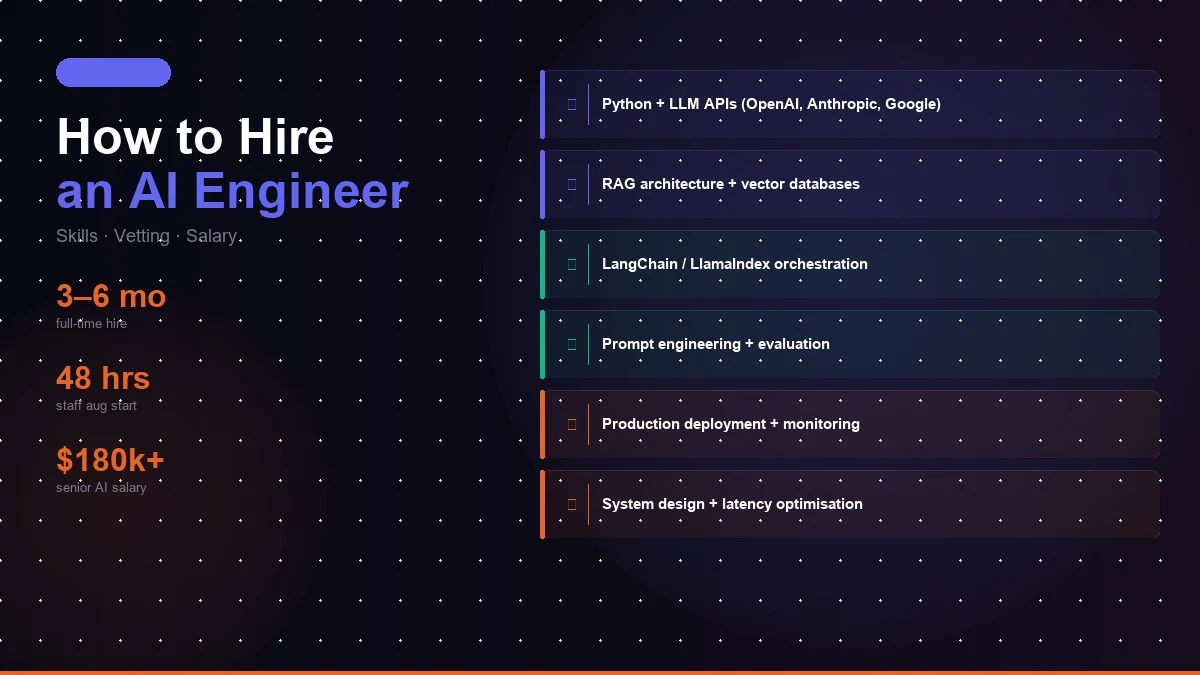
The demand for AI engineers massively outpaces supply in 2026. Companies that built effective hiring pipelines for general software engineers are discovering those same processes do not translate to AI roles. The skill set is newer, the vetting is harder, the market is tighter, and bad hires in AI are more expensive than bad hires in general engineering because AI system failures are often silent and slow to surface.
This guide covers the full hiring process: what skills to look for, how to write a job description that attracts qualified candidates, how to vet candidates effectively (including the interview questions that actually work), what the market pays across seniority levels, and when full-time hiring is the wrong model entirely.
Kovil AI
We build AI-powered software for businesses — from automations to full product builds.
What Is an AI Engineer in 2026?
The term "AI engineer" is used broadly and inconsistently. For this guide, an AI engineer is an engineer who builds production systems that use large language models and related AI infrastructure. This is distinct from a classical machine learning engineer, who focuses on training and evaluating models.
The core of the AI engineer role in 2026 is building reliable systems on top of LLM APIs: designing retrieval-augmented generation (RAG) pipelines, building AI agents, integrating LLMs into product workflows, and ensuring these systems behave predictably in production. For more on the difference, see our guide on what an AI engineer does.
The Core Technical Skills to Look For
A production AI engineer in 2026 needs competency across six areas:
1. Python and LLM APIs
Python is non-negotiable. The AI ecosystem runs on Python: all major LLM SDKs, vector database clients, and orchestration frameworks are Python-first. Beyond Python, the engineer should be comfortable with at least two of the major LLM APIs: OpenAI, Anthropic, and Google. Understanding the differences between models (context windows, pricing, capabilities, rate limits) is practical knowledge that matters in production.
2. RAG architecture and vector databases
Retrieval-augmented generation is the most common pattern for enterprise AI in 2026. The engineer should be able to design a RAG pipeline from scratch: embedding model selection, vector database choice (Pinecone, Weaviate, pgvector, Qdrant), chunking and indexing strategy, retrieval scoring, and response grounding. This is the single most important skill set for most enterprise AI projects.
3. LLM orchestration frameworks
LangChain and LlamaIndex are the dominant orchestration frameworks. Strong candidates know at least one deeply and can articulate why they would use a framework versus building a pipeline directly against the LLM API (the answer is not always "use the framework"). Newer patterns like LangGraph for agent orchestration are increasingly relevant for complex agentic systems.
4. Prompt engineering and context management
Prompt engineering is both a science and a craft. Experienced AI engineers understand structured prompting, few-shot examples, chain-of-thought, system prompt design, and how to manage context window constraints at scale. This is often underweighted in hiring and overweighted in demos. Evaluate it in real system scenarios, not isolated prompting exercises.
5. Production deployment and monitoring
Many AI engineering candidates have strong prototyping skills and weak production skills. Production AI engineering includes: serving models behind an API with latency targets, implementing retry logic and fallback patterns, logging and tracing LLM inputs and outputs, managing token cost at scale, and detecting and alerting on model drift or output quality degradation. Ask specifically about production deployments they have maintained, not just built.
6. AI evaluation methodology
This is the differentiator between good and great AI engineers. Strong engineers have an evaluation mindset: they define what "working" means before they build, design benchmarks and test sets, measure performance systematically, and can diagnose why a system is underperforming. Engineers who cannot explain how they would evaluate the system they are building are a significant risk in production.
How to Write an AI Engineering Job Description
Most AI engineering job descriptions fail to attract strong candidates because they either list every AI technology ever created (which reads as "we don't know what we need") or they focus on model training experience that is not relevant for LLM-based product development.
An effective AI engineering job description for a RAG/agent-focused role should include:
- The specific AI domain you are building in (RAG, agents, fine-tuning, data pipelines)
- The existing stack (which LLM APIs, vector databases, orchestration frameworks)
- A concrete description of what the engineer will build in the first 90 days
- The company or team context (not just "we are an AI-first company" but what the AI system actually does)
- Clear seniority signal (a job description that asks for 5 years of LLM experience and entry-level salary will attract no one)
What to avoid: listing "machine learning" and "deep learning" as requirements for a role that is actually LLM API integration. Listing PhD as a requirement for a production engineering role. Requiring experience with technologies that your team has not used yet.
Where to Source AI Engineering Candidates
The best AI engineering candidates in 2026 are not actively job-hunting on generic job boards. The most effective sourcing channels are:
- AI-specific communities: Hugging Face forums, LangChain Discord, AI Twitter/X, specific AI subreddits. Engineers who are active in these communities tend to be more current on the state of the art.
- GitHub: Engineers who contribute to AI open-source projects or have notable AI repositories demonstrate practical skills more clearly than any resume.
- Referrals from strong engineers you know: The best signal for a candidate's quality is the opinion of a senior AI engineer you already trust.
- AI-specific staffing firms: For faster access to pre-vetted candidates, specialist AI augmentation firms maintain pools of engineers who have been evaluated on AI-specific competencies.
How to Vet AI Engineering Candidates
Standard software engineering vetting does not work for AI engineering roles. A LeetCode problem set will not tell you whether someone can design a reliable RAG system. Here is a four-stage vetting process that works:
Stage 1: Technical screening (30 minutes)
Ask the candidate to walk through a production AI system they have built. Listen for: how they designed the system, what tradeoffs they made, how they evaluated it, what went wrong in production, and how they fixed it. This one conversation reveals more than any coding exercise.
Stage 2: System design (60 minutes)
Give the candidate a realistic scenario: "Design a RAG system for our customer support team that handles 50,000 tickets per month." Evaluate their approach to: embedding model selection, retrieval architecture, evaluation methodology, and production concerns (latency, cost, monitoring). You are not looking for a right answer. You are looking for structured thinking and awareness of tradeoffs.
Stage 3: Practical evaluation exercise (take-home, 2 to 4 hours)
Give the candidate a small, real problem. Provide a sample document corpus and ask them to build a basic RAG retrieval pipeline with an evaluation set. Review the code, the evaluation methodology, and how they documented their approach. This separates engineers who can code from engineers who can build systems.
Stage 4: Production debugging (45 minutes)
Show the candidate a real or realistic production failure: a set of LLM inputs, outputs, and a description of the problem (hallucination, poor retrieval, high latency, token cost overrun). Ask them to diagnose the root cause and propose a fix. This evaluates production engineering maturity, which is the hardest thing to fake.
AI Engineering Red Flags
Red flag: "I built a chatbot" as the lead accomplishment. A chatbot demo is not a production system. Ask specifically about scale, uptime, latency, evaluation, and what failed after launch.
Red flag: No opinion on evaluation. If a candidate cannot explain how they would measure whether the AI system they are building is working, they are not ready for production.
Red flag: Framework-first thinking. Candidates who reach for LangChain before understanding the problem are often over-reliant on abstractions. Strong engineers know when to use a framework and when to go directly against the API.
What AI Engineers Are Paid in 2026
| Level | US Base Salary | Experience |
|---|---|---|
| Junior AI Engineer | $90K to $130K | 0 to 2 years AI-specific |
| Mid-level AI Engineer | $130K to $180K | 2 to 5 years, production deployments |
| Senior AI Engineer | $180K to $250K | 5+ years, architecture ownership |
| Staff / Lead AI Engineer | $220K to $300K | 8+ years, team leadership |
These are base salaries. Total compensation for senior and staff AI engineers at well-funded companies typically includes equity that doubles or triples the effective total package. For a detailed breakdown, see How Much Does an AI Engineer Cost in 2026?
When Full-Time Hiring Is Not the Right Model
Full-time hiring for AI engineering roles makes sense when the need is permanent, senior leadership is in place to evaluate the hire, and you can afford the 3 to 6 month wait. In many cases, none of these conditions are true.
If you need AI engineering capability in weeks rather than months, or if the need is project-specific (9 to 18 months) rather than permanent, AI staff augmentation is almost always the faster and lower-risk path. A vetted engineer can be embedded in your team within 48 hours, with a 2-week trial period before any long-term commitment.
For a full comparison of hiring vs staff augmentation, see What Is AI Staff Augmentation?. For teams that need someone to own AI architecture decisions entirely, rather than extend existing capacity, see our guide on What Is a Dedicated AI Team?
Frequently Asked Questions
What skills should an AI engineer have in 2026?
Core technical skills: Python, LLM APIs (OpenAI, Anthropic, Google), at least one orchestration framework (LangChain or LlamaIndex), RAG architecture, vector databases, prompt engineering, and production deployment. The differentiator between good and great AI engineers is evaluation competency: the ability to measure whether an AI system is working and to diagnose failure modes systematically.
How much does an AI engineer cost in 2026?
Full-time AI engineers in the US earn $130K to $280K base salary depending on seniority and specialisation. Senior and staff-level AI engineers command the top of that range. Staff augmentation through a managed firm runs lower on a comparable hourly basis when you factor in recruiting, benefits, and equity overhead that full-time hires require.
How long does it take to hire an AI engineer?
Full-time hiring typically takes 3 to 6 months from job posting to first day, including sourcing, interviews, offer, and notice period. Staff augmentation through a managed firm can start in 24 to 48 hours. For time-sensitive AI projects, staff aug is often the only practical option.
What is the difference between an AI engineer and an ML engineer?
An ML engineer focuses on training, evaluating, and deploying machine learning models. An AI engineer in 2026 more often builds systems that use pre-trained large language models via APIs: RAG pipelines, AI agents, LLM-based workflows. The roles overlap but have different emphases. Most production AI projects in 2026 need AI engineers, not classical ML engineers.
What are red flags in AI engineering candidates?
Key red flags: can demo a chatbot but has never shipped a production system; knows one framework but cannot explain why they chose it over alternatives; has no methodology for AI evaluation; strong on model knowledge but limited on system design, latency, and cost optimisation; cannot describe how they would monitor an AI system after deployment.
Should I hire a junior or senior AI engineer?
For greenfield AI projects without internal AI expertise, a senior AI engineer who can make architecture decisions is essential. Junior AI engineers are effective once the architecture is defined and they have senior oversight. Hiring junior first to save cost on an AI project without senior guidance is a common and costly mistake.
How should I structure an AI engineering interview?
A strong AI engineering interview includes a system design round (design a RAG system for a specific use case), an evaluation round (how would you measure whether this system is working?), a debugging round (here is a production trace with poor outputs, diagnose the problem), and a discussion of past production AI systems they have shipped.
What are alternatives to hiring a full-time AI engineer?
The main alternatives are AI staff augmentation (an external firm places a vetted AI engineer directly in your team, managed by you) and fixed-price project delivery (an external firm owns the build end-to-end). Staff aug is right when you have internal AI direction. Fixed-price is right when you do not.
Kovil AI
Looking to bring AI into your business?
Whether you need a custom AI build, workflow automation, or a fast MVP — our engineers have done it across industries. Let's talk about what you're trying to solve.