What Is a Dedicated AI Team? (And Do You Need One?)
A dedicated AI team gives you a full squad of AI engineers working exclusively on your project. Here's how it works, what it costs, and when it's the right model versus staff augmentation.
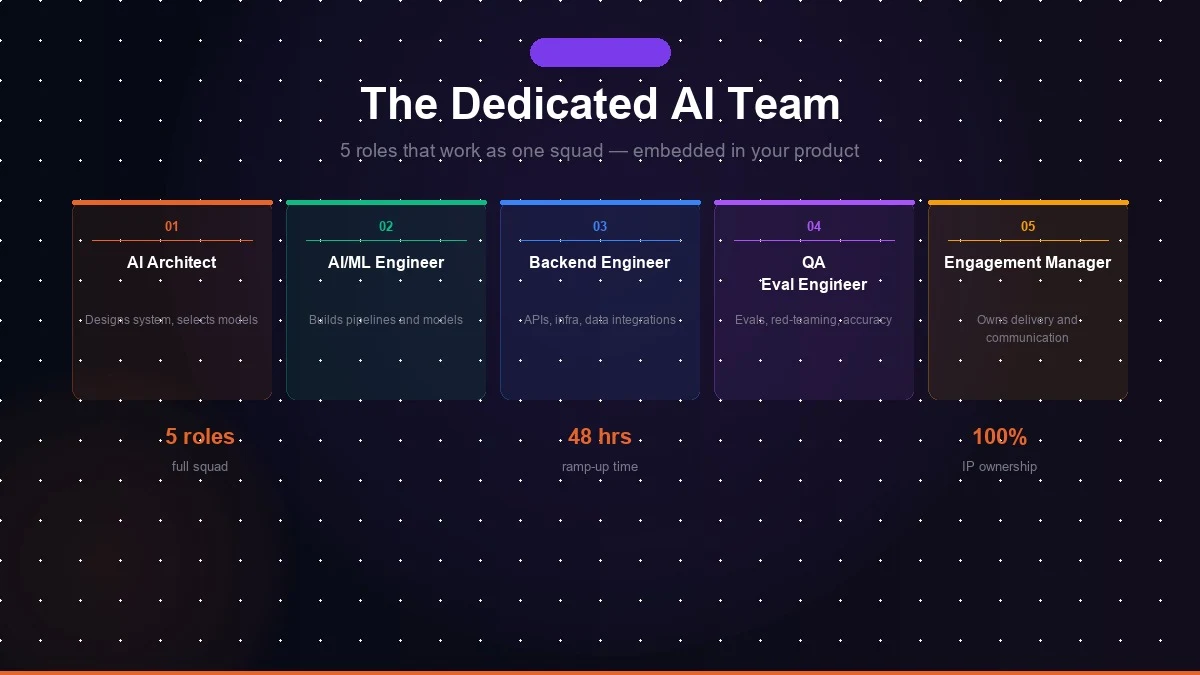
A dedicated AI development team is a model where an engineering firm assembles a purpose-built squad of AI engineers for your project, working exclusively on your initiative rather than split across multiple clients. It sits between individual staff augmentation (where you direct engineers one by one) and full outsourcing (where an external firm manages everything end-to-end), combining the control of the former with more self-sufficient delivery capability than the latter.
In 2026, dedicated AI teams have become one of the most effective ways for companies without established AI engineering depth to build serious AI capabilities. They provide architecture ownership, delivery discipline, and the kind of deep context that a series of individual placements rarely achieves.
Kovil AI
We build AI-powered software for businesses — from automations to full product builds.
What a Dedicated AI Team Actually Looks Like
The composition of a dedicated AI team depends on what you are building, but a typical squad for a production AI system looks like this:
- AI Architect / Lead AI Engineer: Owns the system architecture. Makes decisions about model selection, retrieval design, evaluation methodology, and infrastructure. This role is the most important and the hardest to fill with individual staff augmentation because internal AI direction is required. In a dedicated team, this expertise comes from the squad itself.
- AI / ML Engineer: Builds the AI system components: RAG pipelines, agent orchestration, LLM integrations, evaluation frameworks. Executes against the architecture defined by the lead.
- Backend Engineer: Builds the API layer, database integrations, data pipelines, and system interfaces that connect the AI system to your existing product and infrastructure.
- Engagement Manager: Owns communication between the squad and your organisation. Manages milestone tracking, surfaces blockers early, translates between business requirements and technical delivery, and holds the overall engagement accountable. This role is what distinguishes a dedicated team from a group of freelancers.
Larger or more complex builds add:
- QA / Evaluation Engineer: Owns the evaluation framework, runs benchmarks, identifies failure modes, and validates production quality before releases.
- DevOps / MLOps Engineer: Handles deployment infrastructure, model serving, monitoring, and CI/CD for AI systems.
Dedicated AI Team vs Staff Augmentation: The Core Difference
The fundamental difference is where technical direction comes from.
In staff augmentation, you provide the technical direction. You (or your internal AI lead) define what to build, review the approach, and evaluate whether the result is correct. The augmented engineer executes under your direction. This model works extremely well when you have a strong internal AI lead and just need more execution capacity.
In a dedicated team, the technical direction comes from within the squad, specifically from the AI architect or lead. You define the business requirements and the success criteria. The team designs and builds the solution. You review at milestones and approve direction. This model works well when you do not have internal AI leadership and need the external team to provide it.
| Dimension | Individual Staff Aug | Dedicated AI Team |
|---|---|---|
| Technical direction | Your internal team | Squad's AI lead |
| Best for | Teams with internal AI leadership | Teams without internal AI leadership |
| Internal overhead | Higher (daily direction required) | Lower (milestone reviews sufficient) |
| Architecture ownership | Your team | External squad's AI lead |
| Team cohesion | Variable (individuals, not a squad) | High (purpose-built squad) |
When to Choose a Dedicated AI Team
You are building a full AI product, not a feature
A feature integration might require one engineer for 2 months. A full AI product, a document intelligence platform, an AI agent suite, a customer-facing AI assistant, requires architecture, build, evaluation, and deployment work across multiple months. A dedicated squad with complementary skills delivers this more coherently than a series of individual placements.
Your internal team lacks AI architecture expertise
If your CTO or lead engineer has not shipped a production RAG system or AI agent before, they cannot effectively evaluate an augmented AI engineer's architectural decisions. In this situation, individual staff augmentation carries real risk: you may not realise the architecture is wrong until the system is in production. A dedicated team with its own AI lead solves this by providing the architecture expertise internally to the squad.
The scope justifies a multi-person engagement
For engagements under 3 months or under 2 engineers, individual staff augmentation is usually more efficient. For engagements over 6 months involving multiple components (AI layer, API layer, evaluation framework, deployment infrastructure), a dedicated squad with shared context and a single EM is more coherent and lower-friction.
You want ongoing AI product development
Dedicated teams are especially valuable for companies that want to build AI as a continuous product capability rather than a one-time project. A squad that knows your codebase, your data, your product, and your users becomes more efficient over time in ways that a series of individual placements or one-off projects cannot replicate.
Dedicated AI Team vs Fixed-Price Project
A dedicated team is an ongoing model: the squad works on your AI product across multiple sprints, features, and iterations. You pay monthly for the squad's time. This suits ongoing AI product development where requirements evolve.
A fixed-price project has a defined scope and a defined end date. You pay for a specific deliverable. This suits bounded AI builds where you know exactly what you need to build and what done looks like before you start.
Many companies combine both: a fixed-price project to build the core AI system, transitioning to a dedicated team model for ongoing development and iteration once the foundation is in place.
Making a Dedicated AI Team Work
The most successful dedicated team engagements have several things in common:
- A clear product brief before the squad starts: The AI lead needs to understand your product context, your users, and your success criteria before designing the architecture. A two-to-four page product brief prevents weeks of misalignment later.
- A named product owner on your side: The Engagement Manager owns delivery. You need one person on your side who owns the product direction and is available for weekly milestone reviews and rapid question resolution.
- Milestone-gated payment and review: Even with a dedicated team on a monthly model, agree on 4-week milestones with specific deliverables. This creates natural review points and catches misalignment before it compounds.
- Documentation as a first-class deliverable: Require the squad to document architecture decisions, API specifications, and operational runbooks throughout the engagement. This protects your ability to maintain and extend the system independently if the engagement ends.
For more on the comparison between a dedicated team and individual augmentation, see What Is AI Staff Augmentation?. For teams considering a fixed-price project instead, see Fixed-Price vs Time-and-Materials for AI Projects. To explore our dedicated team service, see Dedicated AI Team.
Frequently Asked Questions
What is a dedicated AI development team?
A dedicated AI team is a purpose-built squad of engineers assembled exclusively for your project. Unlike individual staff augmentation, a dedicated team is a self-sufficient unit with complementary skills: typically an AI architect or lead AI engineer, one or more AI/ML engineers, a backend engineer for APIs and integrations, and an Engagement Manager who owns delivery and communication.
How is a dedicated AI team different from staff augmentation?
Staff augmentation extends your existing team with individual engineers who work under your direction. A dedicated team is a standalone squad that can operate with less internal direction, since it includes its own technical leadership. Dedicated teams work well when you need to build AI capability but do not have internal AI leadership to direct individual augmented engineers.
When should I choose a dedicated AI team over staff augmentation?
Choose a dedicated AI team when: you are building a full AI product rather than a feature, your internal team lacks AI architecture expertise to direct augmented engineers, the scope is large enough to justify multiple engineers (6+ months of work), or you want end-to-end ownership of the AI system including architecture and delivery without managing individual engineer directions.
How much does a dedicated AI development team cost?
The cost of a dedicated AI team depends on team size and seniority. A 3-person squad (AI engineer, backend engineer, Engagement Manager) runs at a monthly rate that reflects the seniority of the engineers. Fixed-price project engagements are also available, where you pay per milestone rather than monthly.
How long does it take to stand up a dedicated AI team?
A well-run AI augmentation firm can have a dedicated team briefed, matched, and starting within 5 to 10 business days. This includes the team composition discussion, candidate matching, technical interviews, and onboarding. Compare this to building a similar team through full-time hiring, which takes 4 to 8 months.
Can a dedicated AI team convert to internal hires?
Yes. Many dedicated team engagements are structured with a conversion option. After working together for several months, companies often identify specific team members they want to bring on full-time. The augmentation firm typically has a transparent conversion fee structure for this, which should be discussed upfront.
What is the difference between a dedicated AI team and a fixed-price project?
A dedicated team is ongoing: you pay monthly for a squad that works on your AI product across multiple sprints and features. A fixed-price project has a defined scope and end date: you pay for a specific deliverable. Dedicated teams suit ongoing AI product development. Fixed-price suits bounded, well-defined builds.
Who owns the IP created by a dedicated AI team?
In any reputable AI staff augmentation or dedicated team engagement, all IP created during the engagement belongs to the client from day one. This should be stated explicitly in the contract before any work begins. Do not proceed with an engagement that does not have a clear IP assignment clause.
Kovil AI
Looking to bring AI into your business?
Whether you need a custom AI build, workflow automation, or a fast MVP — our engineers have done it across industries. Let's talk about what you're trying to solve.