The Real Cost of Building an MVP in 2026
From freelancers to agencies to AI dev shops, here's a transparent breakdown of what it actually costs to build an MVP today.
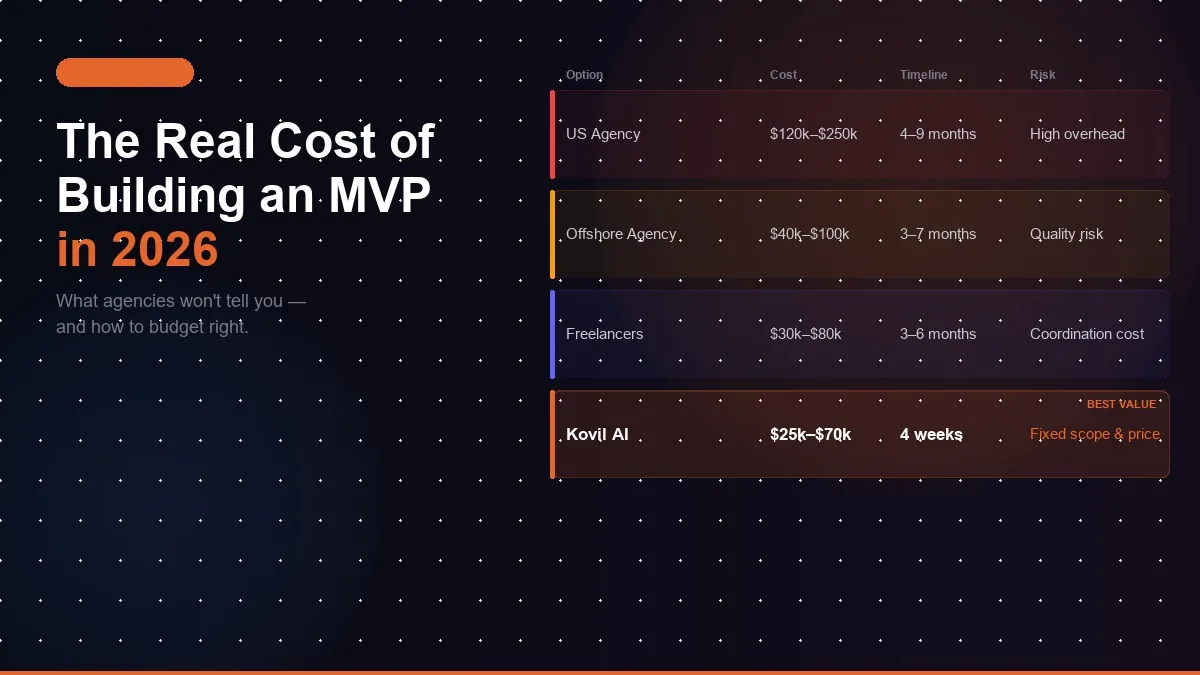
The most common question we hear from founders and product leaders is some variation of: "How much should this cost?" It's a completely reasonable question, and the honest answer, "it depends", is frustrating but true. What we can do is give you the framework to get to a real number for your specific situation, and explain why the quotes you're getting vary so dramatically.
Cost estimates for MVP development range from $5,000 to $500,000 for projects that, on paper, sound similar. That $495,000 range isn't a sign that something is broken in the market, it reflects genuinely different things being sold under the same name. This guide explains what drives the difference.
Kovil AI · Fixed-Cost MVP Build
We scope and price your MVP upfront — no hourly billing surprises.
What You're Actually Paying For
When you pay for an MVP, you're not just paying for code. You're paying for a combination of:
- Discovery and scoping, turning your idea into a buildable specification
- Design, the user experience and visual design of what gets built
- Development, the actual engineering time to build the product
- QA and testing, ensuring the product works reliably before it reaches users
- Infrastructure and deployment, getting it running in a real environment
- Project management, coordination, communication, and delivery management
- Documentation, making sure someone can work on it after the project ends
- Post-launch support, handling the inevitable issues that emerge after launch
Cheap quotes often exclude several of these. Expensive quotes often include more of them than you need. The right quote addresses all of them in proportion to your actual requirements.
The Three Cost Drivers That Matter Most
Scope
The single biggest driver of cost is scope, how much the product does. This seems obvious, but scope is consistently underestimated. Features that sound simple ("users should be able to message each other") often have significant implementation complexity (real-time delivery, notification systems, moderation, attachment handling, mobile push notifications).
A rough rule: for every hour of complexity you can see, plan for 2-3 hours of complexity you can't. The hidden work, error handling, edge cases, security, performance, testing, usually exceeds the visible work.
Developer location and seniority
Hourly rates vary by a factor of 10-20x between the cheapest offshore markets and senior developers in North American or Western European cities. This isn't just about cost, it directly affects quality, communication, and the risk profile of the project.
Junior developers in cheap markets can produce functional code, but they also produce more bugs, more technical debt, and more surprises. Senior developers move faster, make better architectural decisions, and require less oversight. The right level depends on your product's complexity and your risk tolerance.
Build approach and tooling
The most significant recent shift in MVP economics is the widespread adoption of AI coding tools. Developers using tools like Cursor, GitHub Copilot, and Claude API produce substantially more code per hour than those who aren't, consistently 40-60% more in structured environments.
This means that two developers with identical experience and identical hourly rates can produce dramatically different amounts of work per week depending on their tooling. When evaluating proposals, it's worth asking explicitly whether and how AI coding tools are used in development.
Ballpark Costs by Approach
Freelancers ($5,000 – $40,000)
Freelancers, individual developers hired directly, offer the lowest sticker price. For simple MVPs with a competent freelancer, you can get a functional product for $10,000-$30,000.
The risks are real and well-documented. Individual availability is fragile, illness, competing priorities, or simply losing interest can stall your project. Quality varies enormously and is hard to assess upfront. Communication overhead falls entirely on you. Many freelancers are strong in their area of speciality and weak in adjacent areas your project may need.
Freelancers work best for: very small, well-defined projects; founders with technical backgrounds who can effectively manage the work; and situations where you've worked with this person before and know their output quality.
Traditional agencies ($60,000 – $300,000+)
Traditional agencies, usually with offices, account managers, project managers, and teams of developers, charge significantly more. Their pitch is structure, reliability, and breadth of expertise.
The challenge: traditional agency overhead is substantial. Account management, project management, and internal coordination consume a significant portion of your budget before a line of code is written. For a $150,000 engagement, $40,000-60,000 often goes to coordination overhead.
Traditional agencies also tend to be slow. Weekly status calls, approval gates, and the overhead of large-team coordination means a project that could move in weeks often moves in months.
Traditional agencies are most appropriate for: enterprise buyers with procurement requirements that mandate certain agency structures; projects where brand relationships or physical presence matter; and large, complex products where the coordination value justifies the overhead.
Offshore dev shops ($15,000 – $80,000)
Offshore development shops, teams in Eastern Europe, South Asia, or Latin America, offer something closer to agency structure at much lower per-hour costs. For straightforward projects with clear specifications, this model works.
The challenges are well-known: timezone friction, communication overhead, variable English proficiency, quality inconsistency, and the time required to manage the engagement effectively. Projects frequently take longer than estimated and require more client involvement than anticipated.
The quality differential between the best and worst offshore teams is enormous. Top offshore teams compete on quality, not just price. Many offshore teams compete only on price, and deliver accordingly.
AI-augmented dev shops ($25,000 – $90,000)
The newest category: development teams that have fully adopted AI coding tools and built their workflow around them. These teams can operate at the speed of a larger team for the cost of a smaller one.
The economics are genuinely different. A senior developer using modern AI tools can produce 2-3x the output per week compared to the same developer without those tools. This compresses timelines, lowers the headcount required to deliver a given scope, and reduces costs relative to the output delivered.
The key variable is whether the AI tooling is actually improving quality, not just cutting corners faster. The best AI-augmented teams use the efficiency gains to invest more in testing, documentation, and code quality, not just to bill fewer hours for the same output.
Hidden Costs That Blow Budgets
Most MVP cost overruns aren't caused by the initial scope costing more than expected. They're caused by things nobody explicitly planned for:
Scope creep
The most predictable and preventable cost driver. Every "small" addition has a development cost, a testing cost, and a deployment cost. A product with 40% scope creep costs 40% more, not 10% more. Fixed-price contracts protect against this; time-and-materials contracts don't.
Third-party integration complexity
Every external integration is a wildcard. APIs are inconsistently documented. Authentication flows have edge cases. Rate limits hit at unexpected times. Webhooks fail silently. Budget 20-30% more time for integrations than your initial estimate suggests.
Infrastructure and operational costs
Cloud hosting, monitoring tools, authentication services, transactional email, CDN, these ongoing costs are often absent from MVP quotes. For a typical web product, expect $200-800/month in infrastructure costs at launch, scaling with usage.
Feedback-driven pivots
The best MVP outcomes include significant post-launch learning and iteration. This is good, it means the product is getting real signal. But it also means the initial build is the beginning of the spend, not the end.
Post-launch maintenance
The product after launch needs someone attending to it. Bug fixes, dependency updates, monitoring, and user-reported issues don't go away when the project ends. Budget for ongoing maintenance from the start, it's far cheaper to plan for it than to discover it urgently.
How to Evaluate a Proposal
When you receive an MVP proposal, here are the questions that expose whether it's realistic:
- Is this a fixed-price or time-and-materials engagement? Fixed-price requires a clear scope. If you're being offered a fixed price without a detailed scope, the price will change.
- What's included in QA? Testing is often underdefined in proposals. Ask specifically what testing is included.
- How is deployment handled? Getting from a laptop to a production environment is not trivial. It should be explicitly included.
- What post-launch support is included? Most teams include 30 days. Understand what's covered and what's not.
- Do you use AI coding tools? Teams that don't are working at a speed disadvantage that shows up in timelines and cost.
- Can I talk to a previous client? Proposals are marketing. Client references are evidence.
What You Should Actually Budget
If you're building a typical web-based MVP, a SaaS product, a marketplace, a dashboard, an AI-powered tool, here's a realistic range for a quality build with a modern, AI-augmented team:
- Simple MVP (2-3 core features, standard auth, basic integrations): $25,000 – $45,000
- Moderate MVP (5-7 features, third-party integrations, real-time components): $45,000 – $75,000
- Complex MVP (multi-sided platform, complex data models, multiple integrations): $75,000 – $120,000
These ranges assume a 2-6 week timeline with a team that moves at AI-augmented speed. See our guide on how to build an MVP in 4 weeks for the exact framework behind these timelines. Traditional agency timelines at these scopes are typically 3-5x longer and often more expensive.
Cost Breakdown by Component
Here is how a typical MVP budget breaks down across main delivery components, using the moderate complexity tier ($45,000–$75,000) as a baseline (sources: Kovil delivery data; Clutch.co 2024 Web Development Cost Report; Stack Overflow Developer Survey 2024):
| Component | Simple MVP | Moderate MVP | Complex MVP |
|---|---|---|---|
| Discovery & scoping | $1,500–3,000 | $3,000–6,000 | $6,000–12,000 |
| UX design | $2,000–5,000 | $5,000–12,000 | $10,000–25,000 |
| Frontend development | $6,000–12,000 | $12,000–22,000 | $20,000–40,000 |
| Backend & APIs | $8,000–15,000 | $15,000–28,000 | $25,000–50,000 |
| QA & testing | $2,000–4,000 | $4,000–8,000 | $7,000–15,000 |
| Deployment & DevOps | $1,500–3,000 | $3,000–6,000 | $5,000–12,000 |
| Documentation & handover | $1,000–2,000 | $2,000–4,000 | $3,000–8,000 |
| Total (AI-augmented team) | $25K–$45K | $45K–$75K | $75K–$120K |
Which Approach Is Right for You?
The right build approach depends on your situation. Here is a practical decision guide:
- Technical co-founder, small well-defined scope: A vetted freelancer is viable. Budget $10,000–$30,000 and plan for close daily involvement.
- Need it in 4–6 weeks, $25K–$90K budget, want a complete production-ready product: An AI-augmented dev shop delivers the best speed-to-quality ratio at this range.
- Large enterprise budget, procurement requirements, complex product: A traditional agency may be appropriate — get clarity on the ratio of coordination overhead to actual build time.
- Unsure which approach fits: Get at least three proposals from different model types and compare on scope clarity, not price. The proposal with the clearest scope is almost always the safest bet.
The Bottom Line
There's no such thing as a cheap MVP. There are MVPs that cost less upfront and much more in total, through slow timelines, rework, technical debt, and opportunity cost. And there are MVPs that cost more upfront and far less in total, through fast delivery, clean code, and a codebase that's a foundation rather than a liability.
The question to ask isn't "how do I build the cheapest MVP?" The question is "how do I get the best outcome per dollar invested?" Those two questions have very different answers. See how Kovil AI prices a fixed-price AI project, scoped, built, and shipped with no surprises. And if you need to rescue an MVP that's already gone sideways, our App Rescue service is built for that.
Related Services
Frequently Asked Questions
How much does it cost to build an MVP in 2026?
For a quality build with a modern, AI-augmented development team: a simple MVP (2–3 core features, standard auth, basic integrations) costs $25,000–$45,000; a moderate MVP (5–7 features, third-party integrations, real-time components) costs $45,000–$75,000; and a complex MVP (multi-sided platform, complex data models, multiple integrations) costs $75,000–$120,000. Traditional agency timelines at these scopes are typically 3–5x longer and often more expensive.
What's the difference between a freelancer and an AI dev shop for MVP development?
Freelancers typically charge $5,000–$40,000 and work best for small, well-defined projects where you have technical oversight. AI-augmented dev shops charge $25,000–$90,000 but operate at 2–3x the output speed of traditional teams, deliver more consistent quality, and include project management, QA, and deployment. The key advantage of AI dev shops is that senior developers using tools like Cursor and GitHub Copilot can deliver moderate-complexity MVPs in 4–6 weeks rather than 3–6 months.
What are the most common hidden costs in MVP development?
The four most common budget-killers are: (1) Scope creep, every added feature has development, testing, and deployment cost; (2) Third-party integration complexity, APIs are inconsistently documented and often have unexpected edge cases; budget 20–30% extra time per integration; (3) Infrastructure and operational costs, typically $200–$800/month at launch for hosting, monitoring, auth, email, and CDN; (4) Post-launch maintenance, bug fixes, dependency updates, and user-reported issues don't stop when the project ends.
Should I use a fixed-price or time-and-materials contract for MVP development?
Fixed-price contracts are strongly preferable for MVPs because they protect against scope creep, the biggest cause of budget overruns. A fixed-price engagement requires a detailed scope document upfront, which forces clarity before a line of code is written. Time-and-materials contracts put all the scope risk on you. The caveat: if you're being offered a fixed price without a detailed scope, the price will change, guaranteed.
How do AI coding tools change MVP development economics?
AI coding tools like Cursor and GitHub Copilot consistently produce 40–60% more code per hour than development without them. In practical terms: a senior developer using modern AI tooling can deliver in 4 weeks what would otherwise take 6–8 weeks. This compresses timelines, lowers headcount requirements, and reduces cost relative to the output delivered. When evaluating proposals, ask explicitly how AI coding tools are used, teams that don't use them are operating at a significant speed disadvantage.
Keep reading
Kovil AI · Fixed-Cost MVP Build
Want to know exactly what your MVP will cost?
No hourly billing surprises. We scope your MVP upfront and deliver at a fixed price — typically in 4 weeks. Get a clear number before you commit.