Nearshore vs Offshore Staff Augmentation: Pros, Cons, and When to Choose Each
Nearshore and offshore are both forms of staff augmentation, but they make different tradeoffs on cost, time zone overlap, and collaboration quality. Here's how to think through the choice.
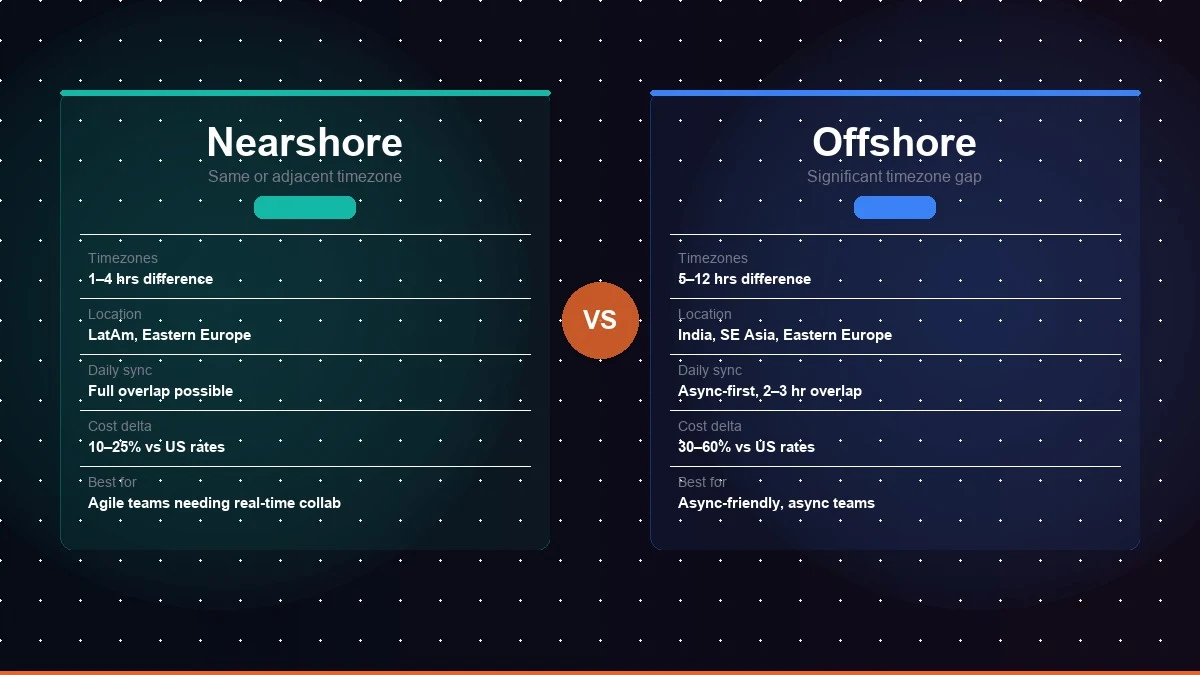
Nearshore and offshore are two geographic models within the broader category of staff augmentation. The terms describe where the engineers are located relative to the client, and the practical implication centres on time zone overlap, collaboration quality, and rate differential.
For general software development, the choice between nearshore and offshore is often straightforward: if cost is the primary driver and the work is async-friendly, offshore works well. But for AI projects specifically, the collaboration requirements are higher, the decision is more nuanced, and the cost savings from offshore are more often offset by slower iteration cycles and higher coordination overhead.
Kovil AI
We build AI-powered software for businesses — from automations to full product builds.
Nearshore Staff Augmentation: Definition and Mechanics
Nearshore means the engineers are in a similar or adjacent time zone to the client. For US companies, this typically means Latin America: Mexico, Colombia, Argentina, Brazil, and Costa Rica. For UK and Western European companies, it typically means Eastern Europe: Poland, Romania, Czech Republic, and similar markets.
The defining characteristic of nearshore is time zone overlap. A US company working with a Colombian engineer has 1 to 3 hours of time zone difference depending on daylight saving time. A UK company working with a Polish engineer has 0 to 1 hours of difference. This overlap enables real-time collaboration: daily standups at normal working hours, immediate Slack responses during shared work blocks, live code reviews and pair programming, and quick architecture discussions without scheduling days in advance.
Offshore Staff Augmentation: Definition and Mechanics
Offshore means the engineers are in a significantly different time zone. For US companies, offshore typically means India (9 to 12 hours ahead), Southeast Asia (11 to 14 hours), and increasingly Eastern Europe for the time zone advantage relative to truly far offshore markets.
The defining characteristic of offshore is the primarily asynchronous collaboration model. With 8 to 12 hours of difference, the working day overlap is minimal (often 0 to 2 hours during edge-of-day windows). Work is communicated through detailed async specifications, the engineer works independently through their local day, and feedback is received on the following client-side morning.
Side-by-Side Comparison
| Dimension | Nearshore | Offshore |
|---|---|---|
| Time zone overlap (US company) | 4 to 8 hours daily | 0 to 3 hours daily |
| Collaboration model | Primarily synchronous | Primarily asynchronous |
| Rate vs US market | 10 to 35% lower | 40 to 70% lower |
| Blocker resolution speed | Same day (during overlap) | Next day (if next cycle) |
| Culture and language alignment | Higher (for US companies) | Variable |
| Best for | Collaborative, iterative work (AI, product dev) | Stable, well-specified work (maintenance, defined features) |
Why AI Projects Have Higher Collaboration Requirements
Standard software development, once the architecture and specifications are clear, can often proceed efficiently with asynchronous collaboration. A developer can work through a well-specified ticket independently, deliver it, and receive review comments on the next cycle. This workflow tolerates time zone gaps reasonably well.
AI projects are different in several ways that make synchronous collaboration more valuable:
- Evaluation is iterative and rapid: AI engineers run evaluations, review results, adjust prompts or retrieval parameters, and re-evaluate. This cycle is most productive when both the engineer and the person reviewing outputs can discuss results in real time. A 24-hour feedback cycle slows this significantly.
- Architecture decisions come up frequently: AI systems have more architectural decision points than standard software (model selection, retrieval strategy, context management, evaluation framework design). Each decision benefits from a quick synchronous discussion rather than a multi-day async thread.
- Debugging LLM behaviour is collaborative: Understanding why an LLM is producing poor outputs often requires looking at examples together, trying variations in real time, and making judgment calls about whether a particular failure mode matters. This is inherently collaborative work.
When Nearshore Is the Clear Choice
Nearshore is strongly preferred when:
- The AI project is in an active build or iteration phase where the team changes direction frequently based on evaluation results
- Your internal AI lead or product owner is available for regular short sync calls and wants to stay closely involved in evaluation reviews
- The project is greenfield with significant architectural uncertainty, where real-time collaboration accelerates design decisions
- Stakeholders require frequent demos and milestone reviews
When Offshore Can Work Well
Offshore can work well for AI projects when the engagement is well-managed. Specifically:
- An Engagement Manager is in place and owns the coordination overhead between the offshore engineer and your team
- The work is well-specified enough that the engineer can work independently through their local day with minimal blocking questions
- There are at least 2 to 3 hours of daily overlap for urgent questions and daily standups
- Async communication standards are rigorous: documented decisions, detailed PR descriptions, Loom recordings for design explanations
The Engagement Manager as the Equaliser
The presence or absence of an Engagement Manager is often more important than the location of the engineer. A strong EM can manage offshore AI engagements effectively by:
- Absorbing coordination overhead that would otherwise fall on your team
- Translating between business requirements and technical specifications to reduce the engineer's dependency on real-time client input
- Surfacing blockers within hours rather than days, using their understanding of both the client's expectations and the engineer's work
- Conducting milestone reviews that give the client visibility into progress without requiring deep technical involvement
For more on what IT staff augmentation looks like in practice across all geographic models, see IT Staff Augmentation: The Complete Guide for 2026. For AI-specific staffing considerations, see What Is AI Staff Augmentation?. For a comparison of augmentation vs outsourcing as project models, see Staff Augmentation vs Outsourcing.
Frequently Asked Questions
What is nearshore staff augmentation?
Nearshore staff augmentation means placing engineers from countries in similar or adjacent time zones. For US companies, nearshore typically means Latin America: Mexico, Colombia, Argentina, and Brazil. These regions offer 1 to 4 hour time zone differences, enabling substantial daily overlap for standups, code reviews, and real-time collaboration.
What is offshore staff augmentation?
Offshore staff augmentation means placing engineers from regions with significant time zone distance. For US companies, offshore typically means India, Eastern Europe, or Southeast Asia, with 5 to 13 hour time zone differences. Offshore rates are typically 30 to 70% lower than US rates, but collaboration is predominantly asynchronous.
Which is better for AI projects: nearshore or offshore?
AI projects have higher collaboration requirements than standard software development. Architecture decisions, prompt evaluation, system design reviews, and debugging complex LLM behaviour benefit significantly from synchronous communication. For AI projects, nearshore collaboration or a well-managed offshore engagement with an Engagement Manager tends to produce better outcomes than unmanaged offshore.
How much cheaper is offshore staff augmentation than nearshore?
Offshore rates are typically 30 to 60% lower than nearshore rates for comparable roles, and 50 to 70% lower than US rates. However, the total cost difference narrows when you account for communication overhead, coordination time, and the increased probability of rework in high-complexity projects like AI systems. Effective hourly rate is not the same as effective cost.
What time zone overlap is needed for effective AI collaboration?
A minimum of 3 to 4 hours of daily overlap enables productive collaboration: a morning standup, a shared working block for quick questions and reviews, and an async handover at the end of the overlap window. Less than 2 hours of overlap makes real-time collaboration difficult and increases the risk of blockers sitting for 24 hours before resolution.
Can offshore AI augmentation work well?
Yes, when it is well-managed. The key factors are: a strong Engagement Manager who owns the coordination overhead and surfaces blockers quickly, clear async communication standards (documented decisions, Loom recordings for design walkthroughs, detailed tickets), and at least 2 to 3 hours of daily overlap for time-sensitive questions. Unmanaged offshore AI augmentation, where the client is left to coordinate directly without EM support, has much higher failure rates.
What are the best nearshore markets for AI engineers in 2026?
The strongest nearshore AI engineering markets for US companies in 2026 are Mexico City, Bogota, Buenos Aires, and Sao Paulo. Eastern Europe (Warsaw, Krakow, Bucharest, Kyiv) is strong for UK and Western European companies. These markets combine availability of AI-trained engineers with reasonable cost and strong English proficiency.
Kovil AI
Looking to bring AI into your business?
Whether you need a custom AI build, workflow automation, or a fast MVP — our engineers have done it across industries. Let's talk about what you're trying to solve.