IT Staff Augmentation: The Complete Guide for 2026
IT staff augmentation lets you scale your engineering team with external specialists on demand. Here's everything you need to know about how it works, what it costs, and how to make it succeed.
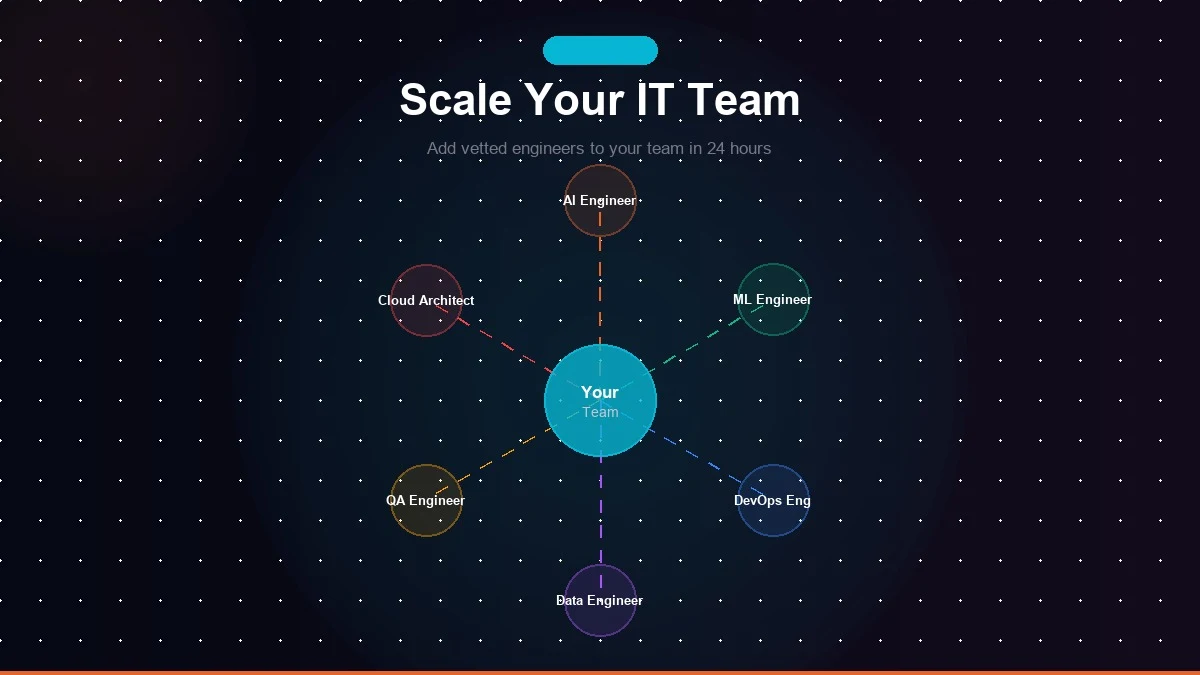
IT staff augmentation has become one of the primary ways technology companies scale engineering capacity in 2026. The model is faster than hiring, more controllable than outsourcing, and more cost-effective than carrying headcount through project cycles. When run well, it delivers engineering capacity that functions like a permanent team member without the overhead of permanent employment.
This guide covers the complete picture: how IT staff augmentation works mechanically, what roles it works for, how to vet providers, what to pay, how to structure engagements for success, and where the model fails.
Kovil AI
We build AI-powered software for businesses — from automations to full product builds.
What IT Staff Augmentation Actually Is
IT staff augmentation is a talent model where an external firm sources, vets, and places technical specialists into your organisation. The engineers work under your direction, using your tools and processes, alongside your internal team. They are not contractors you found on a marketplace: they are vetted professionals placed and managed by a firm that stands behind the quality of the placement.
The fundamental distinction that makes staff augmentation different from outsourcing is control. In staff augmentation, you manage the work. The augmentation firm manages the person. This is a different accountability structure from project outsourcing, where the external firm manages both the people and the work.
The core principle: IT staff augmentation extends your capacity. It does not replace your direction. If you do not have clear technical direction to give an augmented engineer, staff augmentation will not solve your problem. Consider a managed project engagement instead.
How IT Staff Augmentation Works: Step by Step
- Brief the firm: You describe the role: technical skills, seniority, expected responsibilities, tools they will use, and engagement duration. The more specific your brief, the better the match.
- Receive candidates: The firm presents pre-vetted candidates, typically within 24 to 72 hours. Reputable firms present 1 to 3 strong candidates rather than a large unfiltered pipeline.
- Conduct a technical interview: You interview the candidate to assess cultural and technical fit. This is your opportunity to validate the firm's vetting with your own assessment.
- Run a trial period: Start with a 2-week risk-free trial. The engineer integrates into your team and delivers a specific first-week objective. Both parties assess fit before committing to a longer engagement.
- Extend the engagement: If the trial succeeds, you extend on a monthly or quarterly basis. The engineer is now a full participant in your team: standups, code reviews, sprint planning.
IT Roles Most Commonly Augmented in 2026
| Role | Why Augmentation | Market Availability |
|---|---|---|
| AI / LLM Engineer | Full-time AI hiring takes 3 to 6 months; demand exceeds supply | Very tight |
| DevOps / Cloud Engineer | Infrastructure expertise needed at project peaks, not continuously | Tight |
| Data Engineer | Data pipeline builds are project-bounded, not ongoing headcount | Tight |
| Full-Stack Engineer | Capacity extension for product sprints without headcount growth | Moderate |
| QA / Eval Engineer | Testing and evaluation work is cyclical, not always full-time | Available |
| Cybersecurity Specialist | Specialised skill rarely justified as full-time for most companies | Very tight |
Benefits of IT Staff Augmentation
Speed
An augmented engineer can start in 24 to 72 hours. A full-time hire takes 3 to 6 months. For any project with a real deadline or a competitive pressure, the speed difference is decisive. Every month of hiring delay is a month of work not done.
Flexibility
Staff augmentation scales with your project needs. Add engineers when you need them, scale back when you do not. This flexibility is especially valuable for AI projects that have natural build-and-launch cycles, where engineering intensity varies significantly by phase.
Specialisation on demand
Some skills, including AI engineering, MLOps, and cloud security, are too specialised to justify full-time headcount for most companies. Staff augmentation makes these skills available when you need them, at the depth you need them, without carrying the overhead when you do not.
Risk reduction
A 2-week trial period is a far more informative signal than a 4-round interview process. You evaluate the engineer on real work in your actual codebase and team context before committing to a longer engagement. Bad hires are expensive and slow to unwind. Bad augmentation placements end at the trial.
How to Vet IT Staff Augmentation Providers
The difference between a good and a poor IT staff augmentation experience is almost entirely determined by the quality of the provider, specifically their vetting process and the presence or absence of an Engagement Manager.
What to ask
- Show me case studies specific to this role type. A firm that places AI engineers should be able to describe specific AI systems their engineers have shipped to production. Generic "we place engineers" case studies are not useful evidence.
- Walk me through how you vet this specific role. Vetting for an AI engineer is very different from vetting for a DevOps engineer. If the firm describes the same coding test for both, they are not doing domain-specific vetting.
- Who is my Engagement Manager? Ask for the name and role of the person who will be accountable for the engagement after placement. If the answer is "your recruiter" or "our account manager," ask specifically what they own and what their escalation path is.
- What is your replacement policy? If the placement does not work out within the first 4 to 8 weeks, what happens? A reputable firm will replace the engineer promptly at no additional cost.
When IT Staff Augmentation Fails
IT staff augmentation fails for predictable, avoidable reasons. The most common are:
No clear direction
An augmented engineer is not a self-directing hire. They need clear priorities, defined acceptance criteria for their work, and a designated person on your team to escalate blockers to. If your team cannot provide this, the engineer will default to low-value busy work or make independent decisions that may not align with your product direction.
Vetting mismatch
The engineer's stated skills and actual skills do not match. This is the augmentation firm's failure to vet properly. It is more likely with firms that use generic coding tests and less likely with firms that conduct domain-specific vetting against real production scenarios.
No Engagement Manager
When issues arise, and they always do at some point in any engineering engagement, you need someone at the augmentation firm who owns the relationship and can intervene. Without an EM, issues escalate slowly and often damage the engagement before they are resolved.
Trial period skipped
Teams that skip the trial period to "save time" often pay much more time resolving a poor fit that could have been caught in 2 weeks. The trial is the lowest-cost failure mechanism in the engagement. Use it.
IT Staff Augmentation for AI Projects
AI engineering is the fastest-growing staff augmentation category in 2026. Full-time AI engineering hiring pipelines consistently run 3 to 6 months for senior roles, during which time competitive AI products are shipping every sprint. For companies with defined AI roadmaps and the internal leadership to direct AI engineering work, staff augmentation is the most practical way to close the capacity gap without waiting on hiring.
The specific requirements for AI staff augmentation vetting are different from general software engineering. LLM API experience, RAG architecture knowledge, evaluation methodology, and production deployment in AI contexts are the skills that matter. A vetting process designed for general software engineers will produce candidates who are technically competent but not AI-production-ready.
For more on AI-specific staff augmentation, see What Is AI Staff Augmentation? For a comparison of IT staff augmentation with project outsourcing, see Staff Augmentation vs Outsourcing. For roles you can augment across specialisations, see our AI staff augmentation service page.
Frequently Asked Questions
What is IT staff augmentation?
IT staff augmentation is a flexible staffing model where companies bring in external technical specialists to work alongside their in-house teams. Unlike outsourcing, the client retains full control over day-to-day work direction. Unlike full-time hiring, there is no long-term employment commitment. The external firm handles sourcing, vetting, and employment logistics.
What types of IT roles are most commonly augmented?
Software engineers (full-stack, backend, frontend), AI and ML engineers, DevOps and cloud engineers, data engineers, QA engineers, cybersecurity specialists, and product managers. AI engineering is the fastest-growing augmentation category in 2026, driven by the gap between AI demand and available full-time talent.
How do you vet IT staff augmentation providers?
Ask for case studies specific to the role type you need (not generic 'we place engineers' claims). Look for domain-specific vetting methodology. Require a risk-free trial with no upfront deposit. Ask who your Engagement Manager will be and what they own. Understand the replacement policy if the placement does not work out.
How quickly can an IT staff augmentation engagement start?
Reputable IT augmentation firms can match and place an engineer within 24 to 72 hours of a briefing. Compare this to the 3 to 6 month timeline for a full-time hire from job posting to first day. For time-sensitive projects, this speed difference is often the deciding factor.
What is the difference between IT staff augmentation and managed IT services?
IT staff augmentation places individual engineers into your team under your direction. Managed IT services provide an outcome (e.g., keep systems running) that the service provider owns and manages. Staff aug is about capacity extension. Managed services are about outcome delegation. They address different needs.
How do I write an effective brief for an IT staff augmentation placement?
An effective brief includes: the specific technical skills required (be precise, not generic), the seniority level, the expected daily responsibilities, the tools and systems they will use, the team context they will work within, and the engagement duration. Vague briefs produce generic candidates. Specific briefs produce accurate matches.
What are the risks of IT staff augmentation?
The main risks are: insufficient vetting producing unqualified placements, no Engagement Manager leading to accountability gaps when issues arise, knowledge concentration if the engineer is not required to document their work, and direction gaps if your team cannot clearly specify the work. All of these are mitigated by choosing a reputable managed firm with an EM on every engagement.
Can IT staff augmentation work for long-term placements?
Yes. Many IT staff augmentation engagements run 12 to 24 months or longer. Some result in the engineer transitioning to a full-time role. Long-term staff aug works well when the need is consistent but the organisation prefers workforce flexibility over permanent headcount growth.
Kovil AI
Looking to bring AI into your business?
Whether you need a custom AI build, workflow automation, or a fast MVP — our engineers have done it across industries. Let's talk about what you're trying to solve.