RAG vs Fine-Tuning: Which Should Your Company Choose in 2026?
RAG and fine-tuning both make LLMs more useful for your business, but they solve different problems. Here's how to decide which is right for what you're building, with a cost comparison and decision framework.
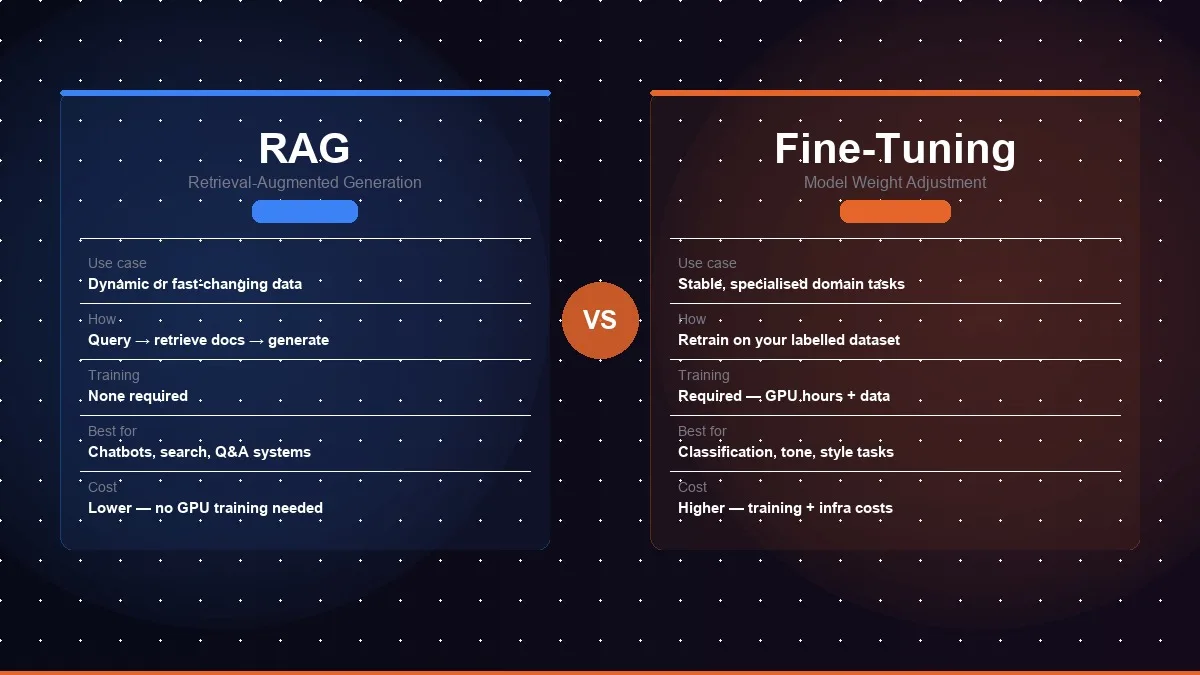
One of the most common questions teams face when building with large language models is whether to use retrieval-augmented generation (RAG) or fine-tuning to adapt the model to their specific domain. Both approaches improve model usefulness for a specific context. They do it in fundamentally different ways, suit different problems, and carry very different cost and maintenance profiles.
Getting this decision wrong early in a project is expensive. Here is a clear breakdown of both approaches and a practical framework for choosing between them. For context on how this decision fits into a larger project, our AI development lifecycle guide covers the full sequence from problem definition to production monitoring.
Kovil AI · AI Engineering
Not sure whether RAG or fine-tuning is right for your use case? Our engineers can help.
What Is RAG (Retrieval-Augmented Generation)?
RAG definition: Retrieval-Augmented Generation is a technique that gives a language model access to an external knowledge base at inference time. The system retrieves the most relevant documents for a given query and passes them to the LLM as context, so the model's response is grounded in your specific data, not just its training knowledge.
The model itself is not changed. Its weights are identical to the base model. What changes is what the model sees before it generates a response. RAG essentially extends the model's knowledge on a per-query basis without touching the model's parameters.
Key infrastructure for RAG: a vector database (Pinecone, Weaviate, pgvector, Qdrant), an embedding model to convert documents to vectors, and a retrieval pipeline that scores and ranks candidate documents by relevance to the query.
What Is LLM Fine-Tuning?
Fine-tuning definition: Fine-tuning is the process of continuing to train a pre-trained language model on a new, domain-specific dataset. The model's weights are updated based on your training examples, so the model fundamentally behaves differently, not just because of what you put in the prompt.
Fine-tuning is appropriate when you want to change how the model writes, what vocabulary or terminology it defaults to, what format it produces output in, or how it approaches a specific class of task. It is a training-time intervention, not an inference-time one.
Fine-tuning requires a labelled training dataset (typically hundreds to thousands of high-quality examples), compute resources for training runs, and a process for evaluating whether the fine-tuned model actually improves on the base model for your use case.
RAG vs Fine-Tuning: Side-by-Side Comparison
| Dimension | RAG | Fine-Tuning |
|---|---|---|
| What it changes | What the model knows (per query) | How the model behaves (permanently) |
| Best for | Facts, proprietary knowledge, dynamic data | Style, format, domain terminology, task precision |
| Knowledge updates | Update the knowledge base — immediate | Requires retraining — slow and costly |
| Transparency | Can cite source documents | Knowledge baked into weights, opaque |
| Upfront cost | Low (no training compute) | High (dataset curation + training runs) |
| Inference cost | Higher (longer context per query) | Lower (smaller fine-tuned model possible) |
| Time to production | 2–6 weeks | 2–6 months (dataset + training + eval) |
| Hallucination risk | Lower (grounded in retrieved text) | Higher (relies on baked-in training data) |
When Should You Choose RAG?
RAG is the right choice in the majority of business AI use cases. Choose RAG when:
You have proprietary documents or data the model has not seen
Your internal documentation, product manuals, legal agreements, customer histories, and support tickets are not in any LLM's training data. RAG makes this information available to the model without exposing it in the training process. This is the single most common enterprise AI use case in 2026. It's also the architecture behind the LLM-powered business chatbots we build at Kovil.
Your knowledge base changes frequently
If the information you need the model to use is updated weekly or monthly, pricing, policies, product specs, regulatory guidance, RAG lets you update the knowledge base without touching the model. Fine-tuning that knowledge in would require retraining every time it changes.
You need citations and source transparency
RAG systems can show users exactly which document a response came from. This is essential in legal, compliance, medical, and financial contexts where users need to verify the source of an assertion.
You want faster time to deployment
A production RAG pipeline can be built in two to six weeks. A fine-tuning project requires dataset curation, training runs, evaluation, and iteration, often adding months to the timeline.
When Should You Choose Fine-Tuning?
Fine-tuning is appropriate in a smaller set of well-defined scenarios. Choose fine-tuning when:
You need consistent output format or style
If your application needs the model to always output valid JSON in a specific schema, always respond in a specific brand voice, or always structure clinical notes in a particular format, and prompt engineering alone is not reliable enough, fine-tuning can bake that behaviour in at the model level.
You have a large, stable, high-quality dataset
Fine-tuning rewards scale and quality of training data. If you have thousands of high-quality labelled examples that are unlikely to change, fine-tuning can produce a model that is measurably better than RAG for your specific task.
You are doing classification or structured extraction
For tasks like document classification, named entity recognition, or structured data extraction, where you need fast, consistent, format-specific outputs, a fine-tuned smaller model often outperforms RAG with a larger model, at a fraction of the inference cost.
Latency is critical
RAG adds latency because it must retrieve documents before the model can generate a response. For applications where response time under one second is essential, a fine-tuned model that has knowledge baked in can respond faster than a RAG pipeline.
Which Costs More?
The cost comparison is not straightforward because the two approaches have different cost profiles.
Fine-tuning has higher upfront costs: dataset preparation, training compute (which can run from hundreds to tens of thousands of dollars depending on model size and dataset volume), and evaluation. But inference costs can be lower if you fine-tune a smaller model rather than using a large model with a long context window.
RAG has lower upfront costs but higher ongoing inference costs: every query requires an embedding step, a vector search, and a longer context window (because you're passing retrieved documents into the prompt). At scale and high query volume, RAG token costs can become significant.
For most business use cases in 2026, RAG is cheaper and faster to reach a production-quality system. Fine-tuning only wins on total cost of ownership when query volume is very high and the fine-tuned model's reduced per-query cost offsets the upfront training investment over time.
Can You Use Both?
Yes, and many production systems do. A common architecture is a fine-tuned model (trained for the right output format and domain vocabulary) combined with RAG (for real-time access to current facts and proprietary documents). The fine-tuning handles the "how the model behaves" and the RAG handles the "what the model knows."
This combined approach is more complex and more expensive to build. It is appropriate for enterprise applications where both behavioural precision and knowledge breadth matter, and where the scale justifies the investment.
Where Should You Start?
If you are building something new, start with RAG. It is faster, cheaper, easier to update, and sufficient for the vast majority of enterprise AI use cases. Add fine-tuning later, once you have production data showing that a specific behavioural gap exists that fine-tuning would close.
If you already have a system running and are seeing consistent output format issues, hallucination in specific domains despite good retrieval, or latency problems at scale, those are signals that fine-tuning may be worth exploring. These are also the kinds of problems our App Rescue engagement diagnoses and fixes in existing AI systems.
Kovil AI's Managed AI Engineer engagement gives you a vetted AI engineer who has built both RAG pipelines and fine-tuning workflows in production. They can assess your specific use case, recommend the right architecture, and build it, scoped, milestone-gated, and risk-free for the first two weeks. Get in touch to start the conversation.
Related Services
Frequently Asked Questions
What is the difference between RAG and fine-tuning?
RAG (Retrieval-Augmented Generation) gives a language model access to an external knowledge base at inference time, the model retrieves relevant documents and uses them to answer the question. Fine-tuning retrains the model's weights on your specific data, changing how the model fundamentally behaves. RAG changes what the model knows; fine-tuning changes how the model acts.
When should I use RAG instead of fine-tuning?
Use RAG when you have proprietary documents or data the model hasn't seen, when your knowledge base changes frequently, when you need citations and source transparency, or when you want faster time to deployment. RAG is the right choice for the majority of enterprise AI use cases in 2026.
When should I use fine-tuning instead of RAG?
Use fine-tuning when you need consistent output format or style that prompt engineering alone can't reliably enforce, when you have a large stable dataset of high-quality labelled examples, when you're doing classification or structured extraction tasks, or when inference latency is critical and a smaller fine-tuned model would respond faster than RAG with a large model.
Is RAG cheaper than fine-tuning?
RAG typically has lower upfront costs, no training compute required. Fine-tuning has higher upfront training costs but can have lower ongoing inference costs if a fine-tuned smaller model replaces a larger model with a long context window. For most business use cases, RAG reaches production-quality faster and at lower total cost.
Can you use both RAG and fine-tuning together?
Yes, many production systems combine both. A fine-tuned model handles consistent output format and domain vocabulary, while RAG provides real-time access to current facts and proprietary documents. This combined approach is more complex and costly, but appropriate for enterprise applications where both behavioural precision and knowledge breadth matter.
Kovil AI · AI Engineering
Building a custom AI model for your business?
RAG or fine-tuning — our engineers have implemented both in production. We help you choose the right approach for your use case and build it without the guesswork.