7 Signs Your AI Project Is Failing (And What to Do About It)
Most AI projects that fail don't fail suddenly. They fail slowly, with warning signs that are easy to dismiss. Here are 7 signals to watch for and how to recover before it's too late.
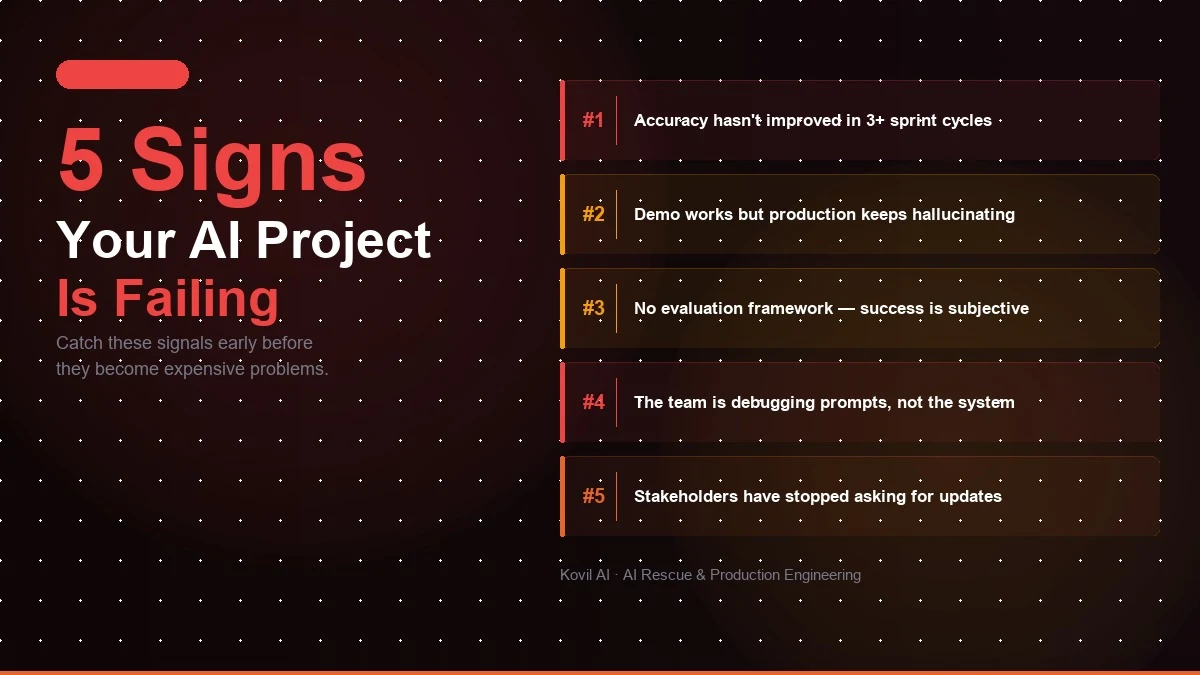
The uncomfortable truth about AI projects: most failures are not sudden. They are slow deteriorations that anyone paying attention could see coming. Teams get optimistic about early demos. Stakeholders lose interest in measuring real performance. Engineers iterate endlessly without a clear success definition. By the time everyone acknowledges the project is failing, months and significant budget have been spent on work that will not ship.
This article covers the 7 most common and most diagnostic warning signs of a failing AI project, what causes each, and what to do about it. If you recognise three or more of these in your current project, it is worth a structured assessment before you spend another sprint in the same direction.
Kovil AI
We build AI-powered software for businesses — from automations to full product builds.
Sign 1: No One Has Defined What Success Looks Like
This is the most fundamental and most common failure pattern. If your team cannot answer the question "at what measurable performance level will we call this AI system ready for production?" in a single clear sentence, you do not have a project. You have an experiment with a deadline.
AI systems are never perfect. They are good enough for a defined use case at a defined quality threshold. Without that threshold established upfront, every sprint produces results that are "almost ready" but never ready. The goal keeps moving. The timeline extends. Stakeholders grow suspicious.
What to do
Stop the build and spend two hours with your product owner, technical lead, and a key stakeholder defining what done looks like in measurable terms. "85% relevance accuracy on our 500-query benchmark set, with under 8% hallucination rate on our blind evaluation set, at under 2 seconds p95 latency." This sentence, agreed in writing, is worth more than any amount of additional engineering time.
Sign 2: The Team Only Demos, Never Evaluates
Demos are cherry-picked. Evaluation is systematic. If your team is presenting impressive demos every sprint but has no evaluation pipeline that measures performance on a representative and blind test set, they have no idea whether the system is improving, degrading, or merely good at the cases they remember to demo.
This pattern is extremely common in AI projects because demos are easy and impressive while evaluation requires discipline and upfront investment. Teams that never build an evaluation framework are flying blind in production.
What to do
Build a minimum viable evaluation framework this sprint. Define 100 to 200 representative queries with expected answers. Run the system against this set. Score outputs. Record the baseline score. Now run it again after the next improvement. Is the score going up or down? That is the only way to know whether your work is actually helping.
Sign 3: Hallucination Rate Is Unknown
If no one on the team can tell you the current hallucination rate of your AI system, that is a significant red flag. For any system that will interact with real users, influence real decisions, or be used in a professional or regulated context, hallucination rate is a first-class production metric that should be measured continuously.
Teams that have not measured hallucination rate often discover it for the first time when a user reports something alarming. At that point, you do not know whether the hallucination was rare or common, and you have no baseline to measure improvement against.
What to do
Add hallucination detection to your evaluation framework. For RAG systems, measure whether the system's assertions are grounded in the retrieved documents. For general LLM systems, create a set of factual questions with known correct answers and measure accuracy. Record the baseline. Monitor the trend.
Sign 4: The Same "Almost Ready" Has Been Said Three Times
AI projects get stuck in an endless "almost ready" loop when there is no objective, written completion criteria. Every week reveals a new edge case. A new type of query the system handles poorly. A new user complaint. A new prompt variation to try. Without a defined and agreed quality bar, the project never ships, because there is always another thing to improve.
What to do
Return to the success criteria. If they exist and the system is not meeting them, diagnose why: is the gap between current performance and the criteria reasonable to close in the next 2 to 4 weeks, or is it a signal of a deeper architectural problem? If the criteria do not exist, see Sign 1. If the criteria exist but keep being renegotiated, that is a stakeholder alignment issue, not a technical one.
Sign 5: The Architecture Is Mismatched to the Problem
This is one of the hardest failures to diagnose from inside the team because the engineers who built the architecture often cannot see that it is fundamentally wrong for the problem. The most common mismatch patterns in 2026:
- Naive RAG for a reasoning task: Building a retrieval-augmented generation system for a use case that requires multi-step reasoning or tool use. RAG retrieves and summarises. It does not reason. For reasoning tasks, agent architecture is required.
- Agent architecture for a retrieval task: Using a complex multi-agent framework to answer factual questions that a simple RAG pipeline would handle better. Over-engineering creates latency, cost, and failure modes that the simpler approach would not have.
- Fine-tuning when RAG is appropriate: Retraining a model on proprietary data when the correct approach is to put that data in a retrieval index. Fine-tuning is expensive, slow to update, and opaque. RAG is fast to update and transparent. Most enterprise AI use cases should be RAG, not fine-tuning.
Diagnostic question: If your team has been iterating on prompts for more than 4 to 6 weeks without crossing the quality threshold, the problem is almost certainly not the prompts. The problem is the architecture. No amount of prompt engineering fixes a fundamentally mismatched system design.
Sign 6: No Single Person Is Accountable for Delivery
AI projects with diffuse accountability fail more often than those with a single named person responsible for delivery. When accountability is distributed, decisions slow down, blockers linger, escalation paths are unclear, and the project drifts in the direction of least resistance rather than toward a defined outcome.
This is especially common in AI projects that are run inside larger engineering teams where no one has "AI project lead" as their explicit primary responsibility. Everyone contributes, but no one owns the outcome.
What to do
Name one person as the accountable delivery owner for the AI project. This person is responsible for tracking progress against success criteria, escalating blockers within 24 hours, and reporting status to stakeholders on a defined cadence. This does not require a new hire. It requires clarity about who holds the accountability.
Sign 7: Stakeholders Have Stopped Asking for Updates
When senior stakeholders stop showing up to AI project demos and stop asking for status updates, they have mentally written the project off. They have decided it is not going to deliver and have moved their attention elsewhere. This is the last and hardest sign to recover from, because it requires rebuilding trust, not just fixing code.
What to do
A stakeholder reset requires three things in this order: an honest acknowledgement of current state (what the system does well, what it does not), a clear and testable new success definition that stakeholders co-create, and demonstrated measurable progress against that definition within 2 to 3 weeks. Optimistic projections without evidence will not recover confidence. Short-cycle demonstrated progress will.
Rescuing a Failing AI Project
Most failing AI projects can be rescued. The common interventions are:
- Establishing or rewriting the success criteria with full stakeholder alignment
- Building a minimum viable evaluation framework and running the first baseline measurement
- Conducting an architecture review to identify mismatch between the approach and the problem
- Fixing data quality issues at the source rather than working around them in prompts
- Adding delivery accountability with a named owner and a weekly reporting cadence
The right time to intervene is when you recognise two or three of the seven signs above, not when all seven are present. Earlier intervention means less rework, less budget lost, and a much higher probability of a successful outcome.
For more on building AI systems that succeed from the start, see our guide on the AI development lifecycle. For teams whose AI project has already stalled, our fixed-price project delivery includes a discovery phase that diagnoses the root cause before any build work continues.
Frequently Asked Questions
Why do most AI projects fail?
The most common root causes are: no agreed definition of what success looks like upfront, poor or misrepresented data quality, an evaluation gap (teams demo results instead of measuring them systematically), architecture mismatch (wrong AI approach for the problem), integration complexity that was underestimated, and stakeholder confidence collapse when early results disappoint.
What is the AI project failure rate in 2026?
Industry estimates consistently put AI project failure rates at 70 to 85 percent. Most AI initiatives either fail to reach production or fail to deliver their intended business value once deployed. The gap between prototype performance and production performance is where most projects are lost.
Can a failing AI project be rescued?
Yes, most of the time. The most effective rescue interventions are: redefining success criteria clearly with stakeholder alignment, adding a systematic evaluation framework, fixing data quality at the source, replacing an architecture that is fundamentally mismatched to the problem, and bringing in delivery oversight with a dedicated Engagement Manager.
How do I know if my AI project's architecture is wrong?
Signs of architecture mismatch: the system works well on simple cases but degrades unpredictably on edge cases; prompt tuning makes it slightly better but never crosses the quality threshold; the team has been iterating on the same problem for 2+ months without measurable improvement. These are signals that the fundamental approach needs to change, not just the prompts.
What is an AI evaluation framework and why does it matter?
An AI evaluation framework is a systematic process for measuring whether your AI system is working. It includes: a representative test set that covers real production scenarios, quantitative metrics (accuracy, hallucination rate, latency, relevance score), and a process for running these evaluations regularly and tracking trends over time. Without this, teams cannot distinguish real improvement from cherry-picked demo results.
What should I do if stakeholders have lost confidence in the AI project?
A stakeholder confidence reset requires: acknowledging the current state honestly, presenting a clear and testable success definition, demonstrating measurable progress against that definition in the next 2 to 3 weeks, and providing a credible timeline for production. Vague optimism without evidence will not recover confidence. Specific, demonstrated progress will.
How long should an AI project take to reach production?
A well-scoped AI project with a good evaluation framework should reach production in 6 to 16 weeks depending on complexity. If your project has been in development for more than 4 months without a clear path to production, that is a strong signal that one or more of the failure patterns in this article is present.
What is the single most common cause of AI project failure?
Across Kovil AI's experience with 150+ AI deployments, the single most common cause of failure is the absence of agreed success criteria before development begins. When teams cannot answer 'at what measurable performance level will we ship this?' before writing code, the project rarely reaches a clear production-ready state.
Kovil AI
Looking to bring AI into your business?
Whether you need a custom AI build, workflow automation, or a fast MVP — our engineers have done it across industries. Let's talk about what you're trying to solve.