AI Staff Augmentation: The Complete Guide for 2026
Everything you need to know about AI staff augmentation in 2026. How it works, what it costs, how to vet providers, and how to run engagements that succeed.
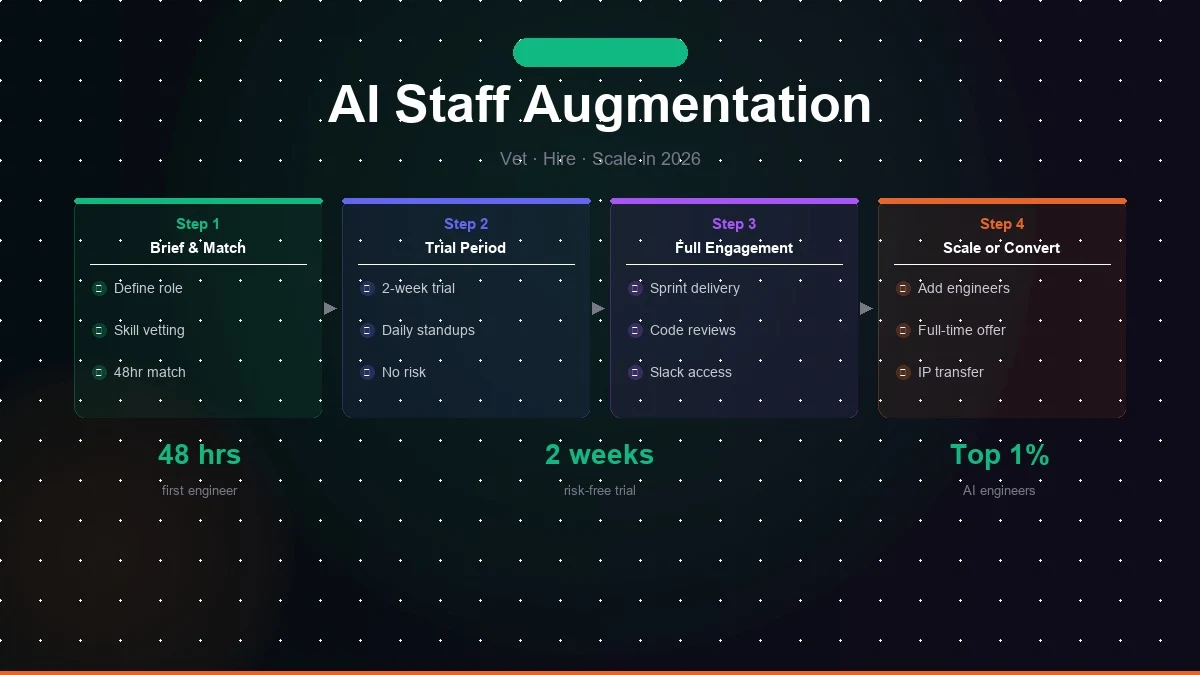
AI staff augmentation is how companies close the gap between AI ambition and AI execution. Full-time AI engineering hiring pipelines run 3 to 6 months on average and produce unreliable results in a market where AI skills are newer, harder to vet, and more in demand than almost any other technical discipline. AI staff augmentation closes this gap by placing vetted AI engineers into your team in 24 to 48 hours, under your direction, with a 2-week risk-free trial and no long-term commitment required.
This guide covers the complete landscape of AI staff augmentation in 2026: the market context, the mechanics of a successful engagement, how to evaluate providers rigorously, what to pay, how to run the trial, and how to scale or convert engagements that succeed.
Kovil AI
We build AI-powered software for businesses — from automations to full product builds.
The AI Talent Market in 2026
The gap between AI engineering demand and AI engineering supply has grown every year since 2022 and shows no sign of narrowing. The number of companies attempting to build AI products has grown enormously. The number of engineers with genuine production AI experience has grown much more slowly, constrained by the newness of the discipline and the gap between prototype skills and production skills.
The result: full-time AI engineering hiring pipelines are slow, expensive, and unreliable. Senior AI engineers in the US receive multiple offers before accepting any. Vetting is hard because the skills are new and the certification landscape is immature. Bad hires in AI are more expensive than bad hires in general engineering because AI systems fail in subtle, delayed ways that take months to surface.
AI staff augmentation has grown as the practical alternative. Companies that need AI engineering capability now, rather than after a 6-month hiring pipeline, use augmentation to get skilled engineers into their team quickly, evaluate fit through a trial period, and extend engagements that succeed.
How AI Staff Augmentation Works: The Full Engagement Lifecycle
Step 1: The brief
You describe your requirements to the augmentation firm. An effective brief for an AI engineering role includes:
- The AI domain: RAG, LLM agents, fine-tuning, data pipelines, computer vision, etc.
- The required tech stack: which LLM APIs (OpenAI, Anthropic, Google), vector databases (Pinecone, pgvector, Weaviate), orchestration frameworks (LangChain, LlamaIndex, LangGraph)
- The expected deliverables for the first 30 days: what concrete progress should the engineer have made?
- The team context: who they will work with, what the daily routine looks like, which tools they will use
- The seniority level: junior for execution under direction, senior for architecture and independent judgment
- The engagement duration: 3 months, 6 months, open-ended?
Step 2: Candidate matching
Reputable AI augmentation firms match within 24 to 48 hours. They present 1 to 3 pre-vetted candidates rather than a large raw pipeline. A firm that sends 20 candidates with no curation has done the vetting on your behalf, not theirs. Quality providers do the hard filtering for you.
Step 3: Technical interview
You conduct a technical interview to validate the firm's vetting with your own assessment. Even with a high-quality provider, this interview serves two purposes: it confirms the technical fit, and it establishes the relationship dynamic and communication style you will be working with daily.
Step 4: The trial period
The trial period is the most important phase of any AI staff augmentation engagement. A standard trial is 2 weeks with no financial commitment if the fit does not work. During the trial:
- Set a specific first-week objective that is representative of real work, not administrative onboarding
- Provide the same tools, codebase access, and communication channels the engineer will use long-term
- Review output at the end of week one and week two against the objective
- Make a clear go/no-go decision at the end of two weeks
Step 5: Full engagement
Once the trial succeeds, the engineer integrates fully into your team. They attend standups, participate in sprint planning, conduct code reviews, and are directed by your technical lead or product owner on a daily basis.
Step 6: Scale or convert
Successful engagements naturally evolve. Options include: extending the single-engineer engagement, adding a second augmented engineer as the project grows, transitioning to a dedicated team model if the scope expands, or making a full-time hire offer to the engineer if the long-term fit is compelling.
How to Evaluate AI Staff Augmentation Providers
The single largest variable in AI staff augmentation outcomes is provider quality. Here is a rigorous evaluation framework:
Question 1: What AI systems have your engineers shipped to production?
Ask for specific examples with measurable outcomes: "We placed a senior AI engineer with a fintech company who built a document extraction pipeline that reduced manual processing from 4 hours to 12 minutes." Generic claims about AI engineering without specific production examples are a red flag.
Question 2: How do you vet AI engineers beyond a coding test?
Generic coding tests measure algorithmic problem-solving, not production AI engineering. A rigorous AI vetting process should include: a system design exercise (design a RAG system for a specific use case), an evaluation methodology discussion (how would you measure whether this system works?), and ideally a review of the candidate's past AI production work. Ask the firm to describe their vetting process in detail.
Question 3: Who is my Engagement Manager?
Ask for the name, background, and specific responsibilities of the EM who will cover your engagement. The EM should own the quality of the placement (not just the initial sourcing), surface blockers quickly, and be available for escalation. If the answer is vague, this is a signal that EM coverage is nominal rather than real.
Question 4: What is your replacement policy?
If the placement does not work out within the first 4 to 8 weeks, what happens? A reputable firm will replace the engineer promptly at no additional cost and will have a clear written replacement policy. Ask to see it.
Question 5: Is there a risk-free trial, and what does risk-free specifically mean?
Risk-free means: no deposit required upfront, no payment due during the trial, and no financial penalty if you end the engagement at the trial conclusion. Ask specifically what "risk-free" means in the firm's contract before starting.
What Makes an AI Staff Augmentation Engagement Succeed
The technical quality of the engineer is necessary but not sufficient for a successful engagement. The following factors are equally important:
Clear written success criteria before day one
Before the engineer starts, write down what success looks like for the first 30, 60, and 90 days. Be specific: "by day 30, the RAG pipeline is returning relevant documents on 80% of the benchmark query set" is a success criterion. "Making good progress on AI" is not.
A named internal point of contact
The augmented engineer needs one person on your team they report to, can escalate to, and takes direction from. Distributed accountability in staff augmentation produces poor results. One contact, one direction.
Documentation requirements enforced from day one
Require the engineer to document key design decisions as they are made, not at the end of the engagement. This protects you if the engagement ends unexpectedly and builds an organisational knowledge base that persists beyond any individual engineer.
An Engagement Manager in the loop
Your EM should know about any blocker within 24 hours of it surfacing. This is not about micromanagement: it is about giving the EM the context they need to intervene before small problems become expensive ones.
Scaling AI Staff Augmentation
As your AI engineering needs grow, staff augmentation scales in several ways:
- Add engineers: Once you have a successful first placement, adding a second or third engineer with complementary skills is straightforward. The firm already understands your context, brief quality improves, and onboarding is faster.
- Transition to a dedicated team: When the scope grows to the point that a multi-person squad makes more sense than individually directed engineers, transitioning to a dedicated team model provides more cohesion and reduces internal direction overhead.
- Convert to full-time: For engineers who have been embedded for 6 to 12 months and are strong fits for a permanent role, most augmentation firms have a conversion path. Discuss this upfront so the terms are agreed before the situation arises.
For more detail on specific aspects of AI staff augmentation, see: What Is AI Staff Augmentation?, How to Hire an AI Engineer, AI Engineer Cost in 2026, and What Is a Dedicated AI Team?
Frequently Asked Questions
What is AI staff augmentation?
AI staff augmentation places vetted AI engineers directly into your team on demand. They work under your direction, on your tools and codebase, alongside your internal engineers. The external firm handles sourcing, vetting, and employment logistics. You handle work direction. The result is AI engineering capacity that can start in 24 to 48 hours without a 3 to 6 month hiring pipeline.
How much does AI staff augmentation cost in 2026?
AI staff augmentation rates through a managed firm with proper vetting and Engagement Manager coverage vary by seniority and specialisation. Senior AI engineers with LLM, RAG, and production deployment experience are at the top of the market range. Marketplace freelancers may appear cheaper but lack managed delivery, vetting accountability, and replacement guarantees.
How do I vet an AI staff augmentation provider?
Ask for AI-specific case studies that describe real production systems shipped. Ask how they vet AI engineering skills beyond a coding test. Require a risk-free trial with no deposit. Ask who your Engagement Manager will be and what they own. Ask about the replacement policy. A reputable provider will answer all five questions clearly.
What is the difference between AI staff augmentation and a dedicated AI team?
Staff augmentation extends your existing team with individual engineers who work under your direction. A dedicated AI team is a standalone squad with its own technical leadership, which means the team can provide AI architecture direction without depending on internal AI expertise from your side.
How do I write an effective brief for an AI staff augmentation placement?
An effective AI staff augmentation brief includes: the AI domain (RAG, agents, fine-tuning, data pipelines), the required tech stack (which LLM APIs, vector databases, orchestration frameworks), the expected deliverables for the first 30 days, the team context they will join, and the seniority level. Vague briefs produce generic candidates. Specific briefs produce accurate matches within 48 hours.
What makes an AI staff augmentation engagement succeed?
The most important success factors are: clear written success criteria before the engineer starts, a named internal point of contact who provides daily direction, a structured trial period with a real first-week objective, documentation requirements enforced from day one, and an Engagement Manager who surfaces blockers within 24 hours. The technical quality of the engineer matters, but direction and structure matter equally.
What AI roles can be augmented?
The most commonly augmented AI roles are: AI engineer (LLM-based system development), ML engineer (model training, evaluation, fine-tuning), LLM engineer (prompt engineering, context management, orchestration), RAG engineer (retrieval-augmented generation pipeline development), AI architect (system design, model selection, infrastructure decisions), and MLOps engineer (deployment, serving, monitoring).
Is AI staff augmentation right for startups?
Yes, for AI-specific needs. Startups benefit from the speed and flexibility of AI staff augmentation: no 6-month hiring timeline, no benefits overhead, no permanent headcount commitment. The key question is whether the startup has a technical lead who can direct the augmented engineer. Early-stage startups without AI technical leadership often benefit more from a managed project engagement or dedicated team model.
Kovil AI
Looking to bring AI into your business?
Whether you need a custom AI build, workflow automation, or a fast MVP — our engineers have done it across industries. Let's talk about what you're trying to solve.